At the edge of Chamba’s great open ground, an old stone shrine holds one of the town’s most remarkable images of Vishnu — not as a distant god in a grand complex, but as a bronze presence guarding the old entrance to the town.
Chamba is a town where sacred geography is not hidden away from daily life. Temples stand near markets, lanes, houses, museums, palaces, and the wide public ground of the Chaugan. Among them, Shri Hari Rai Temple has a special stillness. It does not need the size of a large complex to feel important. Its power comes from placement, age, stonework, and the extraordinary image of Lord Vishnu worshipped within.
The temple stands near the north-west corner of the main Chaugan, close to what has long been understood as an important entrance side of Chamba town. It is associated with Lord Vishnu in a rare and beautiful form, remembered through a bronze image often described as Chaturmurti or Vaikuntha Vishnu. For travellers moving through Chamba’s old temple circuit, Hari Rai Temple is not just another stop. It is one of the town’s finest reminders that Chamba’s sacred life is as Vaishnavite as it is Shaiva and Shakta.
🌄 Location & How to Reach It
Shri Hari Rai Temple is located near the north-west corner of Chamba Chaugan, close to the old entrance area of Chamba town in Himachal Pradesh. Its position beside the Chaugan makes it easy to include in a walking route through the town’s historic and sacred core. The temple belongs to the old urban landscape of Chamba, where shrines, markets, public grounds, and royal memories sit close together.
Google Maps: Get Directions
Elevation: Chamba town is generally around 1,006 m / 3,300 ft above sea level.
- By road: Chamba is connected by road with Dalhousie, Banikhet, Pathankot, Khajjiar, Saho, and Bharmour. From within Chamba town, the temple can be reached easily from the Chaugan side.
- By rail: The nearest major railway station is Pathankot, from where travellers continue by road to Chamba.
- By air: The nearest commonly used airports are Pathankot Airport and Kangra / Gaggal Airport, followed by road travel to Chamba.
This is an easy town temple to visit. There is no trek involved. The best way to experience it is on foot, as part of a slow walk around the Chaugan and Chamba’s old temple neighbourhood.
🌸 Best Time to Visit
Shri Hari Rai Temple can be visited through most of the year because it is located inside Chamba town. The most comfortable months are generally March to June and September to November, when walking around the Chaugan and old town is pleasant.
The temple is especially meaningful during Vaishnavite festivals such as Janmashtami, Ram Navami, and other Vishnu-related observances, though exact local arrangements should be confirmed in Chamba before planning around a festival day. Because it is a living temple, daily worship may follow local custom rather than a formal tourist schedule.
Summer afternoons can be warm in Chamba town, so morning or late afternoon is often better for a quieter visit. Monsoon months may bring rain and road delays in the wider district, while winter is generally manageable but cold in the mornings and evenings.
There is no need to treat the temple like a ticketed monument. Visit during daylight, remove shoes where required, avoid touching carvings, and ask before taking photographs inside the shrine.
🕉️ Vishnu at the Gate of Chamba
Hari Rai Temple is dedicated to Lord Vishnu, the preserver in the Hindu trinity. In Chamba, where Shiva, Shakti, local deities, serpent shrines, and royal temples all shape the sacred landscape, this temple gives a strong Vaishnavite presence to the town’s temple map.
The temple’s most important devotional feature is the image of Vishnu inside. It is often described as Chaturmurti Vishnu or Vaikuntha Vishnu, a multi-faced form associated with deep theological meaning. In this form, Vishnu is not shown only as a serene standing deity. He carries multiple aspects of divine identity at once.
Some descriptions identify the image as having faces associated with Narayana, Varaha, Narasimha, and another divine or sage-like aspect. The exact iconographic description can vary depending on the source, but the central point is clear: this is not an ordinary Vishnu image. It belongs to a refined sculptural and devotional tradition in which Vishnu is shown as cosmic, protective, and many-sided.
For a visitor, the image changes the feel of the temple. The shrine is not large, but the deity gives it depth. One stands before Vishnu not as a single flat idea, but as a presence that gathers preservation, protection, power, and royal dignity.
🏛️ The Temple of Salabahana and the Eleventh-Century Memory
Shri Hari Rai Temple is commonly dated to the 11th century and is often associated with a figure named Salabahana or Salavahana. Tourism references preserve this attribution, though the broader details of his identity and the exact patronage history are not always explained in depth.
The safest way to understand the temple is to place it within Chamba’s early medieval sacred architecture. Chamba, as a hill-state capital, developed a remarkable temple culture in stone, especially around the old town core. The Lakshmi Narayan Temple complex, Champavati Temple, and Hari Rai Temple all help tell the story of a town where royal power and religious architecture were closely linked.
Hari Rai Temple’s age matters, but its survival matters just as much. An 11th-century attribution places it among Chamba’s older sacred monuments, but its continued worship keeps it from becoming only archaeology. It remains a shrine, not just a stone object.
This is the balance that defines many Chamba temples: they are historic, but not dead; architectural, but not silent; protected by memory as much as by stone.
🙏 What Shri Hari Rai Temple Is Known For
Shri Hari Rai Temple is known first for its dedication to Lord Vishnu and especially for the remarkable bronze image of Vishnu in Chaturmurti / Vaikuntha form. This image is one of the temple’s defining features and gives the shrine its distinct importance within Chamba.
The temple is also known for its location near the Chaugan Gate / north-west corner of the Chaugan, which gives it a strong relationship with Chamba’s public life. It is not hidden deep inside a remote valley. It stands near the open ground that has long served as the heart of the town.
For devotees, the temple is a place of darshan and Vaishnavite worship. For travellers, it offers a chance to see how Chamba’s sacred world is not limited to one religious mood. The town honours Shiva in some shrines, Durga in others, local goddesses and serpent deities elsewhere, and Vishnu here in one of his most striking forms.
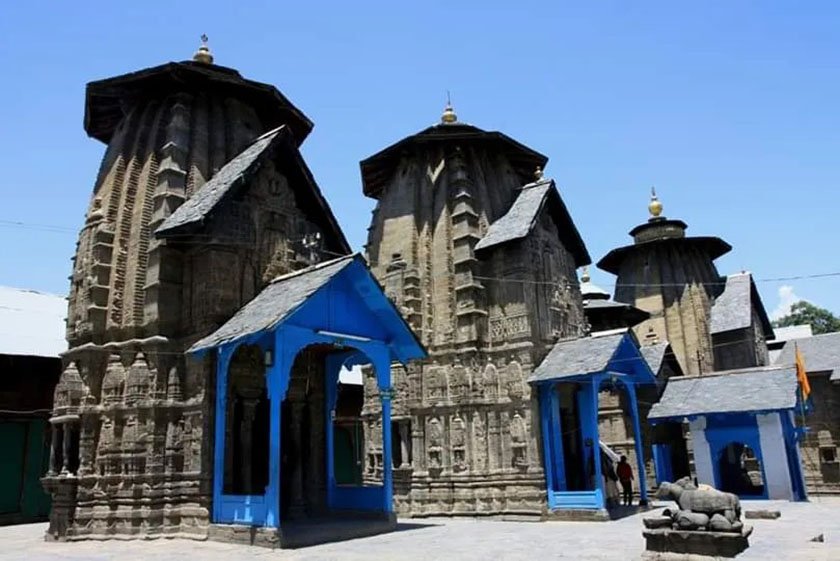
The temple is also known for its Shikhara-style architecture, stone carvings, and old-world scale. It does not overwhelm. It draws the eye upward quietly, from base to tower, from stone surface to sanctum, from the open Chaugan to the deity inside.
🏛️ Shikhara, Stone, and a Shrine Made for Close Looking
Hari Rai Temple is built in the Shikhara style, the North Indian temple form in which the sanctum rises into a tower-like superstructure. This style is central to many of Chamba’s old temples, and at Hari Rai it appears in a compact but elegant form.
The temple is noted for its finely carved shikharas and sculptural detail. It has the kind of architecture that rewards close looking. A hurried visitor may only see an old stone shrine beside the Chaugan. A slower visitor notices the rhythm of the tower, the way the stone is divided, the carved surfaces, and the relationship between the temple’s vertical form and the open space around it.
The stone holds the morning cool. The Chaugan outside may be full of movement, but the temple gathers quiet around itself. In Chamba, this contrast is common and beautiful: public life on one side, sacred stillness on the other.
Inside, the bronze Vishnu image becomes the centre of the experience. Bronze has a different life from stone. It catches light softly. It carries age through surface and shine. In a temple like Hari Rai, the deity and architecture work together — stone holding the shrine, bronze holding the gaze.
📜 The Ravi, the Chaugan, and an Older Townscape
One local tradition says that the Ravi River once flowed differently near the Chaugan, and that the Hari Rai Temple was approached by stepping stones when the river or a shallow stream crossed the open ground. Whether taken as literal memory, landscape tradition, or an echo of older water channels, the story adds an interesting layer to the temple.
Today the Chaugan is Chamba’s great open public space. It is used for walking, gatherings, festivals, and daily town life. But older memories remind us that such spaces change over time. Rivers shift. Grounds are shaped. Roads are made. Temples remain as anchors while the town reorganises around them.
Hari Rai Temple’s position near the Chaugan therefore feels significant. It is close to the public threshold of Chamba, near the old entrance side, and tied to a space where civic and sacred life meet.
This is one reason the temple should not be seen only as a Vaishnavite shrine. It is also a marker of Chamba’s older urban form. It tells us where people entered, where they gathered, where water may once have moved, and where Vishnu’s presence was placed to watch over the town.
🕉️ Vaikuntha Vishnu and the Many Faces of Preservation
The bronze image at Hari Rai Temple is often described as Vaikuntha Vishnu, a form especially important in early medieval Himalayan and north-western Indian art. Vaikuntha Vishnu is usually understood as a multi-faced cosmic form of Vishnu, expressing more than one divine aspect at the same time.
This is important because Vishnu is often introduced simply as the preserver. But preservation is not passive. In Hindu thought, Vishnu protects the world through many forms: gentle, royal, fierce, boar, man-lion, cosmic, and human. A multi-faced form makes that theological idea visible.
The presence of Narasimha and Varaha associations in Vaikuntha imagery is especially meaningful. Narasimha protects dharma with terrifying immediacy. Varaha raises the earth from danger. Narayana represents serene cosmic order. Together, these aspects show Vishnu as protector from many directions.
At Hari Rai Temple, this theology is not explained through a lecture. It is embodied in an image. A devotee may not analyse the iconography in academic terms, but the visual force remains. Vishnu is not small here. He is layered.
🎉 Festivals and Devotion
- Vaishnavite worship: The temple is dedicated to Lord Vishnu, and devotees visit for darshan, prayer, and blessings connected with protection, preservation, and well-being.
- Janmashtami: As a Vishnu-related festival celebrating Lord Krishna, Janmashtami is a meaningful period for Vaishnavite devotion. Confirm local temple arrangements before planning around it.
- Ram Navami: Another important Vaishnavite observance, connected with Lord Rama, may be spiritually relevant for devotees visiting Vishnu temples.
- Daily darshan: Since the temple is located inside Chamba town, it can be visited as part of regular local worship rather than only during large festivals.
- Chamba temple circuit: Many visitors combine Hari Rai Temple with other old shrines around the Chaugan and main town.
🏞️ While You’re in the Area
- Chaugan: The open heart of Chamba town, directly connected with the temple’s setting and useful for understanding the town’s public rhythm.
- Lakshmi Narayan Temple Complex: Chamba’s most important temple group, also built in the Shikhara tradition and dedicated mainly to Vishnu and Shiva forms.
- Champavati Temple: A historic temple associated with Princess Champavati and the founding memory of Chamba.
- Bhuri Singh Museum: A valuable stop for Chamba paintings, inscriptions, sculptures, coins, arms, Chamba rumals, and regional history.
- Akhand Chandi Palace: A former royal palace that helps place Chamba’s temples within the history of the old hill state.
- Sui Mata Temple: A hill shrine connected with Queen Sunaina / Rani Sui and the legend of water being brought to Chamba through her sacrifice.
- Chamunda Devi Temple: A goddess shrine on the hill side, offering another layer of Chamba’s Shakti tradition and wider views of the town.
🙏 Getting in Touch
There is no widely verified official visitor centre, booking system, or public temple contact number available for Shri Hari Rai Temple in common tourism sources. For current darshan access, festival arrangements, priest availability, and photography rules, ask locally near the Chaugan, old market areas, or through residents familiar with the temple.
Because the shrine is both devotional and historic, visitors should treat it carefully. Remove shoes where required, avoid touching the stonework or image, keep the visit quiet, and ask before photographing the sanctum or deity.
❓ Quick Questions Travellers Ask
Where is Shri Hari Rai Temple located?
Shri Hari Rai Temple is located near the north-west corner of Chamba Chaugan, close to the old entrance side of Chamba town.
Which deity is worshipped at Hari Rai Temple?
The temple is dedicated to Lord Vishnu, worshipped here in a remarkable bronze form often described as Chaturmurti or Vaikuntha Vishnu.
How old is Shri Hari Rai Temple?
The temple is commonly dated to the 11th century, though exact patronage details vary across sources.
Who built Hari Rai Temple?
Several references associate the temple with Salabahana / Salavahana, but the details should be treated cautiously because public sources do not always explain the patronage fully.
What is special about the temple image?
The temple enshrines a bronze image of Vishnu in Chaturmurti / Vaikuntha form, showing Vishnu in a multi-aspect divine form.
What is the architectural style of the temple?
The temple is built in Shikhara-style architecture, with carved stonework typical of Chamba’s old temple tradition.
Is there a trek to reach the temple?
No. It is located inside Chamba town and can be visited easily from the Chaugan area.
Can it be visited with other Chamba temples?
Yes. It can be combined with Lakshmi Narayan Temple, Champavati Temple, Sui Mata Temple, Chamunda Devi Temple, and Bhuri Singh Museum.
What is the best time to visit?
The temple can be visited through most of the year. March to June and September to November are comfortable for walking around Chamba town.
Are photos allowed inside?
Ask locally before photographing the inner shrine or the deity, especially because the temple is a living place of worship.
A Last Word
Shri Hari Rai Temple stands quietly near the Chaugan, but it holds one of Chamba’s most powerful sacred images. Vishnu here is not only the preserver in name. He is present in bronze, many-faced and watchful, placed near an old threshold of the town.
Chamba has larger temple complexes and more dramatic legends, but Hari Rai Temple offers something different: a meeting of public ground and sacred interior, stone shikhara and bronze deity, town movement and divine stillness.
To stand before this shrine is to feel how Chamba arranges its sacred life. The temple does not withdraw from the town. It watches from beside the Chaugan, as it has done for centuries.
Fact-check note: Shri Hari Rai Temple’s location near the north-west corner of Chamba Chaugan / Chaugan Gate, its dedication to Lord Vishnu, and its common dating to the 11th century are consistently supported by available tourism references. The temple is widely described as having Shikhara-style architecture and a bronze image of Vishnu in Chaturmurti / Vaikuntha form. Some sources associate the temple with Salabahana / Salavahana, while details of exact patronage and image dating are not uniformly explained in public sources. Local tradition about the Ravi or a shallow stream once crossing the Chaugan is treated here as town memory rather than a verified hydrological record. Exact daily timings, formal temple contact details, and a temple-specific elevation are not firmly verified in accessible public sources and are therefore not forced.