The kings who built this three-faced Shiva shrine on the banks of the Beas trace their own family history back through a fallen Bengal empire and, before that, all the way to Karnataka — a five-century-old temple sitting at the end of a genuinely remarkable dynastic migration.
Some royal temples are interesting mainly for what happens inside them. Triloknath’s temple in Mandi is just as interesting for who built it, and where that family came from before it ever reached the Himalayas. The Sena kings of Mandi and neighbouring Suket trace their lineage back to a dynasty that once ruled Bengal, having originally migrated there from Karnataka to fill the vacuum left by a declining empire — only to lose everything to an Islamic invasion in the early 13th century, scatter westward, and eventually rebuild entirely new hill kingdoms hundreds of miles from where they started. Roughly three centuries after that collapse, one of their descendants’ queens commissioned this temple on the banks of the Beas — a three-faced image of Shiva as “Lord of the Three Worlds,” carrying, whether she intended it or not, the echo of a family that had already crossed most of the Indian subcontinent to get here.
(Worth noting up front: this is a different temple from the more famous Triloknath shrine in Udaipur tehsil, Lahaul and Spiti district — an ancient, shared Hindu-Buddhist pilgrimage site historically known as Tunda Vihar. This article covers the Mandi town temple specifically.)
🌄 Location & How to Reach It
Triloknath Temple stands in Purani Mandi (Old Mandi), on the banks of the Beas River near the historic Victoria Bridge, roughly 1–2 km from the Mandi bus stand.
Google Maps: Get Directions
At least one online listing places this temple’s address on NH-20 in Bhiuli — the same address given elsewhere for Mandi’s separate Bhima Kali Temple — which looks like a data error carried over from a shared listing template rather than an accurate location; every other source consistently places Triloknath specifically in Purani Mandi near Victoria Bridge, and that’s the location worth trusting.
- By road: A short, easy walk or auto ride from Mandi bus stand; the temple sits directly across the Old Victoria Bridge from the town’s main commercial area.
- By rail: Mandi has no railway station of its own; Joginder Nagar’s narrow-gauge terminus is the closest practical option, with a considerable onward road journey required either way.
- By air: Bhuntar Airport near Kullu is the nearest, with Chandigarh Airport as a longer-distance alternative.
Given its central, riverside location, this is one of the easiest stops on any walking tour of Mandi’s old town — no climb, no remote approach, just a short stroll from the bazaar.
🌸 Best Time to Visit
October through March offers the most pleasant conditions for lingering by the riverside courtyard. Mahashivratri and the month of Shravan are the temple’s most significant devotional periods, drawing larger crowds and fuller ritual activity than an ordinary visit. As with much of Mandi town, the wider International Shivratri Fair also brings increased footfall to temples across the town during that week-long celebration.
🕉️ The Legend: A Name Carved Directly Into the Idol
Unlike many of the temples in this series, Triloknath’s core story isn’t built around a dramatic supernatural origin myth — no demon slain on this exact spot, no divine vision guiding a king to this precise stretch of riverbank. The temple’s name comes directly and literally from what’s enshrined inside it: a rare three-faced (tri-mukhi) image of Shiva, each face representing his rule over the three worlds, which is what makes him Trilokinath — “Lord of the Three Worlds” — here rather than at any of his other countless shrines across India.
What the temple lacks in dramatic myth, it makes up for in genuinely well-documented dynastic history. According to consistent independent sources, the temple was commissioned around 1520 CE by Queen Sultan Devi (also recorded as Sultana Devi), wife of Raja Ajbar Sen of Mandi — a founding attribution repeated with unusual consistency across nearly every source consulted for this piece, making it one of the more solidly dated royal commissions in this entire series. One outlying source instead names the king “Maharaja Akbar Sen,” which looks like a simple transcription error — likely a conflation with the far more famous Mughal emperor Akbar, whose name and era roughly overlap with Ajbar Sen’s own reign — rather than evidence of a genuinely different historical figure.
The more remarkable story belongs to the Sena dynasty itself, of which the Mandi and Suket ruling families are both descendants. According to independently corroborated regional history, the Senas originated in Karnataka before migrating to Bengal around 1070 CE, filling the political vacuum left by a declining Pala Empire and ruling there for well over a century. That rule ended abruptly when Bakhtiyar Khalji’s forces overran Bengal in 1203–1204 CE, stripping the Senas of their north-eastern territories, though remnants of the dynasty held onto parts of eastern Bengal until around 1230 CE. Displaced members of the royal family fled west to Ropar in Punjab, where King Rup Sen was killed; his son, Bir Sen, continued into the Himalayan foothills and founded what became the state of Suket. Mandi’s own Sen rulers descend from this same broader lineage — meaning that by the time Sultan Devi commissioned this temple in 1520, her family had already completed one of the more remarkable political migrations in medieval Indian history: from Karnataka, to Bengal, through a devastating conquest, and finally into permanent rule over these Himalayan river valleys.
🙏 What Trilokinath Is Known For
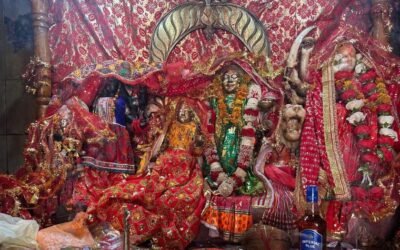
Trilokinath is worshipped here as Shiva in his cosmic, universe-ruling aspect, with Parvati seated on his lap within the same central image — a composition that, alongside the rare three-faced form itself, distinguishes this shrine from more conventional single-faced Shiva sanctums elsewhere in the region. The temple complex also houses images of Sharada Devi (a form of Saraswati) and Narada Muni, broadening its devotional scope beyond Shiva alone, alongside carvings of Mahishasuramardini and various other Hindu deities integrated into the temple’s dense exterior ornamentation.
Devotees offer bilva leaves, milk, and ghee lamps in keeping with standard Shaivite practice, and the temple draws a steady mix of pilgrims, historians, and photographers — its status as one of Mandi’s most architecturally significant and consistently well-preserved old shrines giving it a slightly different character from purely devotional sites, closer to a living heritage monument that also happens to host active daily worship.
🏛️ The Temple Itself
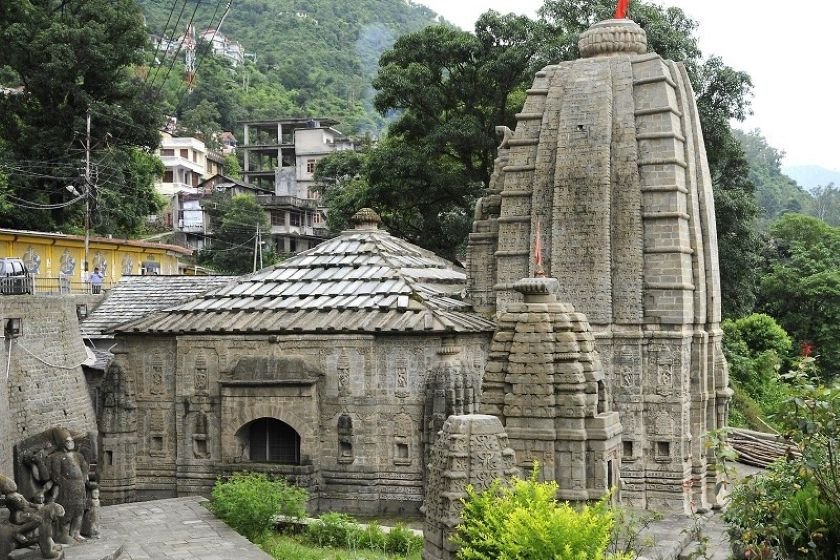
Triloknath is built in the curvilinear Nagara style, with a shikhara topped by an amalaka and kalash in the traditional North Indian manner, its plan shifting from tri-ratha toward pancha-ratha (three- to five-projection) massing depending on which part of the structure you’re looking at. The shikhara itself was originally decorated with chaitya-dormer relief work, traces of which are still visible in places even though much of that original surface detail has since worn away. The temple’s exterior walls carry dense, carefully executed ornamentation reaching all the way down to the plinth — sculptures depicting Shiva and Parvati riding the bull together, Mahishasuramardini, and various hunting and dancing scenes woven throughout the wall surface. Several of the temple’s niches hold their own small sculptural programs, including one flanked by fluted pillars that houses an image of Brahma — a detail worth noting given how rarely Brahma receives independent devotional representation at Shaivite temples.
The mandapa is a particularly sophisticated piece of design: four corner projections rise in a stellar pattern from the base, each one nearly forming its own miniature shrine complete with its own shikhara and amalaka, rather than functioning as simple structural buttressing. Open vatayanas (windows) pierce two sides of the mandapa wall, and at least one retains its original design intact — a beautifully pillared window fitted with a projecting, ornamented balcony feature known as a kakshasana. A large, intricately carved standing Nandi faces the sanctum from the courtyard, and the temple is formally protected as a Monument of National Importance under the Archaeological Survey of India.
The setting adds real weight to the architecture. From Triloknath’s riverside courtyard, visitors look directly across the Beas at the Panchvaktra Mahadev Temple on the opposite bank, with the historic British-era Victoria Bridge visible nearby — a striking arrangement of two significant old temples framing the same stretch of river, best appreciated by walking the courtyard itself rather than viewing either temple in isolation.
📜 The Sena Dynasty and Mandi-Suket’s Bengal Roots
Triloknath’s real historical weight comes from its place within the broader, well-documented Sena migration story shared by both Mandi and Suket’s ruling houses — two neighbouring, historically rival princely states that were eventually merged into a single Mandi district after Indian independence in 1948, despite centuries spent contesting control of the fertile Balh valley between them. That shared Bengal-Karnataka ancestry surfaces elsewhere in Mandi’s cultural life too: the town’s Madhav Rai Temple, home to a revered Krishna murti, marks festivals with luchi — a Bengali-style puri — as its principal prasad, a small but telling culinary echo of the dynasty’s distant eastern origins carried forward through centuries of Himalayan rule.
🎉 Festivals and Devotion
- Mahashivratri: A major devotional occasion at the temple, aligning with Mandi’s wider town-spanning Shivratri celebrations.
- Shravan month: A significant period for Shaivite worship generally, observed with increased visitation at the temple.
- General darshan: The temple remains an active place of worship year-round, alongside its role as a protected ASI heritage site.
🏞️ While You’re in the Area
- Panchvaktra Mahadev Temple: Directly across the Beas, visible from Triloknath’s own courtyard, known for its five-faced Shiva idol.
- Victoria Bridge: A historic British-era bridge spanning the Beas near the temple.
- Bhootnath Temple: Central to Mandi’s Mahashivratri celebrations, elsewhere in the old town.
- Ardhnarishwar Temple: A composite Shiva-Parvati shrine in Mandi town, notable for its roofless mandapa.
- Madhav Rai Temple: Home to a revered Krishna murti and a distinctly Bengali-influenced prasad tradition tied to the Sena dynasty’s origins.
❓ Quick Questions Travellers Ask
Is this the same Triloknath Temple people mention in Lahaul? No — that’s a separate, independently famous shared Hindu-Buddhist pilgrimage site in Udaipur tehsil, Lahaul and Spiti district, historically known as Tunda Vihar. This article covers the distinct temple in Mandi town.
What makes the three-faced Shiva image here unusual? Most Shiva temples depict him in a single form; this tri-mukhi image, with each face representing his dominion over one of the three worlds, is a comparatively rare iconographic choice and is the direct source of the temple’s name.
Is there an entry fee? No entry fee could be confirmed for this article; as an actively worshipped ASI-protected temple, general darshan is very likely free.
How does this temple connect to Mandi’s wider “Chhoti Kashi” identity? It’s one of the town’s oldest and most architecturally significant shrines among the roughly 81 temples that give Mandi its “Little Varanasi” nickname, and is frequently paired on a single walking visit with Bhootnath and other nearby old-town temples.
Is the temple’s exterior carving still fully intact after 500 years? Not entirely — parts of the original chaitya-dormer relief work on the shikhara have worn away over the centuries, though a substantial amount of the wall ornamentation, including the mythological carvings and the mandapa’s stellar corner projections, remains well preserved under ASI protection.
A Last Word
There’s something worth sitting with in a temple whose builders had already crossed most of India before they ever laid its first stone — a family that lost a kingdom in Bengal, rebuilt in the Himalayan foothills, and centuries later commissioned a three-faced god to watch over a river valley that had become, against considerable odds, permanently theirs. Triloknath doesn’t need a supernatural origin story to hold your attention. Its real legend is written in genealogy: Karnataka to Bengal, Bengal to Punjab, Punjab to Mandi, and finally, in 1520, into stone on the banks of the Beas.
Fact-check note: The temple’s 1520 CE construction under Queen Sultan Devi, wife of Raja Ajbar Sen, its three-faced Trilokinath iconography, its Nagara-style pancha-ratha architecture, and its ASI-protected status are exceptionally well corroborated across independent sources, including a detailed academic-style architectural survey. The broader Sena dynasty migration history (Karnataka to Bengal, the 1203–1204 Bakhtiyar Khalji conquest, and the family’s relocation via Ropar to found Suket and Mandi) is independently corroborated across more than one detailed historical source. One source names the temple’s royal patron as “Maharaja Akbar Sen” rather than Ajbar Sen, which appears to be a transcription error rather than a genuine alternate identification. One online listing gives an address on NH-20, Bhiuli — identical to the address used elsewhere for Mandi’s separate Bhima Kali Temple — and appears to be a data error rather than an accurate location. No entry fee could be confirmed.