Deep in a forest that supplies wood for nothing but funeral pyres, a Shivling said to be older than recorded history is also said to be sinking — slowly, patiently — deeper into the ground every year.
Plenty of Himachal’s temples trace themselves back to the Mahabharata; fewer of them can point to a specific classroom. Shiv Bari, hidden in the sacred groves of Ambota near Gagret in Una district, does exactly that — local memory holds that this patch of forest once belonged to Guru Dronacharya, the archery master who trained both the Pandavas and the Kauravas, and that the shrine grew out of something far more personal than a battlefield legend: his own daughter’s stubborn curiosity about where her father disappeared to every morning. What she found, and what she managed to keep here, is the reason people still come. But it isn’t the only story the forest tells. Centuries later, an emperor’s soldiers would learn — the hard way — that the ground here doesn’t give up its secrets easily.
🌄 Location & How to Reach It
The temple sits in Ambota village, close to Gagret town in Una district, on the banks of the Swan River (recorded in older texts as the Sombhadra), in a stretch of dense forest that locals still sometimes call Drone Nagri — Drona’s town. It’s a genuinely wooded setting, unusually so for a lowland temple this close to the Punjab plains, and the walk in under the tree cover is part of what makes the place feel set apart from the busier pilgrim traffic passing through the district.
Google Maps: Get Directions
Elevation: not independently confirmed; Una district as a whole ranges from roughly 300 to 900 metres, and this stretch of the Swan valley sits toward the lower end of that band.
- By road: Gagret lies on the Jalandhar–Mandi highway (NH-70), roughly 25–32 kilometres from Una town and about 26 km from Hoshiarpur — sources vary slightly on the exact distance from Una, but the route itself is a straightforward highway drive with a short turn-off into Ambota.
- By rail: Amb Andaura station, on the Una rail line, is the closest railhead at around 5 kilometres away — one of the more conveniently placed stations for any temple in the district.
- By air: Gaggal Airport near Kangra/Dharamshala is the commonly cited option, though it’s a fair distance out; Chandigarh is sometimes mentioned as an alternative for travellers coming from Punjab, but it’s considerably farther and better suited to those already routing through that city.
This is a low-effort stop by Himachal standards — no climb, no altitude to account for, just a short detour off a highway many pilgrims are already driving to reach Chintpurni.
🌸 Best Time to Visit
There’s no posted daily schedule here, and by most accounts that’s part of the point — travellers describe Shiv Bari as a “crowd-less” temple, a quiet counterpoint to the much busier Chintpurni shrine nearby, and it rewards a visit on an ordinary day as much as a special one. The exception is Maha Shivratri, when a proper fair takes shape on the grounds and many devotees already travelling to Chintpurni for its own festival season stop here as well. Outside of that, the forest setting means the temple is genuinely pleasant most of the year, though the Una plains can get uncomfortably hot in peak summer.
🕉️ The Girl Who Prayed the God into Staying
The founding story here belongs to Dronacharya’s daughter, remembered in most tellings as Yayati. Her father’s routine, the story goes, never varied: every day he bathed in the Swan and then withdrew toward the Himalayas to pray to Shiva, telling no one what happened once he arrived. Children notice these disappearances more than parents expect them to, and eventually Yayati pressed him for an answer. Rather than explain, Dronacharya gave her an assignment instead — sit at home and chant “Om Namah Shivaya” with full sincerity, and the answer would come to her on its own.
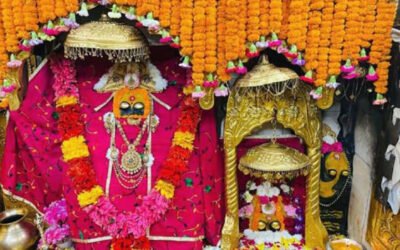
She did, for days, with the kind of undistracted devotion that these stories always insist on. Shiva, moved by it, appeared to her not as a distant deity but as a child, and the two of them played together, the way a god apparently will when a prayer is offered without any agenda beyond wanting to understand. When Dronacharya returned and found his daughter in the company of a long-haired boy he didn’t recognize, the truth came out. Yayati, unwilling to let the moment end, asked Shiva to stay — not as a visiting playmate, but permanently, in the valley she called home. He agreed, taking the form of a self-manifested (swayambhu) Pindi Shivling, and Dronacharya built the temple around it. It’s a gentler founding myth than most temple legends manage: no battle, no curse, just a child’s persistence rewarded.
📜 The Emperor Who Learned Not to Dig
The second story belongs to a much later, much less devotional visitor. During the reign of the Mughal emperor Aurangzeb, known elsewhere for the demolition of temples across the subcontinent, soldiers are said to have arrived at Shiv Bari with instructions to excavate the Pindi — presumably to remove or destroy it. What happened next has been passed down as the temple’s clearest act of self-defense: as the digging began, the story goes, the ground responded on its own, releasing swarms of red insects that attacked the soldiers and left them incapacitated. Confronted with this, the emperor is said to have called off the operation and asked forgiveness at the very shrine his men had come to dismantle.
It’s worth being honest about what this story is and isn’t. There’s no independent historical record of an Aurangzeb-era raid on this specific temple, and stories of temples defending themselves against Mughal desecration are a recurring motif across North Indian shrine lore, which should temper how literally it’s taken. What it does capture accurately, though, is something locals will tell you is still physically true today: devotees describe the Shivling as continuing to sink, fractionally, deeper into the earth with each passing year — as if whatever is under it has never entirely stopped resisting being uncovered.
🙏 What Devotees Come Here For
Shiv Bari doesn’t carry the reputation of a wish-fulfilling shrine in the way some of Una’s other temples do, but it isn’t purely contemplative either — devotees do come here seeking blessings for childless couples and for those pursuing a fair resolution to a dispute or grievance, alongside the more general Shiva worship of a Shivratri pilgrimage stop. The standard rituals apply: abhishek performed with sacred water drawn from the temple’s own jalhari, the lighting of ghee lamps, and the recitation of Shiva mantras and stotras during the morning and evening aartis. Compared to a major Shakti Peetha like Chintpurni a short drive away, Shiv Bari is a lower-key stop — less a destination in its own right for most visitors than a meaningful pause on the way to one, though for locals it clearly carries its own standing.
🏛️ The Temple and the Forest Around It
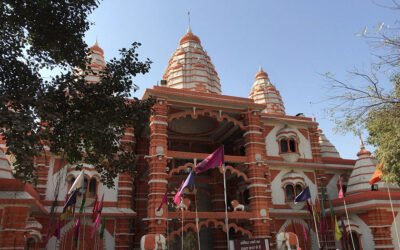
The shrine itself is unpretentious: a stone-and-wood sanctum sheltering the Pindi Shivling, set in a courtyard paved in stone and shaded by old banyan and peepal trees, with the Swan River audible nearby. Alongside the main lingam, the temple houses older idols of Virbhadra, Kartikeya, Kuber, and Ganesha — a small but respectable pantheon for what is, physically, a modest structure. Four old wells, said to have been built by the kings of Jammu and Amb in gratitude after wishes made here were fulfilled, still stand on the grounds. So do the samadhis of saints who are said to have meditated at the site over generations, and — more unusually — four cremation grounds, one set in each cardinal direction around the temple. The forest itself is treated as sacred: local custom holds that wood from these particular trees is never used for ordinary purposes, only for cremation fires and yajnas, which gives the whole grove a quietly solemn character even outside of festival season. It isn’t an especially grand or ornamented complex, but the combination of running water, old trees, and unhurried stillness gives it an atmosphere that a more polished shrine would struggle to manufacture.
🎉 Festivals and Devotion
- Maha Shivratri — the temple’s main event, drawing both dedicated pilgrims and travellers already headed to or from Chintpurni Temple, which lies on the same general route.
- Everyday darshan — outside the festival calendar, this is described consistently as a quiet, largely uncrowded temple, visited in ones and twos rather than in processions.
🏞️ While You’re in the Area
- Chintpurni Temple — one of Himachal’s Shakti Peethas and by far the busiest pilgrimage draw in the district; many visitors combine the two in a single trip.
- Kaleshwar Mahadev Temple, Amb — another riverside Shiva shrine with its own local mythology, not far off.
- Dera Baba Bharbhag Singh, Mairi — a Sikh dera known for its Hola Mohalla fair and its own distinct legend of a saint and a subdued spirit.
- Gobind Sagar Lake — for a complete change of pace, a reservoir near Una offering boating and watersports.
🙏 Getting in Touch
There’s no formal booking system, entry fee, or publicly listed phone number for Shiv Bari — it functions as a community- and trust-maintained shrine rather than a managed tourist site, and by some accounts has faced its own struggles with upkeep and preservation over the years. If you’re planning a visit around Shivratri or want current road conditions, asking locally in Gagret or at the temple itself on arrival is the practical approach.
❓ Quick Questions Travellers Ask
Is Shiv Bari the same as the “Shiv Bari” sometimes mentioned in Una town itself? Not necessarily — some accounts describe a separate, later Shiv temple within Una town linked to a local ruling family, distinct from this forest shrine in Ambota near Gagret. If you’re specifically after the Dronacharya-era temple, Ambota/Gagret is the one to head for.
How old is the temple, really? It’s popularly described as around 5,000 years old (occasionally cited as 6,000), tying it to the Mahabharata era — treat this as devotional tradition rather than an archaeologically dated figure, since no verifiable dating evidence was found.
Is there an entry fee? No — entry is free, as with most temples of this kind in the region.
Can I combine this with a Chintpurni visit in one day? Yes, easily — the two are commonly visited together given their proximity along the same general route.
Is the forest setting safe to walk through? Yes, it’s a maintained temple approach rather than deep wilderness, though as with any forested site it’s worth visiting in daylight hours.
A note on sources: the temple’s age (5,000 vs. 6,000 years) and its exact distance from Una town (25–32 km, depending on source) vary across accounts and are presented here as approximate rather than fixed. No independently verified GPS coordinates or elevation figure were found, so both have been handled with appropriate caution above. One source describing a “Shiv Bari Temple” in Una town itself, attributed to a 16th-century king and built in a Hindu-Islamic architectural style, appears to describe a different site entirely from the Dronacharya-era forest temple in Ambota that the rest of the sourcing consistently agrees on — rather than merging the two into one confused history, that discrepancy has been flagged directly in the FAQ above. The Aurangzeb-era attack story is repeated across several sources but has no independent historical corroboration and is presented in the narrative as legend, not established history.