Climb 305 stone steps above Mandi’s bazaar, and you reach a shrine that two different rulers of this town credited with saving them — one on the eve of a war, the other from a prison cell two centuries later.
Most royal temples get one good founding story and coast on it for the rest of their history. Tarna Devi’s temple, perched on its hill above Mandi town, somehow collected two — separated by roughly a hundred and seventy years, and both genuinely documented rather than lost to pure legend. The first belongs to Raja Shyam Sen, who is said to have invoked the goddess Kali’s blessing before marching on a neighbouring kingdom that had insulted him, and built this temple in gratitude after winning. The second belongs to a much later Mandi king, Raja Balbir Sen, who found himself imprisoned in a Sikh Empire fort a continent away from his own kingdom, prayed to this same goddess from behind those walls, and — according to the temple’s own history — was eventually released and restored to his throne. Two kings, two crises, one hilltop shrine that both of them credited with an answer.
🌄 Location & How to Reach It
Tarna Devi Temple — also known as Shyama Kali Temple — sits atop Tarna Hill in Mandi town, Himachal Pradesh, roughly 3 km from the Mandi bus stand, at an elevation of around 3,000 feet.
Google Maps: Get Directions
- By road: A motorable road climbs to the temple for those who’d rather not walk; Mandi town itself is well connected by bus and taxi from Shimla, Kullu, Manali, and Chandigarh.
- By foot: The traditional approach is a climb of over 300 stone steps directly from Mandi’s main bazaar — a proper hilltop pilgrimage rather than a casual stroll, though well within reach of most reasonably fit visitors.
- By rail: Joginder Nagar’s narrow-gauge terminus is the nearest railhead, roughly 55 km away.
- By air: Bhuntar Airport near Kullu is the nearest, at approximately 60 km.
Given its position directly above Mandi’s town centre, this is an easy addition to a day spent exploring the rest of “Chhoti Kashi’s” temple circuit — climb up for the view and the shrine, then walk back down into the bazaar.
🌸 Best Time to Visit
A nine-day annual fair is held each year in the month of Asuj (roughly September–October, overlapping with the autumn Navratri period), drawing the temple’s largest crowds and its fullest ceremonial activity. October through March generally offers the most comfortable climbing weather, with clear views over Mandi town and the Beas River valley from the hilltop. As with much of Mandi, the town’s broader Shivratri festival period also brings increased footfall across its temples, this one included.
🕉️ The Legend: A Dance That Nearly Ended the World, and a King Who Answered an Insult
Tarna Devi’s core legend is one of Hindu mythology’s most widely told explanations for Kali’s fearsome iconography, applied here to this specific hilltop. According to the story, the goddess Parvati once began dancing in pure joy, her movements growing more graceful and unrestrained until she lost herself entirely in the rhythm. Her steps grew so furious that they began to shake the earth itself, threatening to bring destruction down on all three worlds. Alarmed, the other gods appealed to Shiva for help, and Shiva — finding no other way to interrupt her — lay down directly in the path of her dance. When Kali’s foot came down on her own husband, the shock broke her trance; she stopped, and in her remorse at what she’d nearly done, is depicted ever after with her tongue out in shame, exactly as she’s shown in the temple’s own three-faced black stone idol today.
The temple’s actual founding, however, belongs to real, reasonably well-documented Mandi history rather than pure cosmic myth. Raja Shyam Sen, who ruled Mandi from 1664 to 1675, was by several independent accounts a devoted worshipper of Kali. When Raja Jit Sen of the neighbouring state of Suket insulted him, Shyam Sen prepared to invade Suket in response — and before marching, he prayed to Kali for victory. He won the campaign, and, crediting the goddess directly with his success, built the temple on Tarna Hill and installed her image there in gratitude. This founding story is corroborated with unusual consistency across multiple independent sources, including a government-affiliated environmental and heritage database — making it one of the more solidly attested royal temple foundations in this entire series.
The temple’s second major story belongs to the 19th century and to Raja Balbir Sen, and it ties directly into real, documented Sikh Empire history. Following the death of Maharaja Ranjit Singh in 1839, the Sikh Empire entered a turbulent period under his successors; during the troubled reign of Maharaja Kharak Singh, his son Naunihal Singh is said to have engineered an unprovoked invasion of Mandi and Kullu, largely to occupy an increasingly unmanageable army. A Sikh force under General Ventura advanced on Mandi, extracted payment, then lured Raja Balbir Sen into captivity under the pretext of presenting him with an honorary robe (khilat) — imprisoning him instead and occupying the town along with the nearby Kamlah fortress. Balbir Sen was sent as a prisoner to the Gobindgarh Fort in Amritsar. According to the temple’s own history, a loyal minister escaped Mandi in disguise, worked his way into the confidence of the Sikh rulers, and eventually spread word that the imprisoned Raja possessed genuine spiritual healing powers — a reputation that grew until it reached the ears of those who could act on it. Sources differ slightly on the specific miracle credited with securing his release: one account describes his prayers coinciding with the ending of a prolonged, troubling rain; another describes a vision of a young girl, understood as a form of Kali, appearing to him in response to his devotion. Either way, Balbir Sen was eventually released with full honours, and Mandi state, along with what had been taken from it, was restored to him. In gratitude, he commissioned artists from Jaipur to renovate the temple’s inner sanctum with gold and glasswork — a renovation still cited today as one of the sanctum’s most striking features. One source refers to this king as “Raja Balbir Singh” rather than “Balbir Sen,” which appears to be a naming inconsistency across sources rather than evidence of two different rulers, given that every other Mandi ruler mentioned in connection with this temple carries the Sen dynastic name.
🙏 What Tarna/Shyama Kali Is Known For
Tarna Devi is worshipped here as Shyama Kali, understood as an incarnation of Parvati and approached by devotees with the belief that sincerely made wishes at this temple are fulfilled. Her three-faced black stone idol, alongside a second image of Mahishasuramardini within the temple, reflects the fierce, protective character common to Kali worship generally, tempered here by the specific, personal history of two Mandi kings who credited her directly with saving them at their lowest points.
A distinctive royal tradition tied to the temple involves childbirth within the Mandi ruling family: historically, all children born into the royal household were brought to Tarna Devi for ceremonies performed eight days after birth, embedding the goddess directly into the dynasty’s own life-cycle rituals rather than leaving her worship confined to festivals and crises alone.
🏛️ The Temple Itself
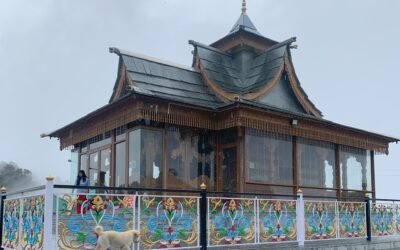
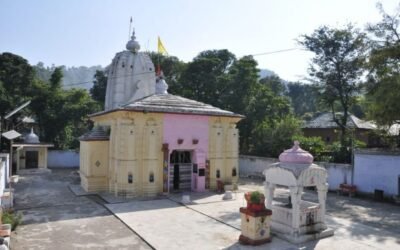
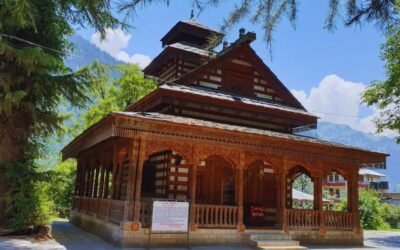
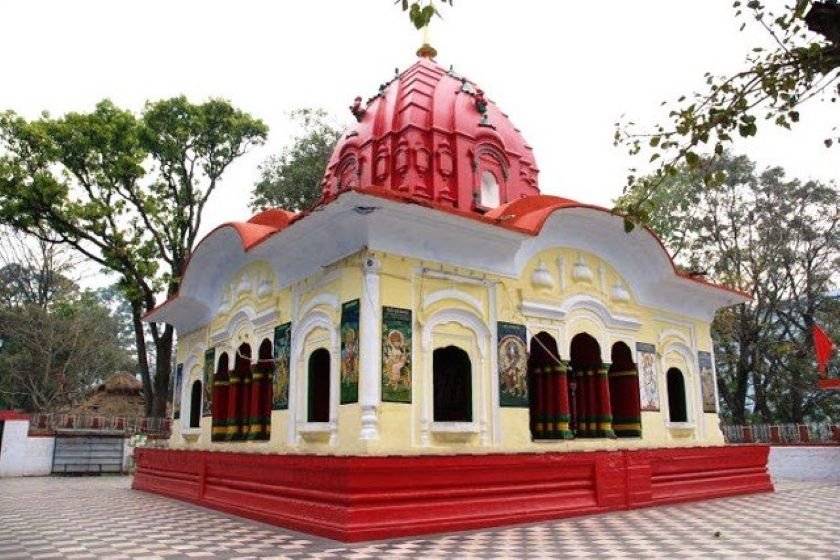
Built from red and white stone, Tarna Devi’s temple is known especially for its garbhagriha (sanctum sanctorum), significantly renovated in the 19th century under Raja Balbir Sen following his release from captivity — a renovation that brought in skilled artists from Jaipur to execute detailed gold and glass work inside the inner sanctum, giving it a richness distinct from many of Mandi’s plainer wooden hill temples. The temple’s walls carry paintings depicting Shiva, Kali, and various gurus, adding a devotional visual narrative to the physical structure itself. The presiding image is a three-faced murti carved from black shila (stone), accompanied by the separate image of Mahishasuramardini.
The temple is formally recorded in India’s National Mission on Monuments and Antiquities built heritage database, giving it a degree of official documentation beyond casual tourism coverage. Physically, its most memorable feature for most visitors may simply be its position: perched high enough above Mandi town to offer sweeping views over the Beas River valley, especially rewarding for anyone who’s just climbed the 300-plus steps to reach it.
📜 Mandi’s Sen Dynasty and the Temple’s Two Royal Chapters
Tarna Devi’s story is, in miniature, a history of the Sen dynasty’s rule over Mandi across two very different centuries — a 17th-century founding tied to inter-state rivalry with neighbouring Suket, and a 19th-century renovation tied to the much larger, better-documented turbulence of the Sikh Empire’s post-Ranjit Singh succession crisis. Few temples in this series carry two distinct royal chapters this clearly separated in time yet this consistently attributed to the same ruling family, giving Tarna Devi an unusually continuous, generation-spanning royal narrative compared to many of Mandi’s other old shrines.
🎉 Festivals and Devotion
- Asuj Mela (nine days, September–October): The temple’s principal annual fair, aligning with the broader autumn Navratri period.
- Royal birth ceremonies (historical): Children of the Mandi royal family were traditionally brought to the temple for rites performed eight days after birth.
- General darshan: The temple remains an active pilgrimage site year-round, alongside its status as a recorded heritage monument.
🏞️ While You’re in the Area
- Bhootnath Temple: An ancient Shiva temple in Mandi town, central to the city’s Mahashivratri celebrations.
- Triloknath Temple: Another of Mandi’s well-known riverside shrines.
- Ardhnarishwar Temple: A composite Shiva-Parvati shrine elsewhere in Mandi town, notable for its roofless mandapa.
- Bhima Kali Temple, Bhiuli: A riverside Shakti shrine on the Beas, within the same town.
- Rewalsar Lake: A sacred lake revered by Hindu, Buddhist, and Sikh traditions alike, about 24 km away.
- Prashar Lake: A high-altitude lake with a mysterious floating island, roughly 49 km from Mandi.
❓ Quick Questions Travellers Ask
Do I have to climb all 305 steps, or is there another way up? There’s also a motorable road to the temple for those who’d prefer not to make the full climb, though the stair route from Mandi bazaar remains the traditional approach.
Is the story about Raja Balbir Sen’s imprisonment historically accurate? The broader historical context — Ranjit Singh’s death in 1839, the troubled Sikh succession, and a Sikh military action against Mandi — is well documented history; the specific details of Balbir Sen’s captivity, the minister’s disguised escape, and the exact circumstances of his release come from the temple’s own devotional history and should be understood as a blend of documented events and locally preserved tradition.
Is there an entry fee? No entry fee could be confirmed for this article; as an actively worshipped town temple, general darshan is very likely free.
What’s the best time to see the temple’s renovated sanctum interior? Any time during regular visiting hours, though visiting outside the Asuj Mela’s peak crowds may allow more time to appreciate the gold and glasswork commissioned by Raja Balbir Sen.
How does this temple fit into a broader day in Mandi? Easily — it’s a short trip from the town’s other major temples, and the climb itself is often treated as part of the experience, with the summit view over Mandi and the Beas valley as much a draw as the shrine itself.
A Last Word
There’s something quietly moving about a temple that two different kings, separated by nearly two centuries, both turned to at the worst moments of their reigns — one facing a war he’d chosen, the other locked in a fortress hundreds of miles from home with no clear way back. Tarna Devi doesn’t ask you to pick which story matters more. She simply sits on her hill above Mandi, three-faced and fierce, having apparently answered both men in her own way — one with victory, the other with an improbable release — and having collected, in the process, a temple that carries the town’s history as faithfully as its mythology.
Fact-check note: The temple’s 17th-century founding under Raja Shyam Sen (who ruled Mandi 1664–1675), its dedication to Shyama Kali as an incarnation of Parvati, its location atop Tarna Hill reached by over 300 steps, and its 19th-century sanctum renovation under Raja Balbir Sen following the documented Sikh Empire invasion of Mandi are corroborated across multiple independent sources, including a government-affiliated heritage database and the site’s National Mission on Monuments and Antiquities listing. A minor naming inconsistency exists across sources regarding whether the 19th-century king is called “Balbir Sen” or “Balbir Singh” — this piece follows the Sen dynastic naming used elsewhere for Mandi’s rulers. The exact miracle credited with securing his release (an end to prolonged rain vs. a vision of a young girl as Kali) is reported differently across sources and is presented above as a devotional tradition rather than settled fact. No entry fee could be confirmed.