The last visitors are walking towards the lower gate.
Their voices grow weaker as they descend through the old stone passages. A bird rises suddenly from a ruined wall, circles above the fort and disappears towards the valley.
For a few moments, everything becomes still.
Then a sound travels through the passage behind you.
One footstep.
A brief pause.
Then another.
You turn, expecting to see someone approaching through the gateway, but the corridor is empty. There is only weathered stone, deepening shadow and a cold current of air moving through a crack in the wall.
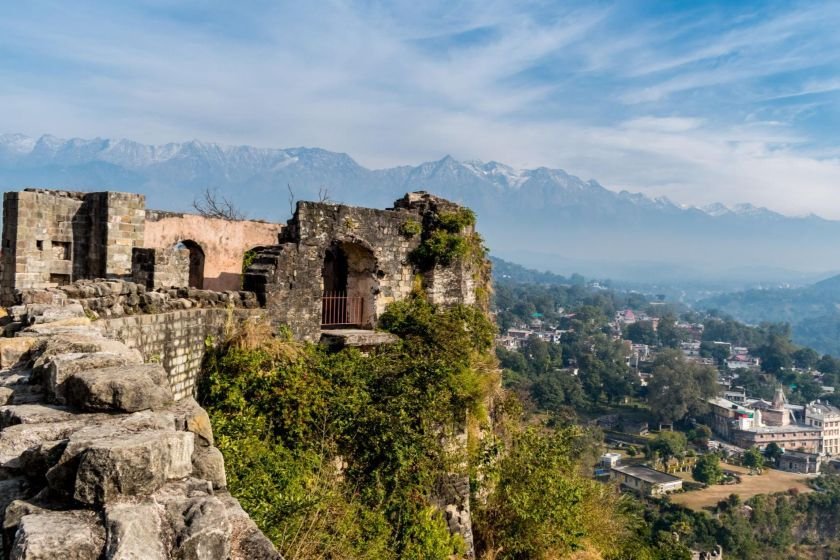
During the day, Kangra Fort is one of Himachal Pradesh’s most remarkable historical monuments. Its gateways, ramparts and temple ruins overlook deep valleys, river channels and the distant Dhauladhar mountains.
But as evening approaches, the fort develops another personality.
Darkness gathers beneath the gateways. Voices return from places where no one appears to be standing. Small stones shift somewhere above, and the narrow passages begin to feel as though they are hiding more than abandoned walls.
Kangra Fort does not have one universally accepted ghost story.
Its haunting comes from something larger—centuries of warfare, siege, ambition, destruction and sudden death.
The fort does not need an invented spirit to feel haunted.
Its history has already left enough behind.
Kangra Fort at a Glance
| Detail | Information |
|---|---|
| Location | Old Kangra, Kangra district, Himachal Pradesh |
| Nearest town | Kangra |
| Distance from Dharamshala | Around 20 kilometres |
| Type of place | Ancient hill fort and historical monument |
| Haunted character | Dark history, local folklore and unexplained sounds |
| Best time to visit | October to June |
| Time required | Around one to two hours |
| Night entry | Not permitted |
| Ideal for | History lovers, heritage travellers and haunted-place enthusiasts |
The Footsteps Behind the Gate
The approach to Kangra Fort passes through a sequence of heavy gateways and narrow defensive passages.
These routes were not created for comfort. They were designed to slow an invading army.
Soldiers entering the fort could not move directly towards its centre. They had to climb, turn and pass through confined spaces while defenders watched from positions above.
Today, these passages appear deserted.
But they do not always sound empty.
A footstep made on an upper level may return from a wall below. A conversation taking place in a distant courtyard can sound as though someone is whispering from the other side of a closed passage.
Wind enters through cracks in the stone and produces low whistles, knocks and scraping sounds.
Some visitors describe hearing footsteps following them through the gateways.
When they stop, the footsteps stop.
When they begin walking again, the sound returns.
There is no verified proof that these footsteps belong to a spirit. The fort’s unusual acoustics offer a reasonable explanation.
But explanations feel less comforting when you are standing alone inside a dark passage.
The Legend of the Unseen Guard
Old forts often develop stories about soldiers who refuse to abandon their posts.
Kangra Fort is no exception.
One version of the local folklore speaks of an unseen guard who continues to patrol the gateways long after the battles have ended. He is never clearly seen, but his footsteps are said to follow visitors through the narrow passages.
Another version describes a shadow appearing near the upper walls, remaining motionless as though watching the road below.
The figure disappears when anyone tries to approach.
Some storytellers believe it is the spirit of a soldier killed while defending the fort. Others say it belongs to a guard who died without ever receiving the order to leave his position.
These accounts have never been independently verified, and their details change with each retelling.
Yet the story fits the character of the place.
Kangra Fort was built around observation. Someone was always watching the road. Someone was always listening for movement below.
Even now, when the ramparts appear empty, it can be difficult to escape the feeling that the fort is still watching.
A Fort That Armies Could Not Ignore
Kangra Fort is associated with the Katoch dynasty, whose history is linked with the ancient Trigarta kingdom. It is regarded as one of the oldest surviving forts in India and one of the most important hill forts of the western Himalayas.
Its position made it extremely difficult to attack.
The fort stands above steep slopes and deep valleys. Approaching armies could be observed from the walls, while the rising entrance route forced attackers into narrow and vulnerable spaces.
Every gate created another obstacle.
Every turn exposed soldiers to defenders standing above them.
Every enclosed passage made retreat more difficult.
Walking through the fort today, it is easy to imagine the fear of an invading soldier entering these walls.
There was no open battlefield ahead.
Only another gate.
Another shadowed turn.
Another unseen defender waiting somewhere above.
The Treasure Beneath the Stones
Kangra Fort was valued for more than its military position.
The old kingdom of Kangra, historically associated with Nagarkot, was known for powerful rulers, important temples and accumulated wealth.
Stories of that wealth attracted invaders from beyond the Himalayan foothills. Over time, historical accounts of riches became legends of treasure hidden beneath the fort.
Local tales speak about concealed chambers, underground passages and valuables that were never recovered.
In some versions, the treasure is protected by the spirits of soldiers who died defending it.
In others, sacred guardians prevent anyone with dishonest intentions from finding the hidden chambers.
There is no reliable evidence proving that supernatural guardians or undiscovered treasure rooms exist inside Kangra Fort.
But treasure legends rarely disappear completely.
They survive because every collapsed passage appears capable of hiding something.
Every blocked doorway suggests that another chamber may exist beyond it.
And every old story leaves one question unanswered:
Did the invaders really take everything?
Siege, Fear and the Sounds of War
Kangra Fort resisted repeated attempts by powerful armies to capture it.
The struggle for control continued across centuries, with the fort passing through periods of Katoch, Mughal, Sikh and British authority. Its history includes campaigns associated with Mahmud of Ghazni, Mughal Emperor Jahangir and Maharaja Ranjit Singh.
A siege was not a brief battle.
It could continue for weeks or months.
The people inside waited while supplies became limited. Guards remained awake through cold nights, listening for movement near the walls. Injured soldiers were carried into chambers that offered little comfort.
Outside, attacking troops faced hunger, disease and the constant threat of weapons falling from above.
The fort would have been filled with sound.
Orders shouted through the passages.
Metal striking stone.
Animals crying in the darkness.
Men running between gateways.
The wounded calling for help.
Doors closing before another attack.
Those who believe Kangra Fort is haunted often imagine that fragments of these sounds still remain.
A metallic knock from an empty courtyard.
A distant voice beneath the wind.
Footsteps moving towards a gate that has not been guarded for centuries.
The Fort That Outlived Its Rulers
Every transfer of power brought new soldiers through the same entrances.
New flags rose above the same walls.
New rulers entered chambers that had belonged to their enemies.
The people changed.
The fort remained.
This repeated cycle gives Kangra Fort much of its unsettling character.
Every ruler believed the fort was now theirs.
None of them remained forever.
The walls survived their victories, their defeats and their names.
The Morning the Earth Moved
Armies attacked Kangra Fort for centuries.
Nature finally caused the destruction they could not.
On 4 April 1905, a powerful earthquake struck the Kangra region. It caused widespread destruction across Kangra, Dharamshala and surrounding areas. Kangra Fort suffered extensive damage, leaving much of the monument in the ruined condition seen today.
There was no approaching army to observe from the ramparts.
No warning carried through the gates.
The ground itself moved beneath the fort.
Walls that had survived military campaigns collapsed.
Temple structures broke apart.
Passages filled with dust and falling stone.
Buildings that had stood for generations disappeared within moments.
The ruins visible today are not simply the remains of a fort that slowly became old. They also carry the scars of sudden and violent destruction.
Some later stories connect unexplained sounds inside the fort with people who died during the disaster.
These accounts remain folklore.
The tragedy behind them was real.
The Most Unsettling Moment
The strangest experience at Kangra Fort is often the sudden change between open space and confinement.
One moment, you are standing on an upper terrace with sunlight, distant hills and an open view of the valley.
Then you enter a narrow gateway.
The light disappears.
The temperature drops.
Your footsteps return from the walls a moment after you make them.
A voice from another part of the fort sounds unexpectedly close. A bird moving above sends dust and tiny stones falling into the passage.
For a few seconds, it becomes difficult to understand where any sound began.
Then something scrapes behind you.
You turn.
The passage is empty.
You may know that it is only an echo.
The fort still makes you check.
Sacred Ruins and Guardian Stories
Kangra Fort was not only a military stronghold.
Temples and sacred structures also stood within its walls, including places associated with Hindu and Jain traditions.
Their damaged pillars, carved stones and temple platforms create an atmosphere very different from the defensive passages below.
Here, the history of warfare meets the silence of a sacred place.
Stories about spiritual protection are sometimes connected with these areas. Some traditions speak of unseen forces guarding sacred ground or protecting what remains of the old temples.
Such beliefs should not automatically be described as ghost stories.
In Himalayan traditions, an unseen presence is not always considered evil or frightening.
It may be understood as a guardian.
Visitors should therefore treat the temple ruins with respect and avoid turning sacred beliefs into sensational paranormal claims.
What Visitors Reportedly Experience
Stories associated with Kangra Fort commonly mention:
- footsteps in empty passages;
- distant voices inside ruined sections;
- shadow-like movement near gateways;
- the sensation of being watched from above;
- small stones falling when no one is visible;
- sudden coldness in enclosed areas;
- an unexplained feeling of heaviness or fear.
None of these experiences has been confirmed as paranormal.
They remain personal impressions, local stories and experiences shaped by the atmosphere of a large ancient ruin.
Why Kangra Fort Feels Haunted
The unsettling atmosphere of Kangra Fort can be explained by a combination of natural and psychological factors.
Its thick walls and narrow passages reflect sound unpredictably. Footsteps from another level may seem to come from behind, while conversations can travel across courtyards and enclosed gateways.
Wind passing through cracks in the ruins may create whistles, knocks and low murmuring sounds.
Birds, monkeys and smaller animals move through sections that appear deserted. Their movement can dislodge stones or create brief shadows.
Light also changes rapidly inside the fort. A visitor moving from a bright courtyard into a dark passage may temporarily mistake a fixed object for a moving figure.
History contributes to the experience as well.
Once you know that armies fought here and that the fort suffered sudden destruction, the ruins stop feeling neutral.
Every dark doorway begins to suggest a story.
Every echo sounds as though it belongs to someone.
Visiting Kangra Fort Today
Kangra Fort is an important historical monument and should be explored only during official visiting hours.
Visitors can walk through the accessible gateways, explore the ruins and enjoy wide views across Kangra Valley. A museum near the fort displays objects connected with the history and artistic traditions of the region.
Opening hours, entry charges and access restrictions may change. Confirm the latest details locally before travelling.
Keep approximately one to two hours for the visit.
Late afternoon offers dramatic light and long shadows, but enter early enough to complete the walk before closing.
How to Reach Kangra Fort
By Road
Kangra Fort is located near Old Kangra and is accessible from Kangra town.
Approximate distances include:
- Kangra town: 3 to 4 kilometres
- Dharamshala: around 20 kilometres
- McLeod Ganj: around 25 kilometres
- Palampur: around 35 kilometres
- Pathankot: around 90 kilometres
Local taxis, buses and private vehicles are available from Kangra and Dharamshala.
By Train
Kangra Mandir railway station on the Pathankot–Jogindernagar narrow-gauge railway line is among the closest rail connections.
Services on this route may be affected by weather, repair work or operational changes, so check the current schedule before travelling.
Pathankot is the nearest major broad-gauge railway junction.
By Air
Kangra Airport at Gaggal is the nearest airport.
The fort is approximately 15 kilometres from the airport, depending on the route taken.
Best Time to Visit Kangra Fort
October to June is generally the most comfortable period for visiting.
Winter offers cool weather and clearer views of the mountains. Spring is pleasant, while early summer can become warm during the middle of the day.
The monsoon gives the valley a dramatic green appearance, but old stone paths may become slippery. Heavy rain can also reduce visibility and affect road conditions.
Safety and Responsible Visiting
Kangra Fort should not be treated as an unrestricted ghost-hunting location.
Visit only during official hours and remain within permitted areas.
Do not climb unstable walls, enter blocked passages or attempt to reach isolated sections after closing. Wear footwear with a reliable grip, supervise children near steep stairways and avoid touching or removing stones and carvings.
Respect the sacred remains inside the fort.
Do not conduct rituals, light fires, damage walls or create staged paranormal videos that disturb other visitors.
Night entry is neither safe nor permitted.
Is Kangra Fort Really Haunted?
There is no verified evidence proving that Kangra Fort is haunted.
Its reputation comes from its violent history, ruined architecture, unusual acoustics and stories passed from one visitor to another.
For some people, every unexplained sound has a natural cause.
For others, a fort that witnessed centuries of warfare cannot become completely silent.
Kangra Fort allows both possibilities to remain.
Frequently Asked Questions
Is Kangra Fort officially considered haunted?
No. It is officially recognised as an important historical monument. Its haunted character comes from folklore, reported experiences and its dark past.
Are there confirmed ghost sightings at Kangra Fort?
No confirmed paranormal sighting has been documented. Most stories describe footsteps, shadows, voices and the sensation of being watched.
Can tourists visit Kangra Fort at night?
No. Visitors should enter only during official opening hours. Night entry and unauthorised exploration are unsafe and prohibited.
What caused most of the visible damage?
The fort suffered extensive damage during the Kangra earthquake of 4 April 1905.
Who built Kangra Fort?
The fort is associated with the Katoch dynasty and the ancient kingdom of Trigarta.
How long does it take to explore Kangra Fort?
Most visitors should keep around one to two hours, with additional time for the nearby museum.
Is Kangra Fort suitable for families?
Yes, but some paths are uneven and include steep steps and exposed edges. Children and elderly travellers may require assistance.
When the Stones Remember
Kangra Fort does not have one famous ghost waiting inside a particular chamber.
Its haunting is spread across the entire place.
It is in the gateway where soldiers once waited for an approaching army.
It is in the ruined temples where carved stones remain after roofs and pillars have fallen.
It is in the staircase that still rises towards a room that no longer exists.
And it is in the silence that follows when a visitor stops walking and hears one final footstep from somewhere deeper within the fort.
Perhaps it is an echo.
Perhaps it is a bird moving above the wall.
Or perhaps some places remember the people who fought, prayed and died within them.
Kangra Fort has been remembering for centuries.