The cemetery is quiet even in daylight.
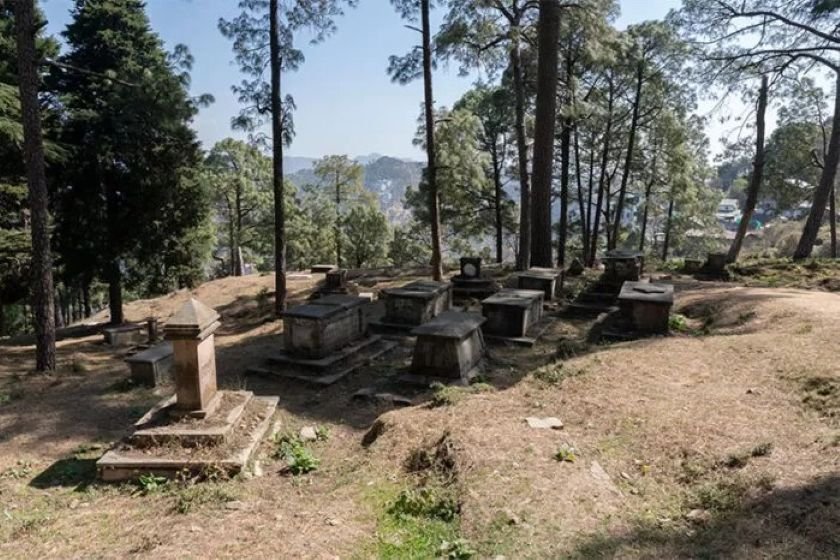
Tall pine trees rise above the old graves, their branches filtering the sun into narrow strips of light. Dry needles cover the ground. Moss spreads across weathered stone, and names carved more than a century ago have begun to fade beneath rain, cold and time.
Nothing moves except the trees.
Then the wind changes.
A branch bends somewhere behind the wall. Pine needles shift across the path. For a moment, the sound resembles someone walking slowly between the graves.
You turn.
There is no one there.
Kasauli’s old cemeteries belong to the colonial history of the hill station. European residents, soldiers and families who lived in the cantonment were buried beneath these forested slopes. Some graves date back to the nineteenth century, while one cemetery contains the identified burials of 29 First World War casualties.
Over time, the isolation of the burial grounds gave rise to darker stories.
Visitors speak about pale figures appearing between the trees, footsteps moving where no person is visible and whispers heard near graves after the road becomes quiet.
There is no verified evidence that Kasauli Graveyard is haunted.
But among old graves hidden beneath a forest canopy, the difference between memory and presence can feel very small.
Kasauli Graveyard at a Glance
| Detail | Information |
|---|---|
| Location | Kasauli, Solan district, Himachal Pradesh |
| Type of place | British-era Christian cemeteries |
| Historical period | Mainly nineteenth and early twentieth centuries |
| Known burials | European residents, families and soldiers |
| Haunted character | Apparitions, footsteps and whispers among the graves |
| Best time to visit | Daylight hours |
| Night access | Not recommended and may be restricted |
| Important rule | Enter only where access is officially permitted |
More Than One Old Cemetery
The name “Kasauli Graveyard” can be misleading because the hill station has more than one British-era burial ground.
Historical accounts describe old Christian cemeteries along routes leading towards Dharampur and Parwanoo. One of the best-known sites lies less than a kilometre from the main town on the Kasauli–Dharampur side. Its oldest graves date to the mid-nineteenth century and belong mainly to Europeans who lived and died in the early cantonment.
Another cemetery is associated with military burials and contains the identified graves of 29 First World War casualties recorded by the Commonwealth War Graves Commission.
For visitors, this distinction matters.
Stories shared online often mix Kasauli’s cemeteries with the better-known haunted legends of Dagshai. The two places are close enough for their folklore to become confused, but they are not the same location.
The haunted character of Kasauli’s graveyards comes less from one famous ghost and more from the atmosphere of several old burial sites hidden among pine trees.
The Figure Between the Graves
One of the most repeated stories speaks of a pale figure moving through the cemetery after sunset.
A person walking along the nearby road notices someone standing between two graves.
At first, the figure appears to be another visitor.
It remains partly hidden behind the trees, dressed in clothing that looks unusually light against the dark forest.
The observer calls out.
The figure does not respond.
A few steps are taken towards the gate.
The person between the graves begins to move.
Not towards the road.
Deeper into the cemetery.
The observer watches it pass behind a large headstone.
It never appears on the other side.
When the area is checked, no one is found among the graves.
Some versions describe the figure as a woman in a long dress. Others say it resembles a soldier standing beside an old military grave.
No named witness or official report confirms these sightings.
The story survives through retelling, with the figure changing according to the person telling it.
What remains constant is the setting:
A pale shape.
A dark forest.
And a grave that briefly hides something that never returns.
The Footsteps That Stop Behind You
The most believable stories from Kasauli Graveyard are often the simplest.
Visitors describe walking near the cemetery and hearing footsteps behind them.
The sound is soft but distinct.
A shoe pressing into dry pine needles.
A short pause.
Then another step.
The person turns.
The path is empty.
When walking begins again, the sound returns.
It continues until the cemetery gate or the nearby road is reached, then stops completely.
There are many ordinary explanations.
Pine cones and small branches fall from the trees. Animals move through the undergrowth. Sound travels unpredictably across sloping forest ground.
Another visitor may be walking on a different level of the hillside.
But footsteps have a rhythm that the human mind recognises immediately.
Once that rhythm seems to be following, every step becomes difficult to ignore.
The Whisper Near the Headstone
Another legend describes voices heard close to individual graves.
The words are rarely clear.
Some people describe a woman whispering. Others hear what sounds like two people speaking quietly beyond the trees.
The voices stop whenever anyone moves towards them.
One version tells of a visitor reading the inscription on an old family grave.
While standing near the headstone, the person hears someone speak directly behind them.
The voice sounds close enough to belong to a companion.
But the visitor is alone.
When they turn, no one is there.
The whisper comes once more, this time from the opposite side of the grave.
The visitor leaves without looking back.
Stories like this are difficult to verify, but cemeteries naturally distort sound. Voices from the road, nearby homes or another part of the slope may travel through gaps between the trees.
Wind through pine branches can also produce low murmuring sounds.
Yet in a place filled with names of the dead, an unclear voice rarely feels meaningless.
A Hill Station Built by the British
Kasauli developed as a British cantonment and hill station during the nineteenth century. Its churches, military buildings, bungalows and cemeteries formed part of the settlement that grew around the cantonment after its establishment in the 1840s.
The cemeteries preserve a more personal history than the surviving colonial buildings.
They record soldiers, officials, wives, children and residents who died far from Britain.
Some graves belong to families who lost more than one member in the hills. Others mark people whose lives are now represented only by a name, date and damaged inscription.
The age of the graves gives the cemetery its emotional weight.
These were not people buried in an abandoned wilderness.
They lived in the same Kasauli roads, forests and buildings that visitors see today.
Their homes changed ownership.
Their institutions continued.
Their graves remained beneath the pines.
The Graves of Soldiers
Military memory is an important part of Kasauli Cemetery.
The Commonwealth War Graves Commission records 29 identified First World War casualties at Kasauli Cemetery.
These graves connect the quiet hill station with a much larger history of military service and wartime death.
Some of those buried in the region died from illness rather than battle wounds. Military cantonments of the period faced diseases, infections and limited medical treatment, particularly before modern antibiotics and public health systems.
This history provides the foundation for stories of uniformed figures seen between the graves.
A straight shadow beside a tree becomes a soldier.
The sound of boots on a distant road becomes a patrol.
A figure disappearing into mist becomes someone returning to a grave that has held his name for more than a century.
There is no proof that a dead soldier walks through the cemetery.
But the graves make the story possible.
Family Graves and Forgotten Names
Not every grave belongs to a soldier.
Many hold European men, women and children who lived in colonial Kasauli.
Family graves are among the most affecting parts of the cemetery. Several names may appear together, revealing lives connected by marriage, parenthood and loss.
Some inscriptions remain readable.
Others have been worn smooth by weather.
When the name disappears, the grave becomes anonymous.
This gradual erasure adds to the cemetery’s haunted reputation. Visitors are not only surrounded by the dead but by people whose identities are slowly being lost.
A ghost story often begins when history no longer has enough details.
Who was buried here?
How did they die?
Who stood beside the grave?
Did anyone return years later?
When records are missing, folklore answers.
The Grave That Draws Attention
Among the old tombs are unusual stone structures, including raised graves and house-shaped memorials that look different from ordinary headstones.
These monuments naturally attract attention because their form suggests a small sealed chamber rather than a simple grave marker.
Moss, lichen and fallen pine needles make them appear older and more mysterious.
Stories sometimes grow around whichever grave looks most distinctive.
Visitors may be told not to touch it.
Someone claims a photograph taken there became blurred.
Another says the grave feels colder than the surrounding ground.
There may be no original legend at all.
The shape of the monument creates one.
This is a common pattern in old cemeteries. Architecture becomes evidence, even when no documented story exists.
What Visitors Reportedly Experience
Haunted accounts connected with Kasauli Graveyard commonly include:
- pale figures moving between headstones;
- footsteps on dry leaves when no one is visible;
- whispers near old family graves;
- sudden coldness in one part of the cemetery;
- shadows passing behind trees;
- the feeling of being watched;
- lights appearing briefly among the graves;
- photographs containing unexplained shapes or mist.
These experiences have not been independently verified.
Some are likely influenced by the cemetery’s setting, age and reputation.
Others remain private memories belonging to the people who say they witnessed them.
Why the Cemetery Feels Haunted
Kasauli’s old cemeteries contain several features that naturally create fear.
The burial grounds lie on sloping terrain beneath tall trees. Visibility is limited, and a person may disappear behind a grave or tree within seconds.
Pine forests are rarely silent.
Branches shift high above the ground. Pine cones fall without warning. Birds and small animals move through dry needles, producing sounds similar to footsteps.
Mist is also common in the hills.
It can form between the trees, hide distant objects and create pale moving shapes in weak light.
Old gravestones cast long shadows. Crosses and broken memorials may resemble human figures when seen from the road.
The mind contributes the final element.
In an ordinary forest, a sound is probably an animal.
In a cemetery, the same sound becomes someone walking between the graves.
Is It Really Haunted?
There is no verified evidence proving that the Kasauli cemeteries are haunted.
Their reputation comes mainly from old graves, forest isolation and stories of apparitions, whispers and footsteps.
Some haunted-place lists repeat these claims without identifying which cemetery they mean or where the story originated.
For that reason, the folklore should be treated carefully.
The cemeteries are historically important burial grounds, not staged horror attractions.
Their atmosphere is real.
The ghosts remain a matter of belief.
Visiting Kasauli’s Old Cemeteries
Access conditions may differ between the burial grounds.
Some cemetery gates may remain locked or display restrictions. Visitors should never climb walls, force gates or enter military or cantonment-controlled land without permission.
Where entry is officially allowed, visit only during daylight and behave respectfully.
Do not walk across graves, sit on tombs or move memorial objects.
Photography should be discreet. Avoid photographing mourners, caretakers or private ceremonies without consent.
The cemetery is not a place for loud videos, staged screams or paranormal challenges.
It is a burial ground first.
How to Reach Kasauli
By Road
Kasauli is in Solan district and is connected by road with Dharampur, Parwanoo, Chandigarh and Solan.
Approximate distances are:
- Dharampur: around 10 kilometres
- Parwanoo: around 35 kilometres
- Solan: around 25 kilometres
- Chandigarh: around 60 kilometres
- Shimla: around 70 kilometres
The exact route to a cemetery depends on which burial ground is being visited. Confirm directions locally rather than relying only on generic map labels.
By Train
Dharampur Himachal railway station on the Kalka–Shimla narrow-gauge line is one of the nearest stations.
From Dharampur, Kasauli is reached by road.
Kalka is the nearest major railway connection for travellers arriving from other parts of India.
By Air
Chandigarh Airport is the most practical airport for most visitors.
The onward journey to Kasauli is by road.
Best Time to Visit
March to June and September to November are generally comfortable for visiting Kasauli.
The monsoon brings mist and lush forests but may also cause slippery paths, reduced visibility and occasional road disruption.
Winter is colder and quieter. Frost can make shaded areas slippery, particularly beneath trees where sunlight is limited.
Visit the cemetery in daylight regardless of the season.
Responsible Cemetery Etiquette
Visitors should follow a few basic rules:
- enter only where access is permitted;
- do not climb gates or boundary walls;
- never touch or damage headstones;
- do not remove flowers, stones or objects;
- avoid walking directly over graves;
- keep voices low;
- do not litter;
- do not conduct rituals or séances;
- avoid night visits;
- respect caretakers, local residents and cantonment restrictions.
Old cemeteries are vulnerable heritage sites.
A damaged inscription cannot easily be restored.
A stolen object may never return.
Frequently Asked Questions
Is Kasauli Graveyard really haunted?
There is no verified evidence of paranormal activity. Its haunted reputation comes from stories of apparitions, footsteps, whispers and the atmosphere of old forested cemeteries.
Is there only one old graveyard in Kasauli?
No. Kasauli has more than one British-era Christian cemetery, and online stories often mix their locations and histories.
Who is buried in Kasauli Cemetery?
The cemeteries include European residents, families and soldiers from the colonial period. One cemetery contains 29 identified First World War casualties.
Can tourists enter the cemetery?
Access varies. Some gates may be locked or restricted. Visitors should enter only when official access is permitted.
Is night entry allowed?
Night visits should be avoided. The sites may be closed, restricted and unsafe after dark.
Is Kasauli Graveyard the same as Dagshai Cemetery?
No. Dagshai has its own cemetery and separate haunted legends. The two locations are often confused because both are in Solan district and connected with British cantonment history.
How much time is needed?
A respectful visit may take 30 to 60 minutes, depending on access and the cemetery being visited.
Where the Pines Guard the Forgotten
By evening, the forest begins to reclaim the cemetery.
The last light leaves the lower graves first.
Crosses become dark shapes between the trees. Names disappear from the stones, and the path is covered once again by falling pine needles.
A branch moves.
Something passes behind a headstone.
You wait for it to appear on the other side.
Nothing does.
Perhaps it was only a shadow.
Perhaps the wind moved through the forest at exactly the wrong moment.
Or perhaps the cemetery is not empty when the road becomes quiet.
The graves have held their stories for generations.
The pines are still keeping them.