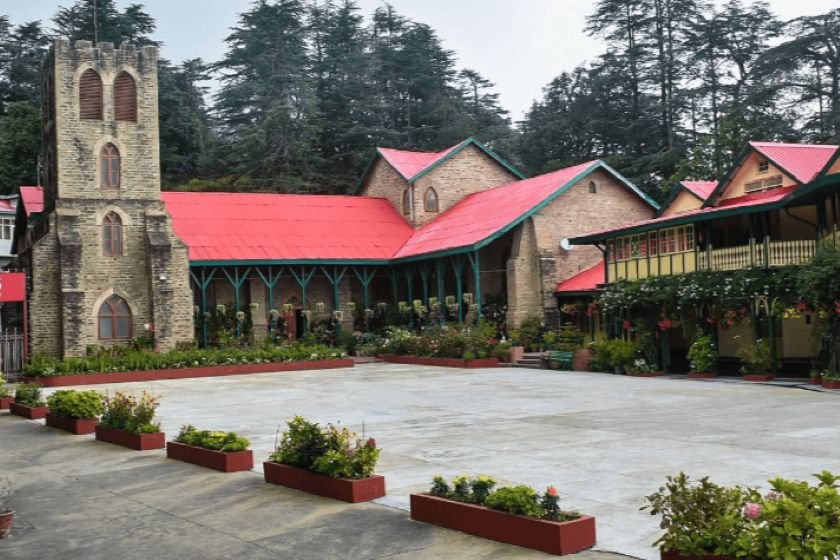
The school courtyard is bright and peaceful during the day.
Sunlight falls across the old stone buildings, red roofs and long green verandas. Tall deodar trees stand beyond the classrooms, and the sounds of students and school activity fill the open spaces.
Nothing about the campus appears frightening.
But old stories say the atmosphere changes when the gates close and the grounds become quiet.
The empty corridors grow darker. Wind moves through the trees, creating soft sounds against the roofs and windows. A distant footstep can travel farther than expected through the old buildings.
Then comes the sound that has shaped the school’s most famous legend.
Hooves striking the ground.
Slowly at first.
Then faster.
According to the story, a horseman sometimes appears near the forested road and old grounds around Chelsea. He rides through the darkness without speaking, and those who claim to have seen him say there is something terribly wrong with the figure.
The rider has no head.
There is no verified evidence that a headless horseman has ever appeared near the Convent of Jesus and Mary. The story belongs to Shimla’s collection of colonial-era ghost legends.
Yet for generations of students and residents, the legend has remained one of the city’s most memorable supernatural tales.
Convent of Jesus and Mary at a Glance
| Detail | Information |
|---|---|
| Location | Chelsea, Shimla, Himachal Pradesh |
| Commonly associated area | Chotta Shimla and Navbahar side |
| Established | 1864 |
| Type of place | Historic convent school |
| Haunted character | Headless horseman, unexplained footsteps and old campus legends |
| Present status | Active educational institution |
| Public tourist access | Not available without permission |
| Important rule | Do not enter or photograph restricted areas without authorisation |
The Sound of Hooves After Dark
The best-known ghost story associated with the convent begins on a quiet road near the school.
It is late in the evening.
Mist hangs between the trees, and the road is nearly empty. A person walking through the area hears a rhythmic sound somewhere behind.
At first, it seems distant.
A horse moving slowly along the road.
The sound grows louder.
The walker turns, expecting to see a rider approaching through the mist.
A dark horse appears between the trees.
A man sits upright in the saddle, dressed in clothing that seems to belong to another time. His body is clearly visible, but where his head should be, there is only darkness.
The horse continues forward.
The rider does not turn or speak.
The frightened witness moves away from the road, but the sound of the hooves keeps coming closer.
Then, just as the figure reaches the next bend, both horse and rider disappear.
The road becomes silent again.
No hoofprints remain.
No animal is found nearby.
Only mist moves across the empty road.
The Headless Horseman of Chelsea
The headless-horseman story has appeared in different forms.
In one version, the rider is a British soldier who died violently during the colonial period. His body was found, but his head was never recovered.
In another, he was an officer killed while travelling through the forest at night.
Some tellings claim that the rider appears only on particular evenings, while others say he can be heard whenever fog covers the road.
There is no dependable historical record identifying the horseman or confirming the death behind the legend.
The rider may have been added to the school’s folklore long after the institution was established. Headless riders appear in ghost traditions from several countries, especially in places connected with old military roads, forests and colonial buildings.
Shimla provides the ideal setting for such a story.
Dark trees.
Sudden fog.
Old bridle paths.
And buildings that have watched generations pass through their doors.
The Rider Who Never Reaches the Gate
One version of the legend tells of a person waiting near the road after sunset.
The weather had changed quickly, and mist had begun covering the trees. From somewhere below came the sound of a horse climbing towards the school.
The person waited for the rider to appear.
The hoofbeats grew louder.
They passed behind a wall.
But no horse emerged.
The sound continued along the road, even though nothing could be seen.
It reached the area near the gate.
Then it stopped.
For a few moments, there was complete silence.
The witness heard the sound of leather moving, as though someone were dismounting.
A shadow crossed the mist.
When the person looked again, the road was empty.
This account has no named witness, date or official record. Like many school legends, it survives because it has been told repeatedly.
The story becomes frightening not because it is proven, but because every generation adds someone who claims to know a person who heard the hooves.
Chelsea’s Long History
The Convent of Jesus and Mary, commonly known as Chelsea, was established in Shimla in 1864 by the Religious of Jesus and Mary.
The institution originally cared for and educated orphaned children of British soldiers. Over time, it developed into a prominent girls’ school and later transitioned from a boarding institution to a day school.
Its age is central to its haunted reputation.
More than a century and a half of students, teachers, boarders and religious sisters have lived or worked within the campus. Old dormitories, classrooms, passages and prayer spaces naturally collected stories.
Some were probably created to frighten younger students.
Others may have begun with unexplained sounds heard in old buildings at night.
A story whispered in a dormitory can become tradition within a few years.
After several generations, no one remembers where it began.
The Fire That Changed the School
A major fire in 1946 destroyed a substantial part of the school complex. Historical accounts state that approximately two-thirds of the building was affected, while the church, rectory and Victorian-style main building survived.
The fire later became part of the supernatural folklore surrounding the campus.
Some stories speak of smoke being smelled when no fire is present.
Others mention the sound of hurried footsteps in old corridors or the faint ringing of a bell during quiet hours.
These claims are not documented as paranormal events.
Old buildings can retain smells from timber, dampness, heating systems and maintenance work. Sound can also travel unpredictably through connected halls.
But once a place has survived a destructive fire, every unexplained smell of smoke feels like a warning from the past.
The Story of the Crying Girl
Another legend associated with the wider Chelsea folklore concerns the sound of a girl crying.
The voice is said to be heard near an empty corridor or older part of the grounds.
At first, the crying sounds distant.
Anyone following it believes a child may be lost or injured.
The voice moves farther away as the listener approaches.
It turns towards another corridor.
Then it stops.
No one is found.
In some versions, the voice belongs to an orphan who died during the institution’s early years.
Other versions connect it with the later boarding-school period.
There is no verified record linking a particular child to this story.
The legend may have developed from the school’s origins as an orphanage, combined with the emotional power of imagining children living far from their families.
The Figure Near the Window
Students’ ghost stories often focus on windows.
A face appears behind glass after a room has been locked.
A curtain moves even though no window is open.
A figure stands on an upper floor and disappears when someone looks again.
Chelsea’s long verandas, timber frames and shaded windows provide ideal conditions for such stories.
Reflections change as people move across a courtyard. Trees cast shadows against the glass. Curtains shift in mountain air.
From a distance, an ordinary reflection can briefly resemble a person watching from inside.
But once someone points towards a window and asks, “Who is standing there?”, everyone sees the same shape.
Even after it disappears.
Roses, Prayer and Old Campus Stories
Some versions of Chelsea’s folklore mix unsettling stories with the school’s religious setting.
The scent of flowers is sometimes said to appear unexpectedly near old passages or prayer areas. A figure resembling a nun may be noticed briefly at the end of a corridor.
These stories should be approached with care.
The school is connected with an active religious community and a functioning chapel. A nun walking through the grounds is not evidence of a haunting, and spiritual traditions should not be turned into horror entertainment.
The official history records that the chapel was built in 1873, making it an important part of the historic campus.
Religious spaces often feel quiet, emotional or powerful. Such experiences may be spiritual, psychological or simply connected with the atmosphere of the place.
They should not automatically be labelled paranormal.
What People Claim to Have Experienced
Stories connected with Chelsea commonly mention:
- the sound of horse hooves on an empty road;
- a headless rider appearing in mist;
- footsteps in old corridors;
- the smell of smoke without an obvious fire;
- a girl crying when no one is present;
- shadows near upper-floor windows;
- doors moving in old buildings;
- the feeling of being watched from a veranda.
None of these experiences has been independently verified.
Most survive as student folklore, local storytelling and haunted-place accounts repeated over time.
Why the Place Feels Mysterious
The Chelsea campus contains many features that naturally encourage ghost stories.
The buildings are old and include stone walls, timber sections, long verandas and interconnected corridors. Such structures produce creaks, knocks and echoes as temperatures change.
Shimla’s weather adds another layer.
Fog can cover the road within minutes. Trees move in strong wind, and their shadows fall across buildings and windows.
Sound travels unusually through hills.
A vehicle on another road may seem close. A horse or mule moving at a distance could be heard without being seen. Voices from lower slopes may rise through the forest.
The location’s colonial past also influences the imagination.
Once people know that the institution began during British rule and survived a major fire, every old corridor appears to contain a hidden story.
Is the Headless Horseman Story True?
There is no reliable historical or physical evidence proving that a headless horseman appears near Chelsea.
No confirmed identity has been established for the supposed rider, and the details differ widely between versions.
The legend should therefore be treated as folklore.
It may have grown from old bridle-road memories, military imagery, fog-related sightings or stories passed between generations of students.
The absence of proof does not make the tale unimportant.
Folklore reveals how people experience a place.
The headless horseman has become part of Chelsea’s unofficial mythology because the setting allows the story to survive.
Can Tourists Visit the School?
The Convent of Jesus and Mary is an active school, not a haunted tourist attraction.
Members of the public should not enter the campus without official permission.
Visitors must not approach students, enter classrooms, photograph children, climb gates or attempt to explore the property after dark.
The surrounding public roads may be used normally, subject to local traffic and access rules, but no one should block entrances or disturb the school while searching for a ghost-story location.
Respect for students, staff and the institution must take priority over paranormal curiosity.
Reaching the Chelsea Area
By Road
Chelsea is located in Shimla and is approached through the Chotta Shimla and Navbahar side of the city.
Traffic conditions, one-way restrictions and local access rules can change, so use current navigation and follow traffic-police directions.
Taxis and local buses operate across Shimla, but visitors should remember that the school itself is not open for casual tourism.
By Train
Shimla railway station is the nearest railhead.
It is connected with Kalka by the historic narrow-gauge railway. The onward journey to Chotta Shimla or Navbahar is by road.
By Air
Shimla Airport at Jubbarhatti is the nearest airport, although services may be limited and weather-dependent.
Chandigarh Airport offers broader connectivity, followed by a road journey to Shimla.
Best Time to Explore Shimla’s Colonial Heritage
March to June and September to November generally offer comfortable weather for exploring Shimla.
The monsoon brings mist and atmospheric scenery but may also cause slippery roads, poor visibility and landslide disruption.
Winter can bring snow and ice.
Anyone interested in Chelsea’s architecture or history should view the area only from legally accessible public spaces and during daylight.
Responsible Storytelling and Visiting
Because Chelsea is a working school, haunted stories must be handled responsibly.
Visitors should:
- never enter the school without permission;
- avoid photographing students or staff;
- not attempt night-time exploration;
- never spread rumours about named students, teachers or religious sisters;
- avoid disturbing prayers, classes or school activities;
- not stage ghost videos near the entrance;
- follow police, school and local traffic instructions;
- treat the institution’s religious and educational history respectfully.
A folklore article should preserve a story without turning real people into part of the entertainment.
Frequently Asked Questions
Is the Convent of Jesus and Mary in Shimla haunted?
There is no verified evidence that the school is haunted. Its reputation comes from local and student folklore involving a headless horseman, footsteps and unexplained sounds.
What is the headless-horseman legend?
The legend describes a rider without a head who is reportedly seen or heard near the forested road after dark.
Was the school originally an orphanage?
Yes. Chelsea was founded in 1864 and originally cared for orphaned children of British soldiers.
Did a fire occur at the school?
Yes. A major fire in 1946 destroyed a substantial part of the complex, while several important structures survived.
Can tourists enter the campus?
No casual tourist access should be assumed. It is an active school, and entry requires permission.
Can people visit at night to investigate the legend?
No. Unauthorised night visits would be unsafe, intrusive and inappropriate.
Is the school in Chotta Shimla?
The institution is at Chelsea in Shimla and is commonly associated with the Chotta Shimla and Navbahar side of the city.
When the Hooves Return
By day, Chelsea belongs to lessons, prayer, conversation and ordinary school life.
After the road grows quiet, the old legend takes over.
Mist gathers between the trees.
The buildings disappear behind shadow.
Then, from somewhere below, comes the sound of a horse climbing through the darkness.
One hoofbeat.
Then another.
The rider never calls out.
He never reaches the gate.
And when the mist clears, the road is empty—as though the horseman has been travelling towards Chelsea for more than a century and is still unable to arrive.