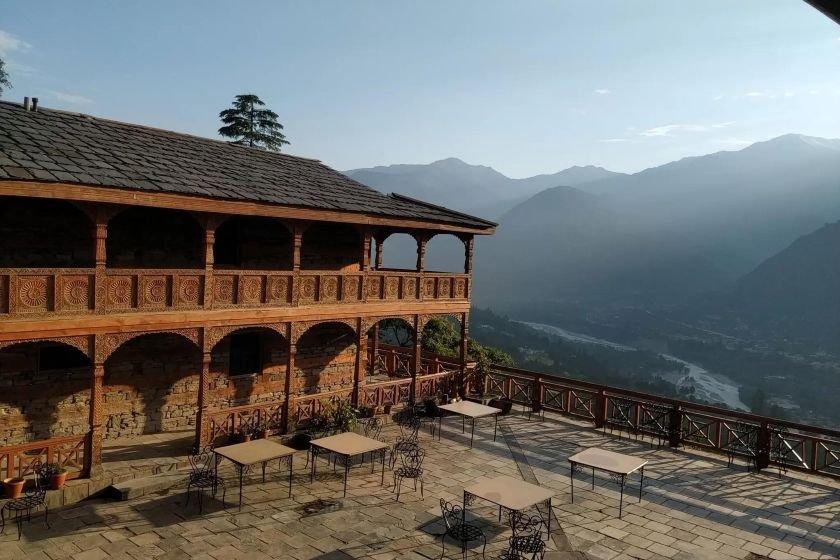
By late afternoon, the courtyard of Naggar Castle is still filled with light.
Sunshine falls across the stone floor, carved wooden balconies glow in warm shades of brown, and the mountains rise quietly beyond the edge of the terrace. Visitors pause for photographs while voices carry through the open galleries.
Nothing about the castle appears frightening.
Then the daylight begins to leave.
The far end of the corridor darkens first. Old wooden floors answer every footstep with a faint creak. Doors that looked decorative during the day begin to resemble entrances into rooms that have remained silent for centuries.
A cold breeze crosses the courtyard even when the trees outside appear still.
Somewhere inside, wood shifts.
It sounds like someone walking slowly along the upper gallery.
Naggar Castle is now a heritage hotel and one of the best-known historical attractions near Manali. Yet local folklore gives the building another identity after sunset.
Stories speak of a royal woman whose sorrow never left the castle. Guests and workers are said to have heard footsteps in empty corridors, noticed doors moving without explanation and sensed an unseen presence passing through the old rooms.
No reliable evidence proves that the castle is haunted.
But when night settles over its timber galleries, the story of the wandering Rani becomes easier to believe.
Naggar Castle at a Glance
| Detail | Information |
|---|---|
| Location | Naggar, Kullu district, Himachal Pradesh |
| Nearest major destination | Manali |
| Distance from Manali | Around 20 kilometres |
| Type of place | Medieval castle and heritage hotel |
| Built by | Raja Sidh Singh of Kullu |
| Approximate construction period | Around 1460 |
| Haunted character | A wandering Rani, footsteps and unexplained movement |
| Present use | Heritage hotel, restaurant and visitor attraction |
| Best time to visit | March to June and September to November |
| Night access | Limited to authorised guests and permitted areas |
The Woman in the Upper Corridor
The best-known supernatural story connected with Naggar Castle concerns the spirit of a Rani.
There is no single agreed version of who she was or what happened to her. Some storytellers describe her as a royal woman who lived unhappily within the castle. Others say she lost someone she loved and spent her remaining years moving quietly through its rooms.
A darker version claims that she died inside the castle before she could escape a life of sorrow.
According to the legend, her presence is felt most strongly in the upper corridors after the public areas become quiet.
People describe hearing measured footsteps moving across the wooden floor.
The sound approaches slowly.
One plank creaks.
Then another.
The footsteps continue until they appear to reach the door of an occupied room.
Then they stop.
When the door is opened, no one is standing outside.
Only the empty corridor stretches beneath the carved wooden arches.
In some accounts, a woman in traditional clothing is briefly seen at the far end of the gallery. She does not speak or look towards the observer.
She simply turns around a corner.
Anyone following her finds the next corridor empty.
The Rani is not usually described as violent. Her presence is said to feel sorrowful rather than threatening—as though she is not searching for a victim, but for something the castle took from her long ago.
The Night Someone Followed Her
One popular version of the story tells of a guest who woke after midnight to the sound of someone walking outside the room.
The footsteps were slow and distinct.
They travelled along the corridor, stopped near the door and then continued towards the staircase.
Believing another guest was wandering through the building, the person stepped outside.
A pale figure was visible near the end of the gallery.
It appeared to be a woman dressed in long, old-fashioned clothing. Her back was turned, and her face remained hidden.
She moved towards the staircase without making a sound.
The guest followed.
At the top of the stairs, the woman disappeared.
There was nowhere for her to go without passing through the courtyard below. No door had opened, and no footsteps continued down the staircase.
The guest returned to the room and locked the door.
By morning, the experience had become another version of the Rani’s story.
There is no named witness or documented report confirming this incident. Like many haunted-castle tales, it survives because it has been retold rather than proved.
Yet the architecture of Naggar Castle makes the scene easy to imagine.
A distant figure.
A dark wooden gallery.
A staircase descending into silence.
A Royal Castle Above Kullu Valley
Naggar was once an important seat of the rulers of Kullu. The castle was built by Raja Sidh Singh around 1460 and stands above the valley in the old settlement of Naggar. Today, the property is managed by the Himachal Pradesh Tourism Development Corporation as a heritage hotel.
Its construction reflects the traditional Himalayan use of wood and stone. Thick masonry walls are combined with horizontal timber beams, helping the structure withstand the difficult climate and seismic conditions of the mountains.
The carved balconies, wooden pillars, internal courtyard and sloping slate roofs give the castle a character unlike the large stone forts found in other parts of India.
The building does not dominate the landscape through size alone.
Its power comes from its position.
From the terrace, the land falls sharply towards the Beas Valley. Forested hills rise on the opposite side, and distant settlements appear small beneath the mountains.
During the day, the view feels peaceful.
After dark, the castle becomes isolated above a valley filled with scattered lights.
A Palace Filled with Memory
For generations, Naggar Castle was more than a residence.
It was a place of royal administration, ceremony, family life and political decision-making. Rulers, queens, guards, servants, priests and visitors would all have moved through its courtyards and galleries.
Royal buildings rarely preserve only stories of celebration.
They also contain memories of arranged marriages, political rivalry, separation, illness and death. People who lived behind palace walls often had little control over their own lives, regardless of their status.
This emotional history provides the foundation for the legend of the sorrowful Rani.
The story does not identify her clearly because it may not belong to one historical woman.
She may represent generations of royal women whose individual experiences disappeared from formal records.
Kings were remembered for battles, alliances and buildings.
The private grief of the women around them was more easily forgotten.
Folklore gave that grief a form.
A woman walking through the corridor.
A figure appearing beside a window.
A presence that refuses to leave the place where her name was lost.
When the Castle Changed Hands
Naggar eventually ceased to be the principal royal capital, and the political centre of the Kullu kingdom shifted to Sultanpur.
During the British period, the castle came into the possession of Major Hay, an official associated with the administration of Kullu. Historical accounts state that Raja Gyan Singh exchanged the property with him for a rifle. The building later served as a rest house before being handed to HPTDC in 1978 for use as a heritage hotel.
Every change altered the life of the castle.
Royal rooms became colonial accommodation.
Administrative spaces became guest rooms.
Private corridors opened to travellers.
Furniture changed, but the timber and stone remained.
This long transition from palace to rest house and hotel contributes to its haunted reputation. The building continues to be occupied, but not by the families for whom it was constructed.
The rooms have new purposes.
The walls still belong to another age.
The Sound of Footsteps on Wood
Many ghost stories at Naggar Castle involve sound rather than a clear apparition.
Wooden buildings are rarely silent.
Floorboards respond to pressure, temperature and moisture. Timber expands during warmer periods and contracts as the air becomes cold. Beams settle, panels shift and doors move slightly within their frames.
At night, when conversation and traffic decrease, these natural sounds become more noticeable.
A single creak can resemble a footstep.
Several creaks in sequence can sound like someone crossing a corridor.
A door moving in a draught may appear to have been pushed.
Yet people who believe the castle is haunted insist that some sounds are too regular to be explained by settling timber.
They describe footsteps with a clear rhythm.
They begin at one end of the gallery.
They approach an occupied room.
They pause.
Then they continue.
No one appears.
The Door That Opens into an Empty Passage
Another recurring story concerns doors that open without an obvious cause.
A guest closes the door before sleeping.
Later, the latch shifts.
The door moves slowly inward.
The corridor outside is empty.
In some versions, the person hears the rustling of clothing immediately before the door opens. In others, the room becomes unexpectedly cold.
Old doors can move because of air pressure, uneven floors or worn fittings. A building with multiple open galleries is especially vulnerable to strong currents of mountain air.
But when a door opens after midnight, few people begin by thinking about air pressure.
They look towards the corridor.
They wait for someone to enter.
And when no one does, the room feels less private than it did before.
The Castle Temple and Sacred Presence
A small historic temple known as the Jagti Patt is housed within the castle complex. It is associated with the deities of the Kullu Valley and holds an important place in local tradition.
According to customary belief, the sacred stone or slab connected with the temple represents the combined spiritual authority of the valley’s deities.
This religious element gives the castle another layer of meaning.
Not every unexplained presence in Himalayan tradition is considered a ghost.
A sensation of power, sudden stillness or emotional heaviness near a sacred place may be understood as divine or protective rather than paranormal.
Visitors should therefore avoid confusing local religious belief with entertainment-oriented ghost stories.
The Rani’s legend belongs to folklore.
The sacred traditions of the castle deserve separate respect.
What Guests and Visitors Report
Accounts associated with Naggar Castle commonly mention:
- footsteps moving through empty wooden corridors;
- doors opening or shifting without anyone nearby;
- the brief appearance of a woman in traditional clothing;
- shadows crossing the upper gallery;
- sudden cold air inside closed rooms;
- the feeling that someone is standing outside a door;
- soft crying or whispering heard late at night;
- the sense of being watched from the balcony.
These reports have not been independently verified.
Some may arise from the natural movement of an old building, other guests, hotel activity or sounds travelling through interconnected galleries.
The power of the legend lies not in proof, but in the setting.
A modern hotel room creates ordinary explanations.
A five-century-old royal castle makes every explanation feel incomplete.
Why Naggar Castle Feels Haunted
Naggar Castle contains nearly every element needed to create an effective ghost story.
Its wooden corridors produce sounds long after people stop moving. Rooms open onto shared balconies, allowing footsteps and voices to travel farther than expected.
Strong valley winds pass through open galleries and around doors. Temperature changes cause timber beams and floorboards to shift.
The building is also visually deceptive at night. Carved pillars and balcony railings create human-like shapes in weak light. Curtains move near windows, and shadows from the courtyard stretch across the walls.
Its history adds emotional weight.
Visitors know that rulers and royal families once occupied the same rooms. They know that the castle has outlived the people who built it and watched its original purpose disappear.
The imagination fills the empty spaces.
A moving curtain becomes a dress.
A creaking floor becomes a footstep.
A shadow becomes the Rani returning to her room.
Staying at Naggar Castle
Naggar Castle functions as an HPTDC heritage hotel, allowing guests to experience the building after ordinary daytime visitors have left. Availability, tariffs, dining arrangements and booking conditions should be confirmed through HPTDC before travelling.
Staying overnight is very different from making a daytime visit.
During the day, the courtyard remains active with tourists, restaurant guests and staff. At night, activity reduces and the age of the building becomes more noticeable.
Guests should remember that it is an operating hotel, not an abandoned haunted site.
Do not disturb other guests by knocking on doors, running through corridors or staging paranormal investigations. Restricted rooms, staff areas and closed sections must remain undisturbed.
Anyone genuinely uncomfortable with old buildings, unexplained sounds or shared wooden galleries may prefer a daytime visit.
Visiting Naggar Castle
The castle can be visited as part of a Naggar sightseeing trip. Public access may be limited to designated areas because parts of the property operate as a hotel.
The main courtyard, architecture and valley views are the principal attractions. Visitors may also combine the castle with other nearby places, including the Nicholas Roerich Art Gallery, Tripura Sundari Temple, Gauri Shankar Temple and the traditional lanes of Naggar.
Entry charges and visiting arrangements can change, so confirm the latest details at the property.
Early morning is quieter, while late afternoon offers warmer light and dramatic views across the valley.
How to Reach Naggar Castle
By Road
Naggar Castle is situated in Naggar village, approximately 20 kilometres from Manali.
Travellers from Manali can reach Naggar by taxi, private vehicle or local bus. The usual route descends towards the Kullu–Manali highway and then crosses towards Naggar through the Patlikuhal side.
Naggar is also accessible from Kullu, which lies roughly 22 kilometres away.
The final approach passes through a mountain settlement with narrow roads. Drive carefully and avoid blocking local traffic.
By Bus
Local buses connect Manali and Kullu with Naggar and nearby Patlikuhal. Service frequency may vary, particularly during winter or periods of road disruption.
From the nearest bus stop, an uphill walk or short taxi ride may be required to reach the castle.
By Air
Kullu–Manali Airport at Bhuntar is the nearest airport. It is around 35 to 40 kilometres from Naggar, depending on the route.
Flights are weather-dependent and may operate with limited frequency.
By Train
There is no direct railway connection to Naggar or Manali.
Chandigarh and Kalka are commonly used major railway points for travellers continuing by road. Jogindernagar has a narrow-gauge station but is not generally the most convenient railhead for most visitors.
Best Time to Visit Naggar Castle
March to June and September to November are generally the most comfortable periods for visiting Naggar.
Spring and early summer bring pleasant weather, green orchards and clear valley views. Autumn often offers crisp air and better mountain visibility.
The monsoon makes the landscape lush but may bring heavy rainfall, slippery roads and occasional landslide disruption.
Winter gives the castle a colder and more mysterious atmosphere. Snowfall may occur in and around Naggar, but icy roads and low temperatures can make travel difficult.
Responsible Visiting
Naggar Castle is a protected heritage property, an operating hotel and a place connected with local sacred traditions.
Visitors should:
- remain within authorised areas;
- avoid entering guest rooms or hotel sections without permission;
- keep noise low around staying guests;
- respect the Jagti Patt temple and other sacred spaces;
- avoid touching old carvings unnecessarily;
- never scratch names into timber or stone;
- obtain permission before professional filming;
- avoid staged rituals or paranormal activities;
- follow all instructions from hotel and tourism staff.
The castle’s haunted reputation does not make it public property after dark.
Only registered guests and authorised personnel should remain in hotel areas at night.
Is Naggar Castle Really Haunted?
No publicly available evidence proves that Naggar Castle is haunted.
The wandering Rani, unexplained footsteps and moving doors belong mainly to folklore and personal accounts.
The building’s age, timber construction and open galleries provide reasonable explanations for many sounds and movements.
Yet those explanations do not completely remove the atmosphere.
The castle has survived for more than five centuries. It has housed rulers, officials, travellers and generations of guests. Its original residents are gone, but their architecture continues to shape every sound made inside it.
Whether the Rani is a spirit, a symbol of forgotten royal women or simply a story created by an old building remains uncertain.
Perhaps that uncertainty is why she still walks.
Frequently Asked Questions
Is Naggar Castle considered haunted?
Naggar Castle is associated with local stories about a wandering Rani, footsteps and unexplained activity. These accounts are folklore rather than verified paranormal evidence.
Can visitors stay overnight at Naggar Castle?
Yes. The property operates as an HPTDC heritage hotel. Accommodation should be booked in advance, especially during the main tourist season.
Who built Naggar Castle?
Raja Sidh Singh of Kullu is credited with building the castle around 1460.
Where is Naggar Castle located?
It is situated in Naggar village in Kullu district, around 20 kilometres from Manali.
Can tourists explore the castle at night?
Ordinary visitors must follow the property’s visiting hours. Night access is generally limited to registered hotel guests and authorised staff.
Is the Rani’s story historically proven?
No. The identity and fate of the Rani are not established through dependable historical evidence. Her story survives primarily as local folklore.
How much time is needed for a daytime visit?
Around one to two hours is generally sufficient for the castle, although more time is useful when visiting nearby temples and the Nicholas Roerich Art Gallery.
When the Courtyard Falls Silent
During the day, Naggar Castle belongs to visitors.
Cameras click beneath the wooden balconies. Cups are placed on tables. People lean against the railing and look towards the mountains.
After darkness, the castle belongs to its sounds.
A beam shifts somewhere above.
A door moves gently in its frame.
One floorboard creaks at the far end of the gallery.
Then another answers closer to your room.
You wait for a guest to appear.
No one comes.
The footsteps stop outside the door.
For several seconds, there is only silence.
Then the sound continues along the corridor, slow and patient, as though the woman walking there has crossed the same wooden floor for centuries—and knows she has nowhere else to go.