She saw his face only once, asleep, and loved him before she knew his name — and that single dream nearly started a war between gods.
There are two Ushas in Hindu tradition, and this temple, whether it means to or not, seems to honor both at once. One is Ushas, the ancient Vedic goddess of dawn, consort of the sun. The other is a very different figure entirely — a demon king’s daughter who fell in love with a stranger she’d only seen in sleep, and whose romance nearly tore two kingdoms apart. In the quiet forests of Nichar, in Kinnaur, both goddesses seem to have settled into the same small temple, and nobody here seems especially bothered by the overlap.
🌄 Location & How to Reach It
The temple sits at Nichar, in Nichar tehsil of Kinnaur district, roughly 38 km from Sarahan, 68 km from Rampur, and 16 km from Bhabanagar — deep enough into Kinnaur that the drive itself, through dense fir, alpine, and deodar forest via Kangosh village, is part of the experience rather than a formality before it. The temple sits at an elevation of around 2,086 meters.
Google Maps: Get Directions
- By road: Reached via a genuinely adventurous drive through Kangosh en route to Nichar — narrow hill roads, dense forest, and real elevation change. Not a casual detour.
- By rail: No direct rail access; Shimla is the nearest practical railhead, several hours away.
- By air: Shimla Airport is closest, though most travelers arrive via Chandigarh and drive up through the Sutlej valley.
Compared to Kinnaur’s true high-altitude pilgrimages — places like Rangrik Tungma near the Tibet border — this one is moderate: a proper hill drive rather than a trek, but still remote enough to reward the effort.
🌸 Best Time to Visit
No formal published temple timings exist for Nichar — this is a village shrine rather than a managed pilgrimage site, so visiting hours follow local rhythm rather than a printed schedule. The forest surroundings make the shoulder seasons especially pleasant; heavy winter snow can complicate the drive, so late spring through autumn is the more comfortable window.
🕉️ The Dream That Started a War
The older, richer story behind this goddess belongs to a different tradition than her “dawn” name suggests. This Usha was the daughter of Banasura, a powerful demon king devoted to Shiva, who ruled from the city of Shonitpur. One night she dreamed of a handsome young man she had never met — and woke unable to think of anything else. Her friend and companion, Chitralekha, gifted with the ability to draw with near-magical precision, sketched portrait after portrait of princes and gods until Usha finally pointed to one and said: him. The face belonged to Aniruddha, grandson of Krishna, living far away in Dwarka.
Chitralekha didn’t stop at drawing him. Using her own mystical powers, she brought Aniruddha bodily from Dwarka to Shonitpur in secret, and the two young lovers were finally, briefly, together — outside the knowledge or blessing of either family. It didn’t stay secret. Banasura discovered the young man in his daughter’s chambers and had him imprisoned, and word reached Krishna’s court that his grandson was being held captive by a demon king. What followed was a war — Krishna, Balarama, and Pradyumna marching against Banasura, who fought back with Shiva’s own backing, since the demon king had long been one of Shiva’s most devoted followers. It took a clash between two of Hinduism’s greatest powers to finally end it, and only once the fighting was resolved were Usha and Aniruddha allowed to marry.
It’s worth being honest about something here: this romance belongs to the Puranic Usha, daughter of Banasura — a genuinely different figure from Ushas, the older Vedic dawn goddess and consort of Surya that some sources call this same Nichar deity. Local tradition appears to have merged the two under one name and one temple, and rather than try to force them apart, it’s more honest to simply say: this is a goddess who has absorbed two very different stories into a single presence.
🙏 What the Goddess Is Known For
Locally, Usha Devi is understood primarily through the second story — as one of the many daughters of Banasura, this particular stretch of Kinnaur said to have become hers when the demon king divided the region among his children, much as neighboring Sairag went to her sister Chandika. She’s also known, more unusually, as the sister of Sungra Maheshwar — the Shiva deity worshipped at the nearby 8th-century Maheshwar Temple in Sungra village — giving this small corner of Kinnaur its own family of related deities watching over neighboring villages.
One tradition here stands out as genuinely unlike anything at the area’s other temples: athletes and teams who win trophies in sports or other competitions bring them to this temple and leave them there permanently, rather than taking them home. It’s a quiet, specific custom — success treated as something to offer up rather than keep — and it says something about how this goddess is understood locally: less a granter of comfort, more a keeper of achievement.
🏛️ The Temple Itself
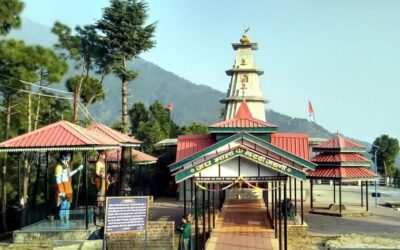
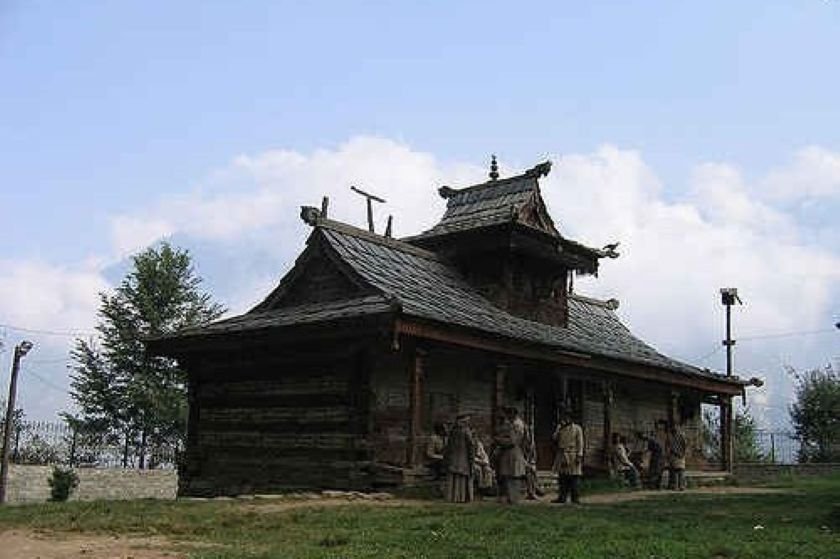
The complex sits inside a walled compound guarded by colorfully painted tiger figures, and contains four ancient structures alongside a newer temple dedicated to Shiva. The main sanctum’s wooden door carries inscriptions in several scripts, including the old Takri script, alongside carved brass images of deities. Inside, walls and pillars are worked with detailed colored carvings, and the murti of Usha Devi herself bears traces of gold, worn smooth by generations of devotion. The temple is also known locally as Ukha Temple — a colloquial variant of her name.
📜 A Family Scattered Across Kinnaur
Usha Devi’s presence here fits into a larger pattern found across this part of Kinnaur: Banasura’s many children, by tradition numbering eighteen, are said to have divided the region among themselves, each claiming a portion and each still worshipped locally as that territory’s guardian. Chandika took Sairag; Usha took Nichar. It turns Kinnaur’s religious geography into something closer to a family map than a scattered collection of unrelated shrines — siblings, in myth, still quietly watching over neighboring valleys.
🎉 Festivals and Devotion
Specific annual festival dates for this temple aren’t well documented in available sources — worship here appears to follow the broader rhythm of Kinnaur’s devta tradition and local village calendar rather than a single widely publicized mela. The trophy-offering custom continues year-round rather than being tied to one date.
🏞️ While You’re in the Area
- Maheshwar Temple, Sungra — the 8th-century Shiva shrine belonging to Usha Devi’s own “brother” deity, a short distance away
- Bhabanagar & Nichar villages — known for their orchards and traditional Kinnauri homes
- Kinnaur Kailash Viewpoint — a sacred peak associated with Shiva, visible from parts of this stretch of the valley
- Sarahan — home to the Bhimakali Temple, a significant detour but a natural pairing for a Kinnaur temple circuit
❓ Quick Questions Travellers Ask
Is Usha Devi the dawn goddess or the daughter of Banasura? Sources genuinely differ — some describe her as Ushas, the Vedic dawn goddess and Surya’s consort, others as the Puranic Usha, daughter of Banasura and wife of Aniruddha. Local tradition appears to honor both under one name.
What’s the trophy tradition about? Athletes and teams who win competitions leave their trophies at the temple permanently rather than bringing them home — a distinctive local custom not documented at other nearby shrines.
Is there accommodation nearby? Yes — a Forest Department rest house is available near the temple.
How difficult is the drive to Nichar? Genuinely challenging by most accounts — narrow hill roads through dense forest via Kangosh village — though manageable by car in good weather.
Is there an entry fee? No entry fee is documented; it functions as a community village temple.
A Last Word
There’s something fitting about a goddess who carries two different stories inside one name — dawn and desire, the quiet accumulation of light and the reckless leap of falling for someone in a dream. Standing before her gold-traced murti, surrounded by silent trophies nobody ever took back home, it’s hard not to think that both versions of Usha are really saying the same thing: that some things, once given, are meant to stay given.
Fact-check note: Usha Devi’s identity is genuinely conflated across sources — some describe her as the Vedic dawn goddess Ushas, others as the Puranic princess-daughter of Banasura who married Aniruddha; this piece presents both rather than resolving them into one, since local tradition itself doesn’t appear to distinguish them. The temple’s coordinates (31°33’11″N, 77°58’46″E) come from Wikimapia, a crowd-sourced source, cross-checked against a Google Plus Code (HX3H+6RM, Nigani) from Wanderlog pointing to the same village area — reasonably consistent, though neither is an official temple-authority source. Elevation (2,086 m) comes from a single visitor account and should be treated as approximate. No formal festival calendar or temple timings were found in available sources and are honestly described as undocumented rather than invented. This is the second article the site has run on this temple; the existing piece (“The Dawn Goddess of the Eastern Hills”) appears to center the Surya-consort/dawn framing — this piece instead leads with the Usha-Aniruddha Puranic romance and the trophy-offering custom, neither emphasized in the title of the earlier piece.