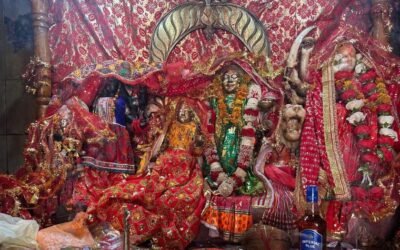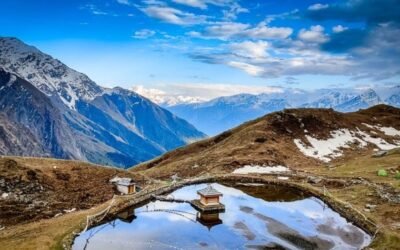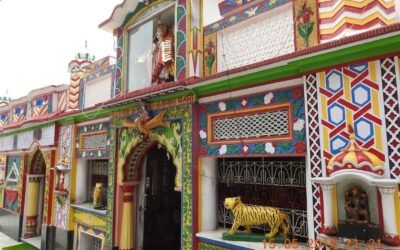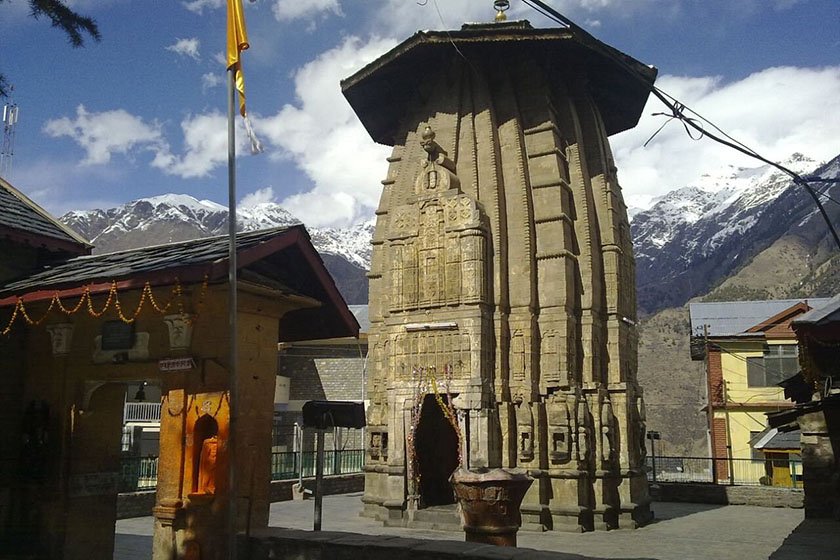
In the middle of Bharmour’s Chaurasi Temple Complex, where Shiva’s presence dominates almost every corner, one stone shrine belongs to Vishnu in his most untamed form — half-man, half-lion, and impossible to ignore.
Some temple complexes have one clear centre. Bharmour’s Chaurasi Temple Complex is more like a sacred village gathered inside a courtyard. Shiva is everywhere here — in the Manimahesh shrine, in the old lingas, in the larger memory of Manimahesh Kailash rising beyond the town. But tucked within this Shaiva landscape stands a temple that shifts the mood sharply.
This is the Narsingh Temple, dedicated to Lord Narasimha, the fierce man-lion incarnation of Lord Vishnu. It does not need to be the largest shrine in Chaurasi to feel important. Its power comes from contrast. In a complex shaped by Shiva, Shakti, Dharamraj, Ganesh, and the old ritual geography of Bharmour, Narsingh stands as a reminder that Himalayan sacred spaces rarely follow neat categories. They collect gods, stories, dynasties, fears, protections, and local memory — and let all of them remain.
🌄 Location & How to Reach It
Narsingh Temple stands inside the Chaurasi Temple Complex in Bharmour, a historic town in Chamba district, Himachal Pradesh. The complex lies in the heart of Bharmour town, not far from the route used by pilgrims heading towards Manimahesh Lake, and the temple is surrounded by other major shrines such as Manimahesh Temple, Lakshana Devi Temple, Ganesh Temple, Nandi Temple, and Dharmeshwar Mahadev / Dharamraj Temple. Bharmour itself is widely associated with the old Brahmapura, the ancient capital region of Chamba before power later shifted towards Chamba town.
Google Maps: Get Directions
Elevation: around 2,100–2,200 metres, with nearby Bharmour-area sources usually placing the town in this range.
- By road: Bharmour is reached by road from Chamba, usually around 60–65 km depending on the route reference. Buses and taxis run from Chamba, but road conditions can change in the hills, especially during monsoon or winter. Pilgrims travelling further towards Hadsar and Manimahesh usually pass through Bharmour.
- By rail: The nearest practical railhead for most travellers is Pathankot, followed by a long road journey through Chamba towards Bharmour.
- By air: The nearest commonly used airport is Gaggal Airport near Kangra / Dharamshala, though the onward journey still requires several hours by road. Some travellers also approach through Jammu, Amritsar, or Chandigarh depending on the larger itinerary.
Compared with Manimahesh Lake, Narsingh Temple is very easy to reach once you are in Bharmour. The sacred effort here is not a trek — it is the slower work of standing inside Chaurasi and noticing how many layers of faith share the same ground.
🌸 Best Time to Visit
The most comfortable time to visit Narsingh Temple is usually April to October, when Bharmour is easier to access and the surrounding region is active with pilgrimage, village life, and travel towards Manimahesh. The temple complex can be visited outside the main season too, but winter conditions in Chamba’s higher belt can make travel colder and less predictable.
The busiest period comes around the Manimahesh Yatra, especially during the fair held around Bhadon, when thousands of pilgrims move through Bharmour on their way to the sacred lake. For devotees, that season gives Chaurasi its fullest public energy. For travellers who want quiet architecture and unhurried darshan, the days just before or after the peak yatra period may feel better.
There is no need to rush the visit. Chaurasi is not a single-shrine stop. Keep at least one to two hours for the wider complex, especially if you want to see Narsingh Temple along with Manimahesh, Lakshana Devi, Ganesh, Nandi, and Dharamraj.
🕉️ The Man-Lion in a Court of Shiva
Lord Narsingh — more commonly written in Sanskrit as Narasimha — is one of Vishnu’s most dramatic forms. He is neither fully human nor fully animal. He appears as half-man and half-lion, tearing through the limits of ordinary categories because the demon king Hiranyakashipu had tried to protect himself through exactly such categories.
The famous Puranic story is simple in its structure and terrifying in its force. Hiranyakashipu believed he had made himself nearly impossible to kill. Not by man or beast. Not indoors or outdoors. Not by day or night. Not on earth or in the sky. Not by ordinary weapons. His son Prahlad, however, remained devoted to Vishnu, and when the king challenged that devotion, Vishnu appeared in a form no condition had accounted for.
Narasimha emerged at twilight, neither day nor night. He appeared on a threshold, neither inside nor outside. He placed the demon on his lap, neither earth nor sky. He was neither man nor beast. And he destroyed arrogance without needing a conventional weapon.
That is the emotional meaning Narsingh carries into Bharmour. He is not only a form of anger. He is divine protection when injustice becomes too clever for ordinary justice.
Inside the Chaurasi complex, this story gains a local force. Surrounded by Shiva shrines and the Manimahesh pilgrimage world, Narsingh does not feel out of place. He feels like a necessary guardian — a fierce Vaishnava presence standing watch in a landscape otherwise shaped by Shaiva devotion.
🏛️ A Stone Shrine With a Fierce Geometry
Narsingh Temple is not a sprawling monument. Its strength lies in its compact, old, stone-built presence. The Archaeological Survey of India has described the temple as following a tri-anga layout, with architectural projections known as Bhadra, Pratiratha, and Karna. These are not decorative labels. They tell us that the temple was planned through a classical temple-architecture grammar, where the wall surface is shaped by projecting vertical divisions rather than treated as a flat box.
In simpler terms, the temple has a body with rhythm. Its walls step forward and back. Its form holds shadow. Even before a visitor understands the technical language, the building gives the impression of an old shrine made with rules, not accident.
The temple belongs visually to the Chaurasi world: stone, weathering, mountain air, and the feeling of a structure that has stood through many rounds of repair, worship, and seasonal change. Nearby shrines, especially the Manimahesh Temple, help set the architectural mood — a Himalayan sacred complex where small temples do not stand alone, but speak to one another across a shared courtyard.
The deity’s fierce identity also changes how the temple is seen. A peaceful Vishnu shrine invites one kind of attention. A Narsingh shrine asks for another. The stone feels less like ornament and more like containment — as though the architecture itself has been built to hold an energy that cannot be made soft.
🙏 What Devotees Seek Here
Devotees come to Narsingh Temple for protection, courage, justice, removal of fear, and blessings against harmful forces. Narasimha is widely worshipped as a deity who protects sincere devotion and punishes arrogance, cruelty, and abuse of power. His story with Prahlad gives the shrine its emotional centre: the vulnerable child protected, the tyrant defeated, the impossible promise broken by divine intelligence.
In Bharmour, this protection feels especially connected to the old pilgrimage landscape. People do not usually come to Chaurasi for only one shrine. They move through the complex, offering respect to multiple deities. A devotee may bow before Shiva at Manimahesh Temple, pause before Lakshana Devi, notice the Nandi, and then come to Narsingh with a different prayer — not only for peace, but for strength.
That is what makes the temple important even if it is not the largest in the complex. Narsingh fills a particular spiritual role. He is not the central ruler of Chaurasi’s sacred order, but he is one of its guardians.
📜 Bharmour, Chaurasi, and the Memory of Brahmapura
To understand Narsingh Temple, the wider Chaurasi setting matters as much as the shrine itself.
Bharmour is one of Himachal’s older sacred towns. It is associated with Brahmapura, the early capital region of Chamba, and the Chaurasi complex is often described as dating back around 1,400 years, with its origins linked to the early medieval period. The name Chaurasi means eighty-four, and the complex is traditionally understood as a group of 84 shrines gathered in the centre of Bharmour.
Local tradition connects the complex with 84 siddhas or yogis who are said to have passed through Bharmour on their way towards Manimahesh. The story says they stayed, meditated, and blessed the ruler. Whether one reads this as history or sacred memory, it explains why the complex is not organised like a single temple compound. It feels more like a spiritual assembly — a place where different powers arrived and stayed.
The major shrines reinforce that feeling. Manimahesh Temple stands at the centre with its Shiva linga. Lakshana Devi Temple preserves one of the most important old goddess traditions of the region. Dharamraj / Dharmeshwar Mahadev Temple gives the complex its unusual association with death, judgement, and the afterlife. Ganesh Temple marks auspicious beginnings. And Narsingh Temple adds Vishnu’s fierce protective form to the same sacred field.
That is the real significance of the Narsingh shrine. It is not isolated Vaishnavism. It is Vaishnavism inside a larger Himalayan mandala of gods.
🏛️ The Chaurasi Atmosphere Around the Temple
A visit to Narsingh Temple is rarely only about Narsingh. The atmosphere of Chaurasi surrounds it completely.
The courtyard is open, stone-paved, and framed by temples of different sizes and ages. Some shrines feel ancient and heavy; others are smaller, quieter, and easier to miss. Bells sound from one side. A priest may be busy in another shrine. Pilgrims cross the open ground in no single straight line, because the complex invites circling, pausing, and returning.
In the morning, the air is usually clearer and the town quieter. The mountains around Bharmour hold the light differently from the lower valleys of Chamba. There is a coolness in the stone, a faint smell of incense and oil, and the steady feeling of a place where worship has become part of ordinary town life.
This is what makes Chaurasi powerful. It is not sealed away from Bharmour. It is Bharmour’s sacred centre. People pass through it, gather around it, and orient memory through it. Narsingh Temple gains from that setting. Its fierce deity does not stand in wilderness or on a cliff, but inside a lived religious courtyard where every shrine adds another layer.
🎉 Festivals and Devotion
- Manimahesh Yatra: The most important pilgrimage season for Bharmour is tied to Manimahesh Lake, situated about 26 km from Bharmour in the Budhil valley. During the yatra period, Bharmour and the Chaurasi complex become major stopping points for pilgrims.
- Bhadon Fair: The official Chamba district page notes that a large fair is held at Manimahesh Lake on the eighth day of the light half of Bhadon, drawing thousands of devotees. Bharmour becomes part of that larger devotional movement.
- Chaurasi Darshan: Many pilgrims pay respect at the Chaurasi temples before proceeding towards Manimahesh. Narsingh Temple is best understood within that wider circuit, not as a standalone stop.
- Narasimha Jayanti: As a Vishnu/Narasimha shrine, the temple may be especially meaningful around Narasimha Jayanti, though specific local observance details for this Bharmour shrine should be confirmed locally before planning around it.
- Everyday Worship: Outside the yatra period, the temple’s quieter strength is easier to feel. A brief darshan, a lamp, a bell, and a prayer for protection may say more than a crowded festival day.
🏞️ While You’re in the Area
- Manimahesh Temple, Chaurasi Complex: The central Shiva shrine of the complex and the main ritual anchor of Bharmour’s sacred geography.
- Lakshana Devi Temple: One of Bharmour’s most important old shrines, known for its deep antiquity and its association with the goddess in a powerful form.
- Dharamraj / Dharmeshwar Mahadev Temple: A rare and unusual shrine connected with Dharamraj/Yama traditions, adding a distinctive afterlife dimension to Chaurasi.
- Bharmani Mata Temple: Located above Bharmour, traditionally connected with purification before the Manimahesh pilgrimage.
- Manimahesh Lake: The great pilgrimage destination beyond Bharmour, reached from the Hadsar side and associated with Lord Shiva and Manimahesh Kailash.
- Chamba Town: Useful for wider heritage context, accommodation, transport connections, and visits to other major Chamba temples.
🙏 Getting in Touch
Narsingh Temple does not appear to have a separate formal visitor office or booking system. Since it is part of the Chaurasi Temple Complex, the practical approach is to ask locally in Bharmour town about priest availability, festival days, and any current restrictions.
For road conditions, especially during monsoon, winter, or Manimahesh Yatra season, check with local taxi drivers, accommodation owners, or Chamba/Bharmour administration updates before travelling. The Chamba–Bharmour road is a mountain route, and conditions can change quickly.
Visitors should dress modestly, avoid loud behaviour in the courtyard, and treat the smaller shrines with the same respect as the famous central ones.
❓ Quick Questions Travellers Ask
Where is Narsingh Temple located?
It is inside the Chaurasi Temple Complex in Bharmour, Chamba district, Himachal Pradesh.
Which deity is worshipped at Narsingh Temple?
The temple is dedicated to Lord Narsingh / Narasimha, the half-man, half-lion incarnation of Lord Vishnu.
Is Narsingh Temple part of the Chaurasi temples?
Yes. It is one of the important shrines within Bharmour’s Chaurasi Temple Complex.
How far is Bharmour from Chamba?
Bharmour is usually described as about 60–65 km from Chamba by road, depending on the route reference.
Can I visit Narsingh Temple with Manimahesh Temple?
Yes. Both are within the Chaurasi Temple Complex, so they can easily be visited together during the same stop in Bharmour.
A Last Word
Narsingh Temple is easy to miss if you enter Chaurasi looking only for the biggest shrine. But that would be a mistake.
Its importance lies in the tension it brings to the courtyard. Here, among Shiva’s temples and Manimahesh memory, Vishnu appears not as the calm preserver but as the fierce protector who breaks every false certainty. The man-lion form stands for the moment when devotion is defended, arrogance is torn open, and justice arrives in a shape no one expected.
That is why Narsingh belongs in Bharmour. Chaurasi is not a simple place. It is a gathering of powers. And in that gathering, the fierce guardian has his own seat.
Fact-check note: Narsingh Temple’s location inside the Chaurasi Temple Complex at Bharmour and its dedication to Lord Narasimha / Narsingh, the man-lion incarnation of Vishnu, are consistently supported across available sources. Himachal Tourism and Incredible India support the wider Chaurasi context: Bharmour’s historic temple complex, its association with 84 shrines, and its broad dating to roughly 1,400 years / 7th century tradition. The Archaeological Survey of India has separately described Narsingh Temple’s tri-anga layout with Bhadra, Pratiratha, and Karna projections. Exact construction date, patron names, and full icon details for this specific shrine are thinly documented online, so this draft does not force a precise founding year. Elevation is given as an approximate Bharmour-area range rather than a survey-certified temple figure.