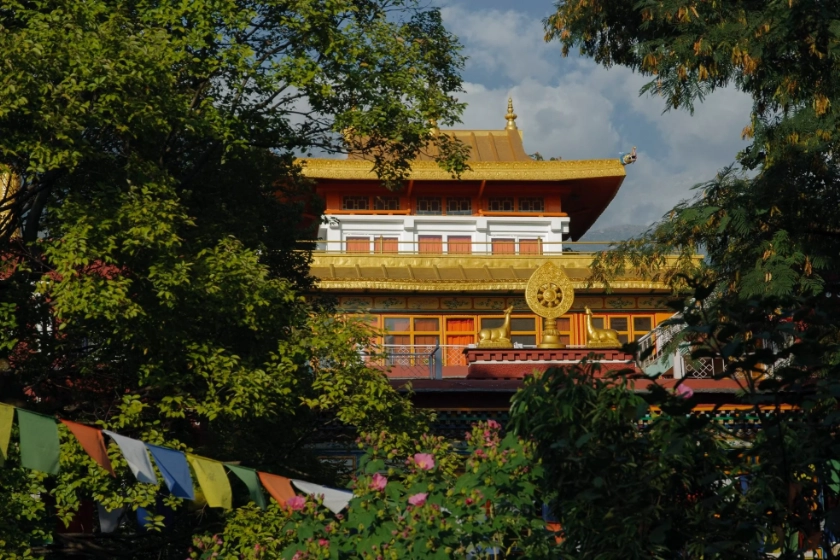
In Sidhpur near Dharamshala, Deden Tsuglagkhang stands at the heart of Norbulingka Institute, where Tibetan art is not displayed like a museum object but practised as a living sacred discipline.
Some temples are built first, and art is added later. Deden Tsuglagkhang feels different. Here, the temple itself is the result of art, apprenticeship, devotion, and cultural survival. It stands inside Norbulingka Institute of Tibetan Culture at Sidhpur near Dharamshala, an institute created to preserve Tibetan arts, crafts, literature, and cultural knowledge in exile. The main temple, known as Deden Tsuglagkhang or the Seat of Happiness Temple, is the spiritual centre of the campus. Its murals, woodwork, gilded copper Buddha, painted surfaces, and sacred geometry show what Norbulingka is really about: not only remembering Tibet, but continuing to make Tibet’s artistic and devotional world by hand.
🌄 Location & How to Reach It
Norbulingka Institute and Deden Tsuglagkhang Temple are located at Sidhpur, near Dharamshala in Kangra district, Himachal Pradesh. The institute’s official address is PO Sidhpur, Dharamshala 176057, Himachal Pradesh, India. It lies below the higher McLeod Ganj area, closer to the Sidhpur–Sidhbari side of Dharamshala, with the Dhauladhar mountains forming the wider backdrop.
Google Maps: Get Directions
- By road: The usual approach is through Dharamshala – Sidhpur / Sidhbari, or from Gaggal / Kangra side towards Dharamshala and Sidhpur. Taxis and local vehicles are easily available from Dharamshala, McLeod Ganj, Gaggal, and Palampur side.
- By rail: The nearest broad-gauge railway station is Pathankot, followed by road travel to Kangra, Dharamshala, and Sidhpur. The Kangra Valley narrow-gauge railway also serves parts of the region, but most long-distance travellers use Pathankot.
- By air: The nearest airport is Gaggal Airport / Kangra Airport, followed by a road journey towards Dharamshala and Sidhpur. Incredible India also lists Kangra Airport and Chandigarh Airport as major air access points for Norbulingka.
This is an easy road-accessible visit once you are in Dharamshala. It is calmer than McLeod Ganj’s main temple area and better suited for slow walking, art observation, and a quieter understanding of Tibetan culture in exile.
🌸 Best Time to Visit
The best months to visit Norbulingka Institute are usually March to June and September to November. Spring and early summer are good for walking through the gardens, visiting the temple, seeing the workshops, and combining the visit with nearby Sidhbari, Gyuto Monastery, McLeod Ganj, or Palampur. Autumn brings clearer skies, pleasant weather, and softer light for the gardens and temple exterior.
Monsoon can be lush and beautiful, but Dharamshala receives heavy rainfall. July and August may bring slippery paths, mist, traffic delays, and road disruption. Winter is quieter and can be a good time for those who prefer fewer crowds, though mornings and evenings are cold.
Incredible India lists Norbulingka’s visiting hours as 9:00 AM to 5:30 PM, Monday to Saturday, and notes that it is closed on Sundays. Timings, fees, and access to workshops can change, so visitors should confirm current details through Norbulingka’s official channels before making a special trip.
🕉️ The Seat of Happiness at the Centre of Norbulingka
Deden Tsuglagkhang is often translated as the Seat of Happiness Temple. It is the main temple of Norbulingka Institute and the spiritual centre around which the campus is organised. Norbulingka’s own website lists Deden Tsuglagkhang among the main visitor experiences, while an older Norbulingka exhibit page describes it as the visual focal point and spiritual centre of the institute.
That description is important. Norbulingka is not only a craft campus with a temple attached. The temple is the heart. The workshops, gardens, museum, studios, library, and research work all gather meaning from the same purpose: preserving Tibetan cultural forms in a way that remains alive, useful, and sacred.
The word “happiness” here should not be understood lightly. In Tibetan Buddhist culture, happiness is not only comfort. It is connected with refuge, continuity, right practice, beauty, compassion, and the ability to keep one’s tradition alive after displacement. Deden Tsuglagkhang stands as a place where art becomes part of that healing.
🕉️ A Temple Built by the Hands of Its Own Artists
Deden Tsuglagkhang is especially meaningful because its sacred art was made by Norbulingka’s own master artists and apprentices. Incredible India notes that the temple’s thangkas, woodwork, and statuary were produced by the institute’s in-house artisans.
This makes the temple more than a finished religious building. It is also a demonstration of what Norbulingka was created to protect. The carving, painting, metalwork, gilding, and design are not imported decoration. They are living skills being taught, practised, and passed on.
Norbulingka’s official site says the institute believes in the preservation and continuation of Tibetan art through self-sustaining means, and that under master artists it provides ancestral knowledge, jobs, and training to a community of more than 300 Tibetans.
When a visitor stands inside Deden Tsuglagkhang, this background matters. The temple is not only something to admire. It is evidence that a cultural tradition can survive by continuing to work with its hands.
🙏 What Deden Tsuglagkhang Temple Is Known For
Deden Tsuglagkhang is known for its large temple hall, its richly painted interiors, and its central image of Buddha Shakyamuni. The older Norbulingka exhibit page describes the main hall as 44 feet high and says it contains 1,173 images of the Buddha, along with paintings of the twelve deeds of the Buddha, the fourteen incarnations of the Dalai Lama, and many saints, sages, and teachers. It also identifies the main statue as a gilded copper image of Buddha Shakyamuni, made by Norbulingka statue-making master Penpa Dorje.
The official Kangra district page describes Deden Tsuglagkhang as a two-storey temple with intricate murals, frescoes, and a large 4-metre gilded copper statue of Sakyamuni Buddha.
These details explain why the temple is not just a campus attraction. It is one of the most important places in Dharamshala for seeing how Tibetan religious art functions inside a sacred space. Every surface has meaning. The Buddha image, murals, painted life histories, symbolic colours, and crafted details are all part of a visual teaching.
🏛️ The Temple Hall, the Buddha, and the Murals
The first impression inside Deden Tsuglagkhang is scale. The hall opens upward, and the gaze naturally moves towards the large Buddha Shakyamuni statue. The copper and gold surface gives the image warmth, while the surrounding paintings turn the hall into a complete sacred environment.
The murals are not background decoration. Tibetan Buddhist painting is full of order, hierarchy, symbolism, lineage, and teaching. The repeated images of the Buddha remind the viewer that enlightenment is not only one event but a presence repeated across space, practice, and mind. The scenes from the life of the Buddha and the Dalai Lama incarnations connect the temple to both classical Buddhist tradition and Tibetan historical memory.
Behind the statue, sculpted clay images decorate the arch, adding another layer of craftsmanship. The Norbulingka exhibit page describes the temple as a tribute to artists who worked for more than a year, sometimes long into the night, to complete it.
That human effort is easy to miss if one only takes a quick photograph. The temple is not only beautiful because of the final result. It is beautiful because of the discipline that made it.
📜 Norbulingka: A Tibetan Cultural World Rebuilt in Exile
The Norbulingka Institute was founded to preserve Tibetan culture after exile. The Central Tibetan Administration notes that it was originally founded in 1988 by Kalon Trisur Kelsang Yeshi and Kim Yeshi at Sidhpur near Dharamshala, and officially inaugurated by His Holiness the Dalai Lama in 1995. It describes the institute as dedicated to preserving Tibetan culture in its literary and artistic forms.
The official Kangra district page also describes Norbulingka as a cultural and artistic centre dedicated to preserving Tibetan arts, crafts, literature, and culture in exile. It says the name Norbulingka means Treasure Garden or Jewelled Park, inspired by the historic summer palace of the Dalai Lamas in Lhasa, Tibet.
That name is carefully chosen. The Norbulingka in Lhasa was once connected with the Dalai Lamas’ summer residence. The Norbulingka in Dharamshala is not a palace, but it carries the memory of that lost cultural landscape into India. Its gardens, workshops, temple, museum, and study spaces create a new Tibetan cultural environment in exile.
Deden Tsuglagkhang is the temple at the centre of that environment. It gives the institute a sacred axis.
🎨 Workshops, Gardens, and the Art Around the Temple
A visit to Deden Tsuglagkhang should not end at the temple door. Norbulingka’s meaning is best understood by walking through the whole campus. Incredible India describes the institute as a dynamic space of learning and making, where visitors can witness the continued practice of authentic Tibetan traditions in India. It also notes workshops connected with thangka painting, appliqué, statue-making, woodwork, tailoring, and other art forms.
The gardens are also part of the experience. The campus is known for landscaped paths, water channels, small bridges, ponds, and Tibetan-style architecture placed in a calm garden setting. The result is very different from a crowded town monastery. Norbulingka asks visitors to slow down.
This matters because Tibetan art is not meant to be consumed quickly. A thangka takes time. A statue takes time. Wood carving takes time. The temple teaches the same lesson through space: walk slowly, look carefully, and understand that beauty here is a disciplined practice.
🧵 Losel Doll Museum and the Everyday Life of Tibet
Norbulingka is also known for the Losel Doll Museum, located within the campus. The official Kangra district page says the museum features dioramas with miniature dolls in traditional Tibetan costumes, showing folk tales, daily life, and cultural scenes.
This museum is important because it shows another side of Tibetan heritage. Deden Tsuglagkhang presents the sacred world: Buddha, lineage, murals, temple art, and devotional space. The doll museum presents social life: clothing, occupations, festivals, regions, and everyday cultural identity.
Together, they make Norbulingka more complete. A culture survives not only through temples, and not only through museums. It survives through both sacred forms and ordinary details — how people worship, dress, paint, carve, sew, tell stories, and remember where they came from.
🙏 What Visitors Should Experience Here
A good visit to Norbulingka should include the temple, the gardens, the workshops, the doll museum, and the shop or studio spaces where traditional crafts are available. The aim should not be to “cover” the institute quickly. The aim should be to understand how one place can hold prayer, art, training, livelihood, and memory together.
Start with Deden Tsuglagkhang. Sit quietly if allowed. Look at the Buddha image and murals without rushing. Then walk through the gardens and workshops. Watch artisans at work respectfully, without interrupting or treating them as a performance. If you buy something, understand that the purchase supports a living craft tradition rather than only a souvenir market.
This is what makes Norbulingka different from many tourist stops around Dharamshala. It gives visitors a way to see Tibetan culture being made in the present tense.
🎉 Festivals, Learning, and Devotion
- Deden Tsuglagkhang Temple: The main sacred space of Norbulingka, known for the large Buddha Shakyamuni statue, murals, and Tibetan religious art.
- Traditional Tibetan Workshops: Visitors can see art forms such as thangka painting, appliqué, statue making, wood carving, wood painting, and tailoring being practised by trained artisans.
- Losel Doll Museum: A cultural museum inside the campus showing Tibetan dress, daily life, folk scenes, and regional identity through detailed dolls and dioramas.
- Norbulingka Festival / Cultural Events: Norbulingka holds cultural programmes and institute events at different times; check current announcements before planning around a specific event.
- Respectful Conduct: Speak softly in the temple, avoid touching murals or statues, ask before photographing interiors or artisans, and do not disturb workshop activity.
🏞️ While You’re in the Area
- Gyuto Tantric Monastery: A major Gelugpa tantric monastery in nearby Sidhbari, known for its yellow buildings and deep chanting tradition.
- Dolma Ling Nunnery: A nearby Tibetan Buddhist nunnery connected with women’s monastic education and Tibetan religious life in exile.
- Chinmaya Tapovan / Sandeepany Himalayas: A major Hindu spiritual ashram in Sidhbari, showing the multi-tradition sacred character of the area.
- Aghanjar Mahadev Temple: A Shiva temple near Khanyara, useful for travellers exploring sacred sites below Dharamshala.
- Tsuglagkhang / Dalai Lama Temple Complex: The main Tibetan temple complex in McLeod Ganj, connected with His Holiness the Dalai Lama.
- Namgyal Monastery: The personal monastery of the Dalai Lama, close to the main Tibetan temple complex in McLeod Ganj.
- Dharamshala: The main town base for hotels, transport, food, markets, and onward travel into Kangra Valley.
🙏 Getting in Touch
Norbulingka Institute’s official website lists the institute at PO Sidhpur, Dharamshala 176057, Himachal Pradesh, India. Visitors should use the official website for current information on entry, workshops, museum access, shop hours, events, hospitality, and special notices.
For ordinary visits, check current opening days and timings before going, especially because public sources note Sunday closure and timings can change during institute events or holidays. Incredible India lists opening hours as 9:00 AM to 5:30 PM, Monday to Saturday, closed on Sundays.
If visiting with a group, school, or photography purpose, contact the institute in advance rather than assuming unrestricted access.
❓ Quick Questions Travellers Ask
Where is Norbulingka Institute located?
It is at Sidhpur near Dharamshala in Kangra district, Himachal Pradesh.
What is Deden Tsuglagkhang Temple?
Deden Tsuglagkhang, also called the Seat of Happiness Temple, is the main temple and spiritual centre of Norbulingka Institute.
What is the main statue inside the temple?
The temple houses a large gilded copper statue of Buddha Shakyamuni, made by Norbulingka’s master statue-making tradition.
Why is Norbulingka Institute important?
It preserves Tibetan arts, crafts, literature, and cultural knowledge in exile through training, employment, workshops, research, museum work, and sacred art.
What are the visiting hours?
Incredible India lists the institute as open 9:00 AM to 5:30 PM, Monday to Saturday, and closed on Sundays. Visitors should confirm current timings before travelling.
A Last Word
Deden Tsuglagkhang is not only a temple inside an institute. It is the reason the institute’s work feels complete. Around it, artists paint, carve, stitch, cast, study, teach, preserve, and adapt. Inside it, all that work becomes prayer.
That is the quiet strength of Norbulingka. It does not preserve Tibetan culture by placing it behind glass alone. It preserves it by keeping the hand moving, the brush steady, the chisel sharp, the copper shaped, the colours alive, and the Buddha at the centre.
At Deden Tsuglagkhang, art is not decoration. It is devotion made visible.
Fact-check note: Norbulingka Institute’s location at Sidhpur near Dharamshala, its purpose of preserving Tibetan arts and culture in exile, and its official address at PO Sidhpur, Dharamshala 176057 are supported by Norbulingka’s official website and the District Kangra tourism page. The Central Tibetan Administration records that Norbulingka was originally founded in 1988 by Kelsang Yeshi and Kim Yeshi and officially inaugurated by His Holiness the Dalai Lama in 1995. Deden Tsuglagkhang’s identity as the Seat of Happiness Temple, its role as Norbulingka’s main temple, the large Buddha Shakyamuni statue, the 1,173 Buddha images, paintings of the Buddha’s twelve deeds and Dalai Lama incarnations, and the role of Norbulingka artists are supported by Norbulingka exhibit material, Incredible India, and District Kangra references. Visiting hours and access can change, so current details should be checked before travelling.