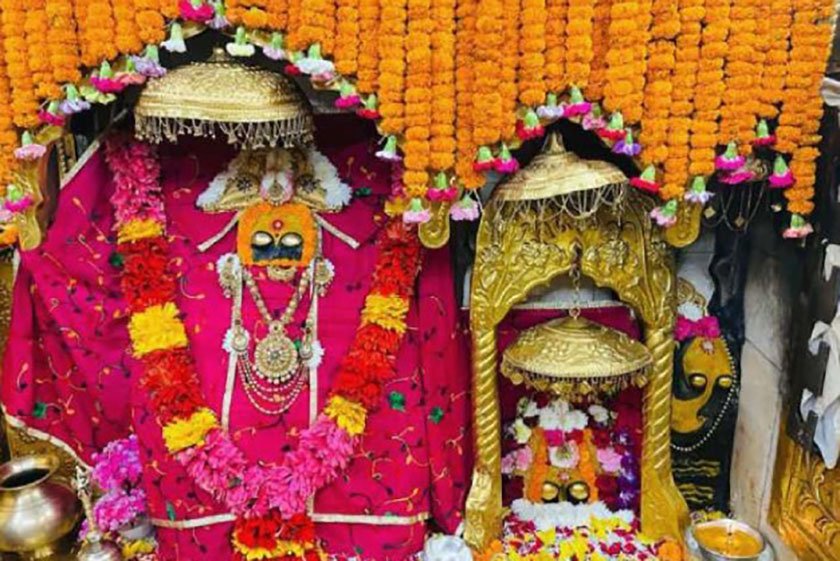
High above the Bilaspur–Punjab borderlands, Shri Naina Devi Ji looks out over lake, hill, road, and pilgrim path — a goddess remembered through the eyes of Sati and the faith of millions who climb towards her.
Some temples are reached like destinations. Shri Naina Devi Ji is reached like a surrender. The road rises through the lower Shivalik hills, the air changes, shops gather, bells begin to sound, and the hilltop slowly becomes more than a viewpoint. It becomes a seat of Shakti.
This is one of Himachal Pradesh’s most important goddess shrines and one of North India’s major Shakti Peeths. Located in Bilaspur district, Shri Naina Devi Ji is worshipped as the goddess whose sacred identity is linked with the eyes of Sati. Devotees come from Himachal, Punjab, Haryana, Chandigarh, Delhi, Jammu, and many other regions, especially during Navratri and the great fair seasons.
The temple’s power comes from its height, its legend, its crowds, and its ability to hold both personal prayer and mass pilgrimage. A devotee may arrive with a family vow, a newborn child, a coconut, a red chunri, or a silent burden. On the hilltop, all of it becomes part of the same darshan.
🌄 Location & How to Reach It
Shri Naina Devi Ji Temple is located on a hilltop in Bilaspur district, Himachal Pradesh, close to the Punjab border and the Anandpur Sahib–Nangal–Bhakra side of the region. The official temple website gives the temple’s distance as about 80 km from Bilaspur town, 108 km north of Chandigarh, 36 km from Nangal, and 20 km from Bhakra Dam. The hilltop setting gives wide views over the surrounding Shivalik landscape and the larger Gobind Sagar–Bhakra region.
Google Maps: Get Directions
Elevation: The temple is generally described as a hilltop shrine in the lower Shivalik range. Exact elevation figures vary across public sources, so travellers should treat any single number as approximate rather than survey-certified.
- By road: The temple is well connected by road from Anandpur Sahib, Nangal, Bhakra, Bilaspur, Kiratpur Sahib, Chandigarh, and nearby Punjab-Himachal routes. During Navratri and major fairs, traffic and parking arrangements may change.
- By ropeway: A ropeway facility is available for devotees. Seasonal timings vary; public ropeway references broadly list operations from morning to evening, with longer hours in summer and shorter hours in winter. Confirm current timings before travelling.
- By steps / walking route: Devotees may also climb by steps from the base area, depending on the route used and current access arrangements. The climb is part of the traditional pilgrimage experience.
- By rail: The nearest practical railway access is usually Anandpur Sahib, Nangal, or Kiratpur Sahib, followed by road travel to the temple.
- By air: The nearest major airport is Chandigarh Airport, followed by road travel. Kangra / Gaggal Airport may also be used by some travellers depending on route planning.
This is a major, road-accessible pilgrimage centre, not a remote trek. But during fair periods, the physical difficulty comes less from distance and more from crowds, queues, heat, and waiting time.
🌸 Best Time to Visit
Shri Naina Devi Ji can be visited throughout the year, but the experience changes sharply with the devotional calendar.
The most important periods are Chaitra Navratri and Shravan / Ashwin Navratri, when the temple becomes one of the busiest Shakti pilgrimage centres in the region. Large numbers of devotees arrive, and arrangements for queue management, security, parking, prasad, and accommodation become more important. If you want the full fair atmosphere, these are the most powerful times. If you want a quieter darshan, choose an ordinary weekday outside the main fair rush.
The cooler months from October to March are generally more comfortable for climbing, standing in queues, and moving around the hilltop. Summer visits are possible, but the lower Shivalik heat can be strong, so early morning or evening darshan is better. Monsoon can bring rain and slippery steps, though the hills are greener.
Ropeway timings change by season. Public ropeway listings generally show longer operating hours from March to September and shorter winter hours from December to February, but current timings should always be confirmed before planning a visit around the ropeway.
🕉️ The Eyes of Sati
The deepest sacred identity of Shri Naina Devi Ji comes from the Shakti Peeth tradition. According to the wider Hindu legend, when Sati gave up her body at Daksha’s yajna, Lord Shiva carried her body in grief. To restore cosmic balance, Lord Vishnu used his Sudarshan Chakra, and parts of Sati’s body fell at different places. These places became known as Shakti Peeths.
At Naina Devi, the tradition says that the eyes of Sati fell here. The name itself carries that memory: Naina means eyes.
This is not a small symbol. Eyes are not only physical organs in Hindu sacred imagination. They are sight, awareness, compassion, protection, and divine attention. A goddess whose identity is linked with eyes is a goddess who sees. She sees the devotee’s suffering, the hidden prayer, the vow carried silently, and the gratitude that words cannot easily express.
That is why devotees often come to Naina Devi with deep personal emotion. They do not only want to see the goddess. They want to be seen by her.
🏔️ A Goddess on the Shivalik Height
The temple’s hilltop position is central to its power. Many Shakti shrines in Himachal are placed on heights: hilltops, ridges, cliffs, and mountain shoulders. Height changes devotion. It makes the body participate before the eyes receive darshan.
At Naina Devi, the climb or ascent is part of the pilgrimage. Some devotees use the road or ropeway; others prefer the steps. Either way, the temple is not approached flatly. The goddess sits above.
From the hilltop, the land opens outward. The Bhakra–Gobind Sagar region, the Shivalik folds, and the Punjab-Himachal borderland create a wide sacred horizon. This view helps explain why the shrine has such a strong regional pull. It stands at a meeting point: hill and plain, Himachal and Punjab, road and pilgrimage, personal devotion and mass faith.
The goddess is local to Bilaspur, but her reach is much wider.
🙏 What Shri Naina Devi Ji Is Known For
Shri Naina Devi Ji is known first as a major Shakti Peeth, worshipped as the seat where the eyes of Sati are believed to have fallen. The official temple site describes it as one of the chief Shakti Peeths and a major shrine of Goddess Shakti.
Devotees visit for blessings, protection, fulfilment of vows, family well-being, children, health, marriage, success, and gratitude after wishes are fulfilled. Many families come repeatedly, treating the temple as a kul-devi-like place of faith even if their ancestral deity is elsewhere.
The temple is also known for its large fairs during Navratri, when lakhs of devotees may visit the hill. The shrine becomes a living river of faith: red chunris, coconuts, bells, prasad shops, security queues, chants of “Jai Mata Di,” and the steady movement of people towards the sanctum.
Naina Devi is also an important stop in the wider North Indian Devi pilgrimage circuit, often combined with Anandpur Sahib, Bhakra Dam, Nangal, Chintpurni, Jwala Ji, Kangra Devi, and other Himachal-Punjab sacred routes.
🏛️ The Temple Complex and Darshan Route
The temple complex is built for pilgrimage flow. Unlike a small village shrine where a handful of devotees may gather at a time, Shri Naina Devi Ji has to receive large crowds, especially during fairs. The darshan route, railings, queue areas, shops, offerings, security, and public facilities all reflect that scale.
The sanctum is the centre, but the experience begins earlier: the road up, the market approach, the purchase of prasad, the sound of bells, the movement through lines, and the first glimpse of the temple structure. For many devotees, the journey is as important as the moment of darshan.
The temple is also connected with nearby sacred features and local points of worship, including Kali Mata, Lord Hanuman, and other smaller shrines around the complex area, depending on the route taken. As in many Shakti temples, the goddess is not isolated from the wider divine family. Guardian and companion deities strengthen the sacred enclosure.
The temple architecture may not be the main reason devotees come, but the hilltop complex has its own visual identity: bright temple structures, flags, railings, steps, shops, and open views that make the shrine feel both public and intensely devotional.
📜 Naina Devi, Trust Management, and Modern Pilgrimage
Shri Naina Devi Ji is not only an ancient sacred site; it is also a major managed pilgrimage centre. The official temple website states that the management of the temple has been under a government-established Temple Trust since 17 December 1985, under the Himachal Pradesh Hindu Public Religious Institutions and Charitable Endowment Act, 1984. The Deputy Commissioner Bilaspur is listed as Commissioner of the Temple Trust, with local administrative roles connected to the trust structure.
This matters because a shrine of this scale cannot function only through informal arrangements. During major fairs, crowd control, security, sanitation, medical support, parking, and movement of devotees become essential. The temple’s living tradition now exists together with modern management.
The official site also provides online services and information for devotees. This shows how a hilltop Shakti Peeth has entered the modern pilgrimage era: online booking systems, live darshan or aarti facilities, trust administration, ropeway access, and organised fair management.
Yet despite all this, the heart of the place remains old. A devotee still comes for the same reason as before: darshan of the Mother.
🚡 Ropeway, Steps, and the Meaning of the Climb
One of the practical features of Shri Naina Devi Ji is the ropeway, often called the Udan Khatola by devotees and travellers. It allows many visitors, especially elderly people and families with children, to avoid the full climb and reach closer to the temple more comfortably.
Public ropeway references list seasonal operating hours, generally from morning to evening, with timings changing from summer to winter. Because weather, maintenance, crowds, and festival arrangements can affect operations, it is best to confirm ropeway timings on the day of travel.
But the steps still matter.
For many devotees, climbing is part of the vow. The body’s effort becomes an offering. Sweat, breath, waiting, and chanting turn the approach into devotion. A ropeway gives access; the steps give tapasya. Both have their place.
The temple accommodates different kinds of pilgrims: the elderly grandmother who needs the ropeway, the young devotee who climbs barefoot, the family carrying prasad, and the child who sees the hilltop temple as a festival of colour and sound.
🎉 Festivals and Devotion
- Chaitra Navratri: One of the busiest and most important pilgrimage periods, usually falling around March–April. Large crowds visit the temple for darshan of the goddess.
- Shravan / Ashwin Navratri: Another major devotional period, with fairs, special worship, and heavy pilgrim movement. Confirm current arrangements before travelling.
- Daily darshan: The temple remains active throughout the year, with devotees visiting for blessings, vows, and family prayers.
- Live darshan / aarti: Official digital services are available through the temple’s online presence, though timings and access should be checked on the official platform.
- Offerings: Devotees commonly offer coconut, chunri, prasad, flowers, and other items according to temple custom.
- Shakti Peeth pilgrimage: Many devotees include Naina Devi Ji in a larger Devi circuit across Himachal and North India.
🏞️ While You’re in the Area
- Bhakra Dam: A major landmark about 20 km from Naina Devi according to the official temple distance reference, important for the region’s modern history and landscape.
- Gobind Sagar Lake: The large reservoir associated with Bhakra Dam, visible from parts of the wider region and central to Bilaspur’s identity.
- Anandpur Sahib: A major Sikh sacred city in Punjab, often combined with Naina Devi because of the route and regional proximity.
- Nangal: A practical road and rail-side town for approaching Naina Devi from Punjab.
- Bilaspur Town: The district headquarters and a useful base for combining Naina Devi with other Bilaspur sacred sites.
- Markandeya Ji Temple: A rishi shrine near the Jukhala side, associated with Rishi Markandeya and a sacred spring.
- Vyas Gufa: A sacred cave site in Bilaspur associated with Rishi Vyas and the old naming memory of the town.
🙏 Getting in Touch
Shri Naina Devi Ji has an official temple website and a government-established Temple Trust structure. Devotees should use the official temple platform for current information on online services, live darshan, bookings, donation options, and administrative updates.
For ropeway travel, check current ropeway timings before starting, especially in winter, monsoon, or during heavy festival rush. Public ropeway schedules vary by season, and operations may be affected by weather or maintenance.
For festival visits, especially during Navratri, confirm arrangements for parking, queue systems, accommodation, medical help, and crowd management before travelling. The temple can become very crowded during major fairs.
As with all major Shakti shrines, remove shoes where required, keep offerings organised, follow queue discipline, avoid pushing, and do not photograph restricted inner areas.
❓ Quick Questions Travellers Ask
Where is Shri Naina Devi Ji Temple located?
Shri Naina Devi Ji Temple is located on a hilltop in Bilaspur district, Himachal Pradesh, near the Punjab border.
Is Naina Devi Ji a Shakti Peeth?
Yes. It is worshipped as a major Shakti Peeth, associated with the belief that the eyes of Sati fell here.
How far is Naina Devi Temple from Bilaspur town?
The official temple website gives the distance as about 80 km from Bilaspur town.
How far is it from Chandigarh?
The official temple website gives the distance as about 108 km north of Chandigarh.
Is there a ropeway to Naina Devi Temple?
Yes. A ropeway facility is available, with seasonal timings. Confirm current operation before travelling.
Can devotees climb by steps?
Yes. Devotees may use the steps or walking route depending on access arrangements. Many pilgrims still prefer climbing as part of their devotion.
What is the best time to visit?
Ordinary weekdays outside major fairs are better for a quieter darshan. Navratri is the most powerful but busiest time.
Which festivals are most important here?
Chaitra Navratri and Shravan / Ashwin Navratri are the major pilgrimage periods.
Can Naina Devi be combined with Anandpur Sahib?
Yes. Many travellers combine Shri Naina Devi Ji with Anandpur Sahib, Nangal, Bhakra Dam, and Gobind Sagar Lake.
Are photos allowed inside the temple?
Photography rules may vary by area. Do not photograph restricted inner spaces, and follow temple instructions.
A Last Word
Shri Naina Devi Ji is a temple of sight in the deepest sense. The legend speaks of Sati’s eyes, but the experience speaks of being seen — by the goddess, by faith, by the hill, and by the long line of devotees who have climbed before.
From the top, the land opens wide. Roads come from Punjab, Himachal, and beyond. Families arrive tired and hopeful. Bells ring. Red chunris move in the wind. Somewhere in the crowd, a prayer that has been carried for months finally reaches the Mother.
That is why Naina Devi Ji remains one of Himachal’s great Shakti seats. The hill is high, the crowds can be heavy, and the journey may test patience. But for devotees, the moment of darshan is simple: the goddess sees, and that is enough.
Fact-check note: The official Shri Naina Devi Ji website identifies the temple as a major Shakti Peeth in Bilaspur district, located about 80 km from Bilaspur town, 108 km north of Chandigarh, 36 km from Nangal, and 20 km from Bhakra Dam. It also confirms the temple’s hilltop setting and the government-established Temple Trust management structure since 17 December 1985. The Shakti Peeth legend connecting the shrine with the eyes of Sati is treated here as sacred tradition. Ropeway timings are seasonal and vary across public references, so this article gives general guidance and advises confirming current operation before travel. Exact elevation figures, darshan queue timings, festival crowd arrangements, and photography rules can change and should be checked through official or local sources before visiting.