Between Paprola and Taragarh, Tashi Jong is not only a monastery; it is a Tibetan village, craft community, and Drukpa Kagyu seat built by people who carried Khampagar’s memory out of Tibet.
Some monasteries stand apart from villages. Tashi Jong does not. The monastery and the settlement belong to one another. Located near Paprola, Taragarh, and Palampur in Kangra district, Tashi Jong / Khampagar Monastery is both a Tibetan Buddhist monastic centre and a living refugee village. It was founded by H.E. the 8th Khamtrul Rinpoche, Kalzang Dongyu Nyima, who left Tibet with monks and reincarnate lamas before the old Khampagar world in Kham was lost to exile. In Himachal, that tradition was rebuilt not only through prayer halls and rituals, but through homes, workshops, thangka painting, woodcarving, carpet weaving, monastic training, and the daily discipline of a community that refused to let its lineage disappear.
🌄 Location & How to Reach It
Tashi Jong / Khampagar Monastery is located in Tashi Jong village in Kangra district, Himachal Pradesh, between Paprola and Taragarh, near the broader Palampur–Baijnath belt. Travel references commonly place it about 15 km from Palampur, and it is often visited from Palampur, Baijnath, Bir, or Dharamshala. Tripadvisor’s listing also describes the monastery as being in a small rural area between Paprola and Taragarh and as home to the Drukpa Kagyu tradition.
Google Maps: Get Directions
- By road: The usual approach is through Palampur – Paprola / Baijnath – Tashi Jong, or from the Bir–Baijnath side. Local taxis are available from Palampur, Baijnath, Bir, and Dharamshala.
- By rail: The nearest narrow-gauge rail access is Baijnath Paprola / Paprola on the Kangra Valley Railway. For broad-gauge travel, Pathankot is the practical railhead, followed by road travel into Kangra Valley.
- By air: The nearest airport is Gaggal Airport / Kangra Airport, followed by road travel through Dharamshala, Palampur, or Baijnath depending on route.
This is an easy road-accessible monastery visit once you are in Palampur or Baijnath. It is quieter than McLeod Ganj and less tourist-heavy than Bir, but it should still be approached as an active Buddhist settlement, not only as a photo stop.
🌸 Best Time to Visit
The best months to visit Tashi Jong are usually March to June and September to November. Spring and early summer are pleasant for walking through the monastery village, visiting the main temple, and combining the trip with Palampur, Baijnath, Bir, or Andretta. Autumn brings clearer skies and softer light over the Kangra Valley.
Monsoon makes the landscape very green but can bring heavy rain, slippery roads, and mist around the Palampur–Baijnath belt. Winter is peaceful and suitable for travellers who prefer fewer crowds, though mornings and evenings can be cold.
For ordinary visitors, daytime is best. Tashi Jong is a working monastery and residential community, so access to certain areas may depend on prayers, monastic routines, retreat restrictions, or local rules. The Yamantak Retreat Center is specifically described in travel references as restricted to the general public, so visitors should not expect access to all parts of the complex.
🕉️ Khampagar’s Memory in a New Valley
The deeper story of Tashi Jong begins in eastern Tibet. The official Khampagar/Tashi Jong account says that in 1958, H.E. Khamtrul Rinpoche VIII, Kalzang Dongyu Nyima, left Tibet for India with a group of 16 monks and reincarnate lamas after foreseeing the coming upheaval. In eastern Tibet, he had been the head of Khampagar Monastery, which had more than 200 branch monasteries of the Drukpa Kagyu lineage. After reaching India, the community first settled in Kalimpong, where people from the Khampagar region came seeking refuge.
This is what gives Tashi Jong its emotional weight. It is not simply a monastery founded in Himachal. It is a monastery replanted after loss. The old Khampagar institution could not remain where it was, so its teachers, monks, rituals, and community memory were carried into exile.
The name Tashi Jong is often understood as “auspicious valley” or “valley of auspiciousness.” In the Kangra setting, that name feels fitting. The monastery does not stand in a stark high desert like Spiti or Kinnaur. It sits in a gentler valley belt, surrounded by villages, fields, hills, and the everyday life of Kangra.
🕉️ The Drukpa Kagyu Tradition at Tashi Jong
Tashi Jong belongs to the Drukpa Kagyu tradition of Tibetan Buddhism. This is important because not every Tibetan monastery in Himachal belongs to the same school. McLeod Ganj’s Namgyal Monastery is closely linked with the Dalai Lama and the Gelug tradition. Palpung Sherabling near Bir belongs to the Karma Kagyu lineage. Tashi Jong carries the Drukpa Kagyu stream through the Khamtrul Rinpoche lineage.
Travel references consistently identify Tashi Jong as home to the Drugpa / Drukpa Kagyu tradition, established by the 8th Khamtrul Rinpoche, Dongyu Nyima.
The Drukpa Kagyu tradition has its own saints, practices, ritual forms, retreat systems, and artistic expression. At Tashi Jong, that lineage is not only preserved in texts or statues. It is preserved through monks, lay families, ritual practice, craft work, community structure, and a lived Tibetan village environment.
That is why the monastery-village form matters. The tradition was not rebuilt by monks alone. It was rebuilt by a community.
🙏 What Tashi Jong / Khampagar Monastery Is Known For
Tashi Jong is known for its Drukpa Kagyu monastery, its connection with Khamtrul Rinpoche, its Tibetan refugee settlement, and its craft traditions. The monastery complex includes the main temple, the stupa of Khamtrul Rinpoche, and the Yamantak Retreat Center, which is restricted to the general public.
The place is also known for traditional Tibetan arts and crafts. Visitors often find thangka painting, woodcarving, carpet weaving, and handicraft work associated with the settlement. This is not a decorative side activity. In exile communities, craft is often part of cultural survival. It carries iconography, skill, livelihood, memory, and identity.
For travellers, Tashi Jong is usually quieter than the more famous Tibetan sites of Dharamshala and Bir. That quietness is part of its appeal. The monastery does not feel like a major tourist stage. It feels like a community that continues its own rhythm while allowing respectful visitors to pass through.
🏛️ Woodcarving, Gilding, Painting, and a Temple Designed by a Lama
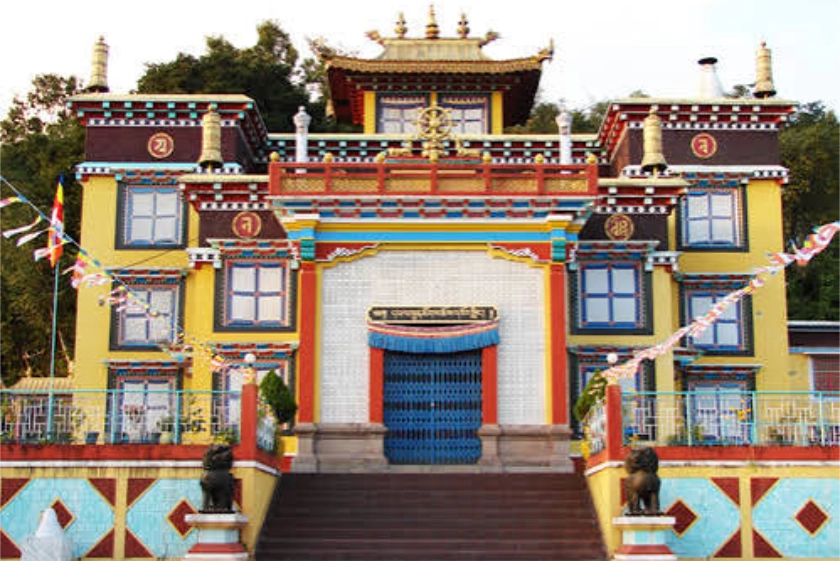
The Tashi Jong monastery building is visually rich. Travel references describe the complex as designed by Khamtrul Rinpoche, with the building adorned through woodcarving, gilding, and painting. The façade carries bright Tibetan colours: yellow walls, red and green borders, painted panels, golden details, prayer flags, roof ornaments, and a ceremonial entrance that gives the monastery its strong visual identity.
The craftsmanship matters. This is not generic decoration. Tibetan Buddhist architecture uses colour, symbol, geometry, deity imagery, protective motifs, and ritual meaning. A painted wall or carved beam is not only ornamental. It participates in the sacred language of the building.
Inside, the prayer hall and sacred spaces may contain images, murals, ritual objects, lamps, and seating for monks. Visitors should enter quietly, remove shoes where required, avoid touching sacred objects, and ask before photographing interiors.
The monastery is beautiful, but beauty is not its only purpose. It was built to hold practice.
📜 Tashi Jong as a Tibetan Village, Not Only a Monastery
The official Khampagar account refers to Tashi Jong as a Tibetan village, not merely a monastery. That detail is important. After leaving Tibet, the community did not rebuild only a shrine. It rebuilt a social world: monks, reincarnate lamas, lay families, artisans, children, elders, homes, workshops, rituals, and livelihoods.
This makes Tashi Jong different from a monastery that stands alone in the mountains. The sacred and everyday are intertwined. A visitor may see prayer flags, monks, temple buildings, homes, craft shops, children, elders, and local movement in the same area. The monastery is the spiritual centre, but the village is part of the sacred story.
For a website article, this is the strongest angle. Tashi Jong is not only “a beautiful monastery near Palampur.” It is Khampagar rebuilt as a community. That line gives the place its depth.
🎉 Rituals, Retreat, and Devotion
- Drukpa Kagyu Practice: Tashi Jong is associated with the Drukpa Kagyu lineage through the Khamtrul Rinpoche tradition.
- Main Temple Worship: Visitors may enter public areas of the main temple respectfully, depending on current monastery rules and prayer schedules.
- Khamtrul Rinpoche Stupa: The complex includes the stupa of Khamtrul Rinpoche, an important devotional point within the monastery.
- Yamantak Retreat Center: The retreat centre is generally restricted to the public, and visitors should not attempt to enter restricted practice areas.
- Craft Tradition: Thangka painting, woodcarving, carpets, and other Tibetan crafts are part of Tashi Jong’s cultural identity and livelihood.
🏞️ While You’re in the Area
- Baijnath Temple: One of Kangra’s most important ancient Shiva temples, located close enough to combine with Tashi Jong in one trip.
- Palampur Tea Gardens: The tea landscape around Palampur pairs well with Tashi Jong for a calm Kangra Valley day.
- Andretta Artist Village: A cultural stop near Palampur known for art, pottery, and Norah Richards’ legacy.
- Bir Tibetan Colony: A major Tibetan settlement area near Bir, useful for comparing different Tibetan Buddhist communities in Kangra.
- Palpung Sherabling Monastic Seat: A major Karma Kagyu monastery at Bhattu near Bir, best combined if you are exploring Buddhist sites around Bir.
- Taragarh: A nearby area associated with old estates, valley views, and access towards Tashi Jong and Palampur.
- Dhauladhar Viewpoints: The Palampur–Baijnath belt offers wide views of the Dhauladhar range, especially in clear weather after monsoon or in winter.
🙏 Getting in Touch
There is no need for a casual visitor to book a general visit to the public areas of Tashi Jong, but access may depend on monastery rules, prayer schedules, retreat restrictions, and community privacy. If a hall is closed or a section is marked restricted, do not insist.
For serious study, retreat, donations, interviews, or formal contact, use the Khampagar / Tashi Jong official channels where available. For ordinary travel access, ask locally in Palampur, Paprola, Baijnath, Taragarh, or Tashi Jong village.
Photography should be handled gently. Avoid photographing monks, ritual spaces, or private community areas without permission.
❓ Quick Questions Travellers Ask
Where is Tashi Jong / Khampagar Monastery located?
It is in Tashi Jong village, between Paprola and Taragarh, near Palampur / Baijnath in Kangra district.
Which Buddhist tradition does Tashi Jong belong to?
It belongs to the Drukpa Kagyu tradition of Tibetan Buddhism.
Who founded Tashi Jong in India?
The monastery-village was established by H.E. the 8th Khamtrul Rinpoche, Kalzang Dongyu Nyima, after leaving Tibet with monks and reincarnate lamas.
How far is Tashi Jong from Palampur?
Travel references commonly place it about 15 km from Palampur.
Can visitors enter all parts of the monastery?
No. Public areas may be visited respectfully, but the Yamantak Retreat Center and some monastic sections are restricted.
A Last Word
Tashi Jong is easy to visit, but it should not be seen quickly. Its meaning is not only in the temple façade, the prayer flags, or the craft shops. Its meaning lies in the fact that a whole religious community crossed into exile and rebuilt itself in Kangra.
Khampagar’s old world could not be carried as land. So it was carried as lineage, ritual, memory, craft, language, and discipline. Tashi Jong is where those things took village form again.
At Tashi Jong, the monastery is not separate from the settlement. The village itself is part of the prayer.
Fact-check note: The official Khampagar / Tashi Jong account states that H.E. Khamtrul Rinpoche VIII, Kalzang Dongyu Nyima, left Tibet in 1958 with 16 monks and reincarnate lamas, after having been head of Khampagar Monastery in eastern Tibet, which had more than 200 branch monasteries of the Drukpa Kagyu lineage. Travel references consistently place Tashi Jong in a rural area between Paprola and Taragarh, around 15 km from Palampur, and identify it as a Drukpa Kagyu monastery established by the 8th Khamtrul Rinpoche. The main temple, Khamtrul Rinpoche stupa, and restricted Yamantak Retreat Center are also supported by multiple travel references. Exact public visiting hours and access to interior spaces should be confirmed locally, because active monastic and retreat areas may not be open to visitors.