Climb high enough into the outer Himalayas above Sirmaur, and you’ll find pilgrims by the thousand converging on a god that some accounts insist has never had an idol to look at.
Most temples in this series have a settled physical anchor — a lingam you can point to, a statue with a known installation date, a sanctum you can stand inside and describe. Churdhar complicates that. This is the highest point in the outer Himalayas, a genuinely difficult trek reached only by foot or horse, and the deity worshipped at its summit, Shirgul Maharaj, is treated with a devotion so intense that entire districts organize their religious calendar around him — and yet you’ll find sources that flatly disagree about whether any idol or lingam was ever formally established here at all. That contradiction, rather than undermining the place, ends up being the most honest thing you can say about it: some gods are defined less by a fixed image than by the mountain itself, and the exhausting, purifying act of reaching it.
🌄 Location & How to Reach It
Shirgul Maharaj Temple sits at the summit of Churdhar Peak, 3,647 metres (11,965 feet) above sea level, straddling the Sirmaur–Shimla district border — the highest peak in the outer Himalayan range.
Google Maps: Get Directions
There is no road to the temple itself — this is a trek-only pilgrimage, with three commonly used routes:
- From Nohradhar (Sirmaur): The most popular route among pilgrims, roughly 14–18 km depending on the exact trailhead, typically taking 6–8 hours on foot or by horse. Nohradhar itself is reachable by road from Solan (around 60 km) and Rajgarh (around 38 km).
- From Sarahan/Chaupal (Shimla district): The shortest but steepest route, around 7–8 km, involving a sharp continuous climb.
- From Haripurdhar (Sirmaur): The longest route at roughly 50 km, generally taken by those wanting a more extended trekking experience rather than the fastest ascent.
The nearest railheads are at Solan or Barog, roughly 60–70 km from the trailheads, with onward road travel required to reach Nohradhar, Sarahan, or Haripurdhar.
This is genuinely one of the more demanding pilgrimages in this series — not a hilltop shrine reachable by taxi, but a multi-hour trek at altitude, and it should be planned and respected as such.
🌸 Best Time to Visit
The temple is only accessible from around mid-April through late November; heavy snowfall from December through February cuts the peak off entirely. Within that window, May–June and September–November offer the most stable trekking conditions and clearest mountain views — on an exceptionally clear day, distant peaks including Shrikhand Mahadev, Kedarnath, Badrinath, and Kinnaur Kailash are visible from the summit. Mahashivratri and the Navratri period draw significant crowds despite the difficulty of reaching the peak in cooler weather, and the broader summer pilgrimage season (May–October) is when the mountain sees the bulk of its devotional traffic.
🕉️ A Mountain of Stories That Don’t Quite Agree
Ask why this specific ridge carries such weight, and you’ll be handed several different answers, and they don’t sit together comfortably.
The most widely repeated version places the story in the Mahabharata era: a devotee named Churu and his son, meditating on a massive rock here, were attacked by a serpent. Shirgul Maharaj — worshipped as a local, protective form of Shiva — split the rock apart to crush the snake and save them, and the site took its name from Churu: Churdhar, “Churu’s ridge,” with the deity accordingly known as Chureshwar Mahadev.
A second, quite different local tradition skips the snake entirely and instead describes Churu as a loyal servant of Shirgul Maharaj, entrusted with the kingdom while Shirgul himself fought a lone battle against Mughal rule — a detail that, if taken literally, would place the story many centuries after the Mahabharata era it’s sometimes paired with, and the two versions are rarely reconciled by the people repeating them. A separate tradition holds that Adi Shankaracharya, on pilgrimage between Badrinath and Kedarnath, passed through Churdhar and installed a Shivlinga here himself — though even sources sympathetic to this version are upfront that no written record supports it.
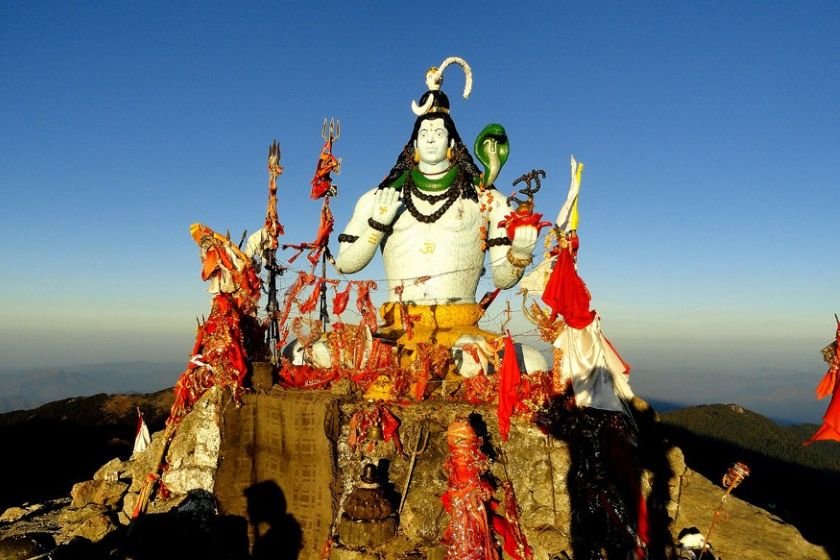
And then there’s the detail that cuts hardest against the tidy version of any of these stories: at least one detailed local account states plainly that no idol has ever been formally installed at Churdhar, and that in the strictest sense, no fixed image-based worship takes place at the summit at all — that what’s sacred here is the mountain and the Shivling-like rock formations themselves, not a consecrated murti in the usual sense. Other equally confident sources describe a small, deodar-roofed temple housing an actual lingam. Both can’t be fully true as stated, and rather than pick one, it’s worth simply naming the disagreement: Churdhar is a place people agree is sacred and disagree, in real and specific ways, about exactly how.
🙏 What Shirgul Maharaj Is Known For
Shirgul Maharaj is worshipped across Sirmaur, Shimla, Solan, Chaupal, and parts of Uttarakhand’s Dehradun district as a protector, healer, and — distinctively — a dispenser of justice: local devtas (village deities) from surrounding communities are said to visit Churdhar during festivals as a kind of divine court, seeking Shirgul’s mediation or blessing on disputes. This isn’t a shrine visited primarily for personal wish-fulfillment in the way many Devi temples are; it functions more as a regional seat of moral and spiritual authority, binding together communities across several districts under one shared object of devotion.
A recurring piece of local folklore adds an unexpectedly human note to this: Shirgul Maharaj and a neighboring deity, Bijjat Maharaj — described in some tellings as his younger brother — are said to have fallen into conflict centuries ago after a violent dispute during a festival, to the point that their respective devotee communities stopped meeting at joint celebrations altogether. Some retellings describe a formal, generations-long estrangement; at least one reader familiar with the region has pushed back publicly on this version, calling the “fight between two gods” framing an exaggeration of what was more accurately a dispute between two villages. It’s a good reminder that even actively-told local folklore isn’t always settled among the very communities who tell it.
🏛️ The Temple Itself
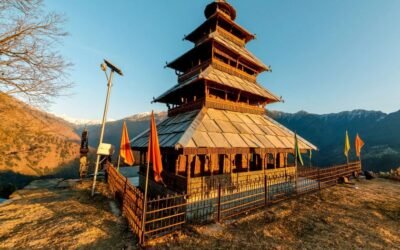
Descriptions vary, as noted above, but the more commonly repeated physical account is of a modest, deodar-roofed, single-storey square structure just below the peak’s true summit, housing a lingam associated with Chureshwar Mahadev. The setting does the rest of the work: this is high alpine terrain, blanketed in snow from November through March and transformed into lush flowering meadow through the summer trekking season, within the Churdhar Wildlife Sanctuary — home to the Monal, Himachal’s state bird, among other high-altitude species. Pilgrims commonly bathe in nearby mountain streams before approaching, treating the ascent itself, and the cold water at the top, as a form of purification distinct from anything performed inside a conventional sanctum.
📜 Regional Context — A Peak That Binds Several Districts Together
Churdhar’s religious pull extends well beyond Sirmaur, drawing devotees from Shimla, Solan, and Chaupal, and from Dehradun district across the Uttarakhand border — an unusually wide devotional catchment for a single peak, reflecting Shirgul Maharaj’s role as a shared regional deity rather than one tied to a single princely state or village, unlike several of the more locally-rooted shrines elsewhere in this series. The Bijjat Maharaj relationship, whatever its true history, further embeds Churdhar within a wider web of village devta politics and alliances that shapes religious life across this part of Himachal in ways that operate somewhat independently of mainstream temple Hinduism.
🎉 Festivals and Devotion
- Mahashivratri: Marked with night-long bhajans, havans, and community feasts, despite the difficulty of winter-adjacent access.
- Navratri: Marked by devta processions and folk dances, drawing pilgrims and neighboring village deities alike.
- Summer Pilgrimage Season (May–October): The bulk of the year’s foot traffic, when trekking conditions are safest and the mountain is at its most accessible.
🏞️ While You’re in the Area
- Nohradhar – The most common trailhead and a reasonable base for organizing the trek.
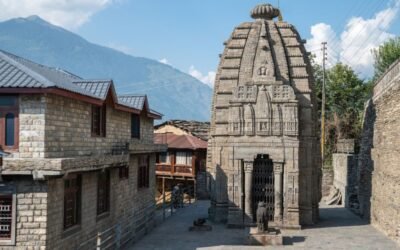
- Sarahan (Chaupal) – Starting point for the shortest route, and a worthwhile stop for those wanting to see the (unrelated) architectural Bijat Maharaj temple en route.
- Haripurdhar – The longer trekking option, and a scenic hill station destination in its own right.
- Churdhar Wildlife Sanctuary – The alpine forest and meadow surrounding the peak, rich in birdlife including the state bird, the Monal.
- Renuka Lake – Considerably further afield in Sirmaur district, but a common pairing for those touring the wider region.
❓ Quick Questions Travellers Ask
Is there an entry fee at the Churdhar temple? No, entry is free, though this is a remote trek rather than a roadside shrine.
Which trekking route is easiest? The Nohradhar route is the most popular and generally considered the most manageable of the three, though all involve a genuine multi-hour climb.
When is the temple actually accessible? Roughly mid-April through late November; heavy snow closes off the peak from December through February.
How difficult is the Churdhar trek? Generally described as moderately difficult — manageable for a reasonably fit beginner with preparation, but a real high-altitude trek rather than a casual walk.
Is there accommodation near the summit? Basic shelter is available for pilgrims near the temple, though facilities are simple; most visitors plan around an overnight stay to manage the trek in daylight.
A Last Word
There’s a strange comfort in a sacred site that resists being pinned down — where even the basic question of whether an idol exists gets different answers depending on who you ask, and where a kingdom-spanning devotion is organized less around a fixed image than around the sheer, punishing act of climbing to meet it. Whatever Shirgul Maharaj actually looks like, or doesn’t, the mountain itself seems to be doing most of the talking.
Fact-check note: The peak’s altitude (3,647m/11,965ft), its status as the highest point in the outer Himalayas, the three trekking routes, and the seasonal accessibility window (roughly mid-April to November) are corroborated across multiple independent sources. The Churu-and-serpent origin legend is the most widely repeated story, but a competing local tradition (Churu as a loyal servant during a conflict with Mughal rule) and the Adi Shankaracharya installation legend both circulate without documentary support, and sources explicitly disagree — including at least one direct source claiming no idol has ever been formally installed at the summit, against others describing an actual lingam-housing structure. Both versions are presented above without resolving the contradiction, since no reliable way to adjudicate between them was found. The Bijjat Maharaj rivalry story is repeated in several tourism-oriented sources, but at least one commenter with regional familiarity has publicly disputed its framing as an exaggeration; it’s presented above as contested folklore rather than settled history. No verified GPS coordinates, specific temple contact details, or precise construction date could be confirmed, so none are stated as fact.