Most gods are carried to their devotees in a palanquin. This one is said to arrive differently — by entering the body of a priest who climbs the mountain barefoot, stopping seven times along the way to pour milk into the earth before he lets the god step inside him.
There’s a particular kind of Himachali devotion that treats a deity not as a fixed presence waiting in a sanctum, but as something that has to be periodically fetched, invited, and carried into the moment — and Bhureshwar Mahadev, high on a ridge above the plains of Sirmaur, is one of the clearer examples of it still practiced today. This is a temple with two separate legends layered on top of each other — one cosmic, set during the Mahabharata war; one intensely local and human, involving two grieving siblings — but the detail that makes it genuinely distinctive isn’t either origin story. It’s the way the god is still, in living memory, brought to the mountain rather than simply found there.
🌄 Location & How to Reach It
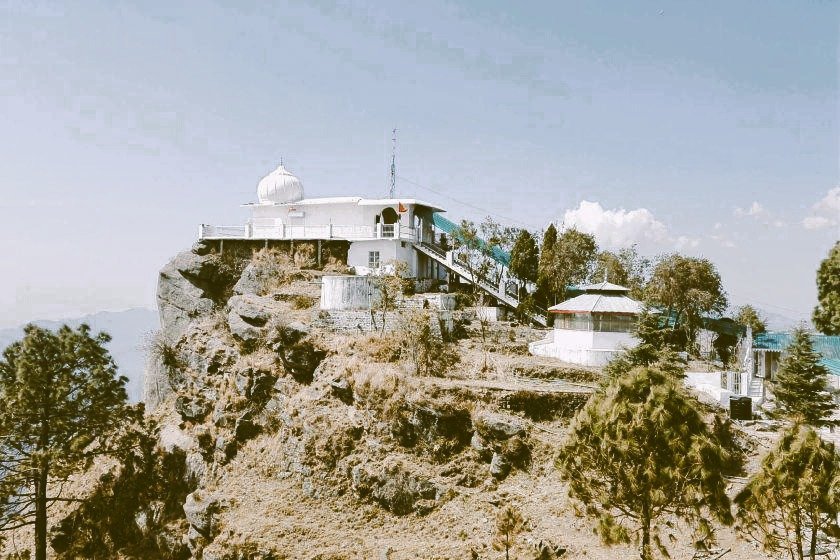
Bhureshwar Mahadev Temple — also known locally as Bhurshing Mahadev or Bhurshing Devta — sits at roughly 1,870–2,070 metres (accounts vary between about 6,100 and 6,800 feet) on a ridge in the Kwagdhar range, Pachhad tehsil, Sirmaur district, near Panwa village and Tikri Pajerli, close to Sarahan.
Google Maps: Get Directions
- By road: The temple sits just off the Nahan–Solan state highway (also referred to locally as the Kumarhatti–Sarahan–Nahan road); a link road from near Panwa village leads most of the way, motorable though narrow and winding, with parking available near the top.
- By trek: Two main walking routes exist — one from Kwagdhar, taking around 30–45 minutes through forest and grassy paths and generally considered the more scenic option, and a shorter but less scenic route directly from Panwa village.
- Distances: Roughly 12 km from Sarahan, and around 70 km from Chandigarh via Kumarhatti, making it a realistic day trip from the Chandigarh–Solan–Shimla belt.
Given how close the drivable road now comes to the temple, this is a manageable half-day outing rather than a demanding expedition — though the short trek from Kwagdhar is worth choosing over the direct road walk if you have the time, if only for the views along the way.
🌸 Best Time to Visit
October through March brings the clearest skies and the most rewarding panoramas — on a good day, the temple’s hilltop position offers views stretching toward Chandigarh, Solan, the hills around Shimla, the Morni range, and Churdhar peak. The monsoon months of July and August are best avoided, as both the link road and the forest trekking paths become slippery and less safe. The single most significant date on the calendar here is Ekadashi, the eleventh day after Diwali, when an annual fair transforms the quiet hilltop into a gathering of music, food stalls, and devotion in memory of the temple’s most personal legend.
🕉️ Two Stories, One Mountain
Ask about the temple’s history and you’ll generally hear two different stories, rarely reconciled into one — which is itself worth sitting with rather than glossing over.
The older, more cosmic version places the temple’s origin in the Dwapara Yuga, during the events of the Mahabharata: local tradition holds that Shiva and Parvati sat on this very ridge to watch the battle of Kurukshetra unfold on the plains below, and that a swayambhu — a self-manifested — Shivling emerged from the earth at that moment, sanctifying the spot for all time. Interestingly, an older name recorded for the deity here is Bhuri Shringa, sometimes glossed as “the milk-consuming lord” — a name that survives today, worn down by centuries of local pronunciation, into “Bhurshing.”
The second story is smaller, sadder, and far more specific. It tells of two siblings, Bhur Singh and Dahi Devi, from the nearby village of Panwa (or, in some tellings, Pajarli), who made their living grazing cattle in the forest around this hill. One day, in a sudden storm, they lost a calf from the herd; returning home with the rest of the animals but not all of them, they were met with cruelty from a stepmother the stories describe as unforgiving. The siblings fled into the forest and, in the most commonly repeated version, died there rather than return. The grieving villagers are said to have built the temple on the exact spot where their story ended, and the Ekadashi fair held here each year exists specifically to keep their memory alive alongside Shiva’s own.
It’s tempting to wonder whether the name “Bhur Singh” and the older title “Bhuri Shringa” share more than a passing phonetic resemblance — whether, over generations, a specific human tragedy quietly grafted itself onto an older, cosmic name for the local Shiva. That’s speculation on this writer’s part rather than anything documented, but it would explain why a single hilltop carries both a story about gods watching a mythic war and a story about two frightened children running from an unkind home — two very different registers of sacredness, sitting comfortably on the same ridge.
🙏 What the Temple Is Known For
Bhureshwar Mahadev draws devotees seeking the fairly universal range of Shiva’s blessings — protection, peace, relief from hardship — but the presence of the Bhur Singh and Dahi Devi legend gives it a specific emotional register beyond that: people come here associating the site with sibling loyalty, grief, and emotional healing, not just general Shaiva devotion. A separate, more concrete tradition ties the temple to a wish granted: a 16th-century Maharaja of Sirmaur is said to have prayed here for a child, and upon his wish being fulfilled, appointed a hereditary priestly custodian for the temple and instituted an annual silver offering — a practice reportedly still acknowledged in local revenue records today, giving the temple an unusually well-documented thread of royal patronage for a shrine this remote.
What sets Bhureshwar Mahadev apart most distinctly, though, is its living ritual practice. Unlike many Himachali devtas who are carried to their devotees in a palanquin, the divine presence here is said to enter the body of the temple’s priest directly. Dressed in ceremonial attire and bearing the deity’s ceremonial umbrella (chhatra), the priest treks the steep mountain path on foot, stopping at seven designated sacred stones along the way to pour offerings of raw milk into the earth, before reaching an eighth spot at the temple’s threshold and finally entering the sanctum. It’s a striking, physically demanding form of devotion — the god quite literally walking the mountain each time, rather than waiting passively at its summit.
🏛️ The Temple Itself
The shrine itself is modest, centred on the swayambhu Shivling in its sanctum, and open around the clock rather than keeping fixed hours. What the temple lacks in architectural grandeur it makes up for in setting — surrounded by deodar, pine, kafal, and flowering buransh (rhododendron), with a rock formation at the rear of the complex that visitors are asked not to approach. Photography and videography are prohibited inside the sanctum itself, though mobile phones may be carried, and the approach path is dotted with smaller Shivling formations that visitors encounter on the way up, giving the whole ascent a cumulative, layered sense of arrival rather than a single dramatic reveal at the top.
📜 Regional Context — A Ridge That Watches Two Kinds of History
Bhureshwar Mahadev’s hilltop position places it within a wider regional pattern of Sirmaur shrines that double as vantage points — places where a temple’s physical prominence over the surrounding valleys gets folded into its mythology, much as it does at Katasan Devi further along the same district’s temple map. The 16th-century royal patronage tradition also connects it to Sirmaur’s broader pattern of ruling-family devotion at specific local shrines, a thread that runs through several of the district’s temples in different forms, from Katasan Devi’s battle-thanksgiving origin to this temple’s wish-granting one.
🎉 Festivals and Devotion
- Ekadashi Fair (eleventh day after Diwali): The temple’s major annual event, drawing large crowds for music, traditional dance, local food, and rituals honoring both Shiva and the memory of Bhur Singh and Dahi Devi.
- Shravan month: A period of heightened devotional activity typical of Shiva shrines generally, reflected here as elsewhere in the region.
- The priest’s ceremonial ascent: Not a single annual event so much as an ongoing ritual practice — the ceremonial trek and milk offerings at the seven sacred stones mark the temple’s living, active relationship with its deity.
🏞️ While You’re in the Area
- Sarahan – About 12 km away, a good base or connecting point for those exploring this part of Sirmaur.
- Kwagdhar – The starting point for the more scenic of the two treks up to the temple, worth a stop in its own right for the views.
- Solan – A reasonable stop for food and lodging on the way to or from Chandigarh or Shimla.
- Kasauli – A well-known hill town nearby, easily combined with a Bhureshwar Mahadev day trip.
- Morni Hills – Visible from the temple itself on a clear day, and a worthwhile onward destination for those continuing toward Chandigarh.
❓ Quick Questions Travellers Ask
Is there an entry fee at Bhureshwar Mahadev Temple? No, entry is free, as is typical for Himachal’s local Shiva shrines.
How long is the trek to the temple? Around 30–45 minutes from Kwagdhar, or a shorter but less scenic walk from Panwa village; a motorable link road also reaches close to the top for those who’d rather not walk.
Can I take photos at the temple? Mobile phones are allowed on site, but photography and videography are specifically prohibited inside the sanctum itself.
Is the temple open all day? Yes, it’s commonly described as open 24 hours, unlike many temples with fixed timings.
What’s the best time of year to visit? October through March for the clearest views and safest road/trail conditions; the monsoon months of July–August are best avoided due to slippery paths.
A Last Word
Whichever story you find yourself drawn to here — the gods watching a mythic war unfold below, or two frightened siblings who never made it home — what stays with you afterward is probably neither. It’s the image of a priest, alone on a steep mountain path, stopping seven times to pour milk into the ground before he lets a god step into him. Most temples ask you to come find the divine. This one, in its own quiet way, still goes out to meet it halfway.
Fact-check note: The temple’s location, its alternate names (Bhurshing Mahadev/Devta), the Kurukshetra-witnessing legend, the Bhur Singh and Dahi Devi story, the Ekadashi fair, and the priest’s ceremonial ascent with milk offerings at seven sacred stones are corroborated across multiple independent sources, including a detailed Tribune newspaper feature. The temple’s exact altitude is reported inconsistently across sources (ranging from roughly 1,870m/6,135ft to 6,800ft), so a range is given rather than a single figure. The 16th-century royal patronage story and its connection to present-day revenue records comes primarily from a single detailed source (The Tribune) and could not be independently cross-verified elsewhere, so it’s presented with appropriate confidence but not treated as exhaustively confirmed. The possible etymological link between “Bhur Singh” and the older name “Bhuri Shringa” is speculation offered in this article for interest, not a documented claim, and is flagged as such above. No verified GPS coordinates or specific temple contact details could be confirmed, so none are stated as fact.