Near the edge of Kinnaur’s cold desert, Nako Monastery stands beside a quiet lake, carrying the memory of old translators, painted mandalas, and a Buddhist world that once looked directly towards Tibet.
Some monasteries impress through size. Nako Monastery impresses through survival. It stands in Nako village, one of the highest inhabited settlements of Kinnaur, close to the old Indo-Tibetan cultural route and only a short distance from the border region. The monastery is associated with the 11th-century Buddhist revival, the legacy of Lochen Rinchen Zangpo, and a group of old temples whose murals, stucco images, and mandala art connect Nako with the wider sacred world of western Tibet, Tabo, and Spiti. Beside it lies Nako Lake, ringed with willows and poplars, giving the monastery an atmosphere very different from the larger gompas of Lahaul and Spiti. Here, the sacred story is not loud. It is held in old walls, painted chambers, thin air, and the stillness of a high Himalayan village.
🌄 Location & How to Reach It
Nako Monastery is located in Nako village, in the Hangrang Valley / upper Kinnaur region of Himachal Pradesh. The official Kinnaur district page places Nako at 3,663 metres and describes it as situated about 3 km above the Hangrang valley road, around 119 km from Kalpa, on the western side of the huge mountains of Pargial / Reo Purgyal. Nako is known as the highest village in the valley, with a lake formed from the ice and snow masses above it. (hpkinnaur.nic.in)
Google Maps: Get Directions
Elevation: about 3,663 metres, according to the official Kinnaur district page.
- By road: The usual approach is through the Hindustan–Tibet Road / NH-5 via Shimla – Rampur – Reckong Peo / Kalpa – Pooh – Nako, or from the Spiti side via Kaza – Tabo – Sumdo – Nako, depending on the season and route condition.
- By rail: The nearest practical railhead is Shimla Railway Station on the Kalka–Shimla line, followed by a long road journey through Kinnaur. For broader railway connectivity, travellers usually use Kalka or Chandigarh.
- By air: The nearest practical airport is Shimla Airport, though Chandigarh Airport is generally more reliable for flight options, followed by a long road journey into Kinnaur.
This is a high-altitude road journey, not a casual hill-station detour. Roads beyond Rampur and Reckong Peo can be affected by landslides, shooting stones, snow, and seasonal closures, so current local road status should be checked before travelling.
🌸 Best Time to Visit
The best time to visit Nako Monastery is usually May to October, when the road access is more reliable and the village is easier to explore on foot. June to September is the main travel window for most visitors combining Kinnaur with Spiti, though monsoon damage and landslides can still affect the highway.
Spring and early summer bring clearer access and a livelier village rhythm. Autumn is often excellent for sharper skies, colder evenings, and strong mountain light. Winter is beautiful but difficult. Nako sits above 3,600 metres, and snow, freezing temperatures, icy roads, and limited services can make travel challenging.
There are no tourist-style fixed visiting hours that should be assumed without confirmation. Nako Monastery is a living Buddhist site. Arrive during daylight, ask locally or at the monastery if doors are closed, and treat the temples, murals, and old chambers with care. Photography inside ancient painted spaces may be restricted, so ask before taking pictures.
🕉️ The Translator’s Monastery
Nako Monastery is closely associated with the great translator Lochen Rinchen Zangpo, one of the most important Buddhist figures of the western Himalayas. Rinchen Zangpo is remembered for translating Buddhist scriptures from Sanskrit into Tibetan and for helping establish a network of temples and monasteries across western Tibet, Ladakh, Spiti, and Kinnaur during the second diffusion of Buddhism.
The monastery is often dated to the 11th century, with some references giving 1025 CE. It is also connected with the name Lotsava Jhakang, meaning the Translator’s Temple / complex of the translator, in honour of Rinchen Zangpo. This connection places Nako in the same broad sacred-cultural world as Tabo Monastery and other early western Himalayan Buddhist sites.
The word “translator” can sound ordinary until one understands what it meant here. Translation was not only language work. It was the transfer of a whole religious world — scriptures, rituals, iconography, philosophy, monastic practice, and sacred art — from India into Tibetan Buddhist civilization. Nako’s monastery stands as a small but important marker of that bridge.
🕉️ Four Temples, Old Murals, and a Mandala World
Nako Monastery is not just one room. It is commonly described as a complex of four temple halls, with the oldest and largest hall known as the Dukhang. Heritage references describe the monastery’s artwork as connected with Vajrayana Buddhism, with mandala-based wall decoration, stucco sculptures, and images such as Vairochana and Yellow Tara in different halls.
This is where the monastery becomes more than a travel stop. The outer buildings may look simple — stone walls, wooden elements, flat roofs, prayer flags, and high-desert light — but the inner spaces preserve a painted Buddhist universe. Mandalas are not decoration in the ordinary sense. They are sacred diagrams of enlightened order. To stand inside such a chamber is to enter a visual teaching.
Nako’s old temples have often been compared in spirit with Tabo because both belong to the early western Himalayan Buddhist world. But Nako feels more intimate. It is smaller, quieter, and more closely held inside village life. The monastery does not overwhelm the settlement. It sits within it, as if the village and the gompa have been breathing the same thin air for centuries.
🙏 What Nako Monastery Is Known For
Nako Monastery is known for its 11th-century Buddhist heritage, its association with Lochen Rinchen Zangpo, its old murals and stucco images, and its location near Nako Lake in one of Kinnaur’s highest villages.
For Buddhist devotees, the monastery carries the memory of the translator lineage and Vajrayana sacred art. For travellers, it is often one of the first places where Kinnaur begins to feel culturally close to Spiti and Tibet. The landscape changes here. The air becomes drier. The houses change. Prayer flags appear more naturally in the village frame. The monastery’s presence explains that shift.
Nako is also known because of its lake. The official Kinnaur page describes Nako’s lake as formed from the masses of ice and snow above the village and fringed with willows and poplars. (hpkinnaur.nic.in) The lake gives the monastery a gentle setting within an otherwise stark high-altitude landscape.
🏛️ Stone Walls, Wooden Edges, and Cold-Desert Light
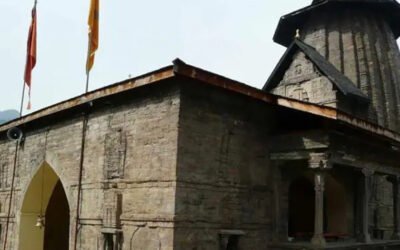
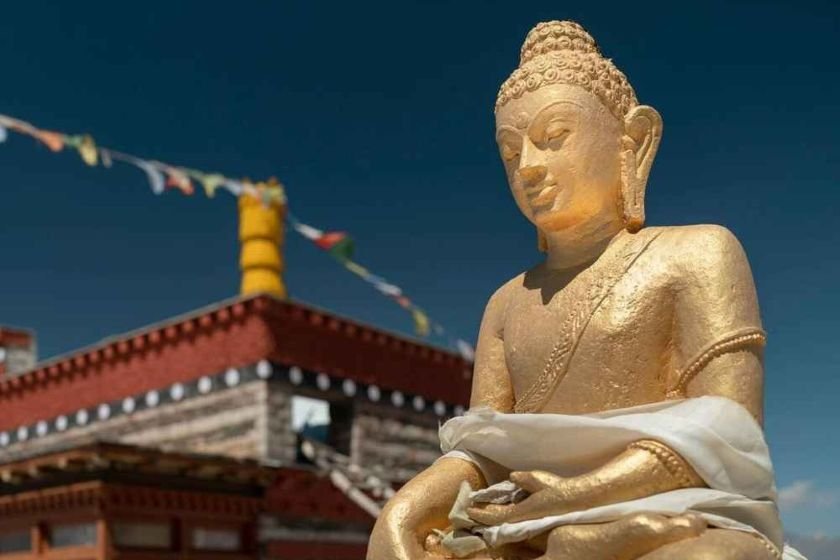
The architecture of Nako Monastery reflects the high Himalayan environment around it. The buildings are modest from outside, with stone walls, flat rooflines, wooden balconies or frames, and prayer flags moving in the wind. This is not the large fortress-like architecture of Key Monastery or the dramatic hilltop mass of Dhankar. Nako’s architecture is quieter, more village-bound.
That restraint is part of its beauty. The monastery does not try to rise above the village. It belongs to the settlement’s material language: stone, mud, timber, sun, dust, and winter. In the high cold-desert climate, walls hold warmth, roofs stay low, and the buildings sit close to the ground.
Inside, the mood changes. The bright mountain light gives way to darker painted chambers. Murals, mandalas, stucco images, and old surfaces hold the eye. These interiors need protection. Ancient Himalayan wall paintings are fragile, and careless photography, touching, smoke, dampness, or crowding can damage them.
A visitor should move slowly here. The monastery is not a place to rush through for one photograph. Its real value is in the transition from open sky to sacred interior.
📜 Nako, Tabo, and the Old Indo-Tibetan Route
Nako’s importance comes partly from where it stands. Kinnaur has long been a cultural corridor between the Indian Himalaya and Tibet. The old Hindustan–Tibet route carried trade, pilgrimage, language, and religious influence through these mountains. Nako sits in the upper Kinnaur belt near that old exchange zone.
This helps explain why the monastery feels related to the Buddhist world of Tabo, Spiti, and western Tibet. The style of art, the Rinchen Zangpo association, and the mandala imagery all point to a period when these high valleys were connected by more than roads. They were connected by teachers, translators, patrons, monks, artists, and travelling religious lineages.
The monastery’s conservation history is also important. Nako’s old temple art has required preservation attention because high-altitude conditions, age, and structural vulnerability can threaten murals and sculptures. Conservation efforts around Nako are a reminder that these temples are not only devotional spaces; they are fragile archives of Himalayan Buddhist art.
🌊 Nako Lake and the Padmasambhava Footprint Tradition
Nako Lake adds another sacred layer to the village. Public references describe a rock near the lake believed to carry the footprint of Guru Padmasambhava, with a shrine connected to that belief. This makes Nako not only a Rinchen Zangpo-associated site, but also part of the wider Padmasambhava memory found across the Himalayan Buddhist world.
The lake itself is small, but its setting is memorable. Willow and poplar trees soften the edge of the water. Houses, fields, prayer flags, and the surrounding mountains give it a quiet, enclosed feeling. In winter, the lake may freeze; in summer, it becomes a gentle centre for the village.
It is important not to treat the lake only as a photography point. For local people, it is part of the village’s identity and sacred landscape. Walk around it gently, avoid littering, do not disturb the water, and remember that in high-altitude settlements, water bodies are precious.
🎉 Festivals and Devotion
- Buddhist Ritual Life: Nako Monastery remains part of the Buddhist sacred landscape of upper Kinnaur. Specific pujas and ceremonies should be confirmed locally because small monasteries do not always follow tourist-facing schedules.
- Rinchen Zangpo Memory: The monastery is associated with Lochen Rinchen Zangpo and the translator tradition of the western Himalayas.
- Vajrayana Art: The old temple halls preserve mandala-based art, stucco images, and Buddhist iconography connected with Vajrayana practice.
- Padmasambhava Footprint Tradition: The nearby lake area is associated in local belief with a footprint of Guru Padmasambhava.
- Respect for Interiors: Ask before photographing murals, old statues, manuscripts, or inner temple spaces. Flash photography and touching walls should be avoided.
🏞️ While You’re in the Area
- Nako Lake: The village lake is the natural companion to the monastery, fringed with willows and poplars and central to Nako’s quiet setting.
- Padmasambhava Footprint Shrine: A local sacred point near the lake associated with Guru Padmasambhava’s visit in Buddhist tradition.
- Khab Sangam: The dramatic confluence area near Khab, where the Spiti and Sutlej river systems meet in a stark mountain landscape.
- Chango Monastery: A nearby Buddhist site on the road towards Spiti, known in references for an old prayer wheel tradition.
- Tabo Monastery: One of the great early Buddhist monasteries of the western Himalayas, best combined if travelling onward into Spiti.
- Kalpa: A major Kinnaur destination with views of the Kinnaur Kailash range, useful before or after the upper Kinnaur drive.
- Reckong Peo: The district headquarters and practical travel base for permits, supplies, transport, and onward movement into upper Kinnaur.
🙏 Getting in Touch
There is no need for ordinary travellers to book a formal visit to Nako Monastery, but access to old halls may depend on whether caretakers or monks are present. If a door is closed, ask locally rather than trying to enter.
Because Nako is close to the sensitive upper Kinnaur border belt, travellers should also check current road conditions, permit requirements if moving further towards restricted zones, and weather advisories before planning the route.
For a respectful visit, dress modestly, speak quietly, avoid touching murals or old objects, and do not photograph inside without permission. In high-altitude monasteries, preservation is part of devotion.
❓ Quick Questions Travellers Ask
Where is Nako Monastery located?
Nako Monastery is in Nako village, upper Kinnaur district, Himachal Pradesh, near Nako Lake.
How high is Nako?
The official Kinnaur district page places Nako at about 3,663 metres.
How old is Nako Monastery?
The monastery is commonly dated to the 11th century, with many references connecting it to 1025 CE and the Rinchen Zangpo tradition.
Who is Nako Monastery associated with?
It is associated with Lochen Rinchen Zangpo, the great translator linked with the spread of Buddhist learning and temple-building in the western Himalayas.
Can Nako Monastery be visited with Spiti?
Yes. Nako is commonly visited on the Kinnaur–Spiti route, especially between Kalpa/Reckong Peo and Tabo/Kaza, but road conditions should be checked.
A Last Word
Nako Monastery does not ask for attention loudly. It stands in a high village where lake water, stone houses, old walls, and thin air do most of the speaking. From outside, it may look modest. Inside, it carries a painted world of mandalas, translators, Tara, Vairochana, and Buddhist memory shaped over centuries.
That is the quiet power of Nako. It is not a fortress. It is not a huge monastic city. It is a small high Himalayan gompa that survived beside a lake, on a road once turned towards Tibet, in a village where winter can close in and silence can feel older than speech.
At Nako, the monastery does not dominate the landscape. It completes it.
Fact-check note: Nako’s location in upper Kinnaur, its elevation of 3,663 metres, its position above the Hangrang Valley road, its distance of about 119 km from Kalpa, and the presence of a lake fringed with willows and poplars are supported by the official Kinnaur district page. Nako Monastery’s common dating to the 11th century / 1025 CE, its association with Lochen Rinchen Zangpo, the name Lotsava Jhakang, and the description of the monastery as a four-hall complex with Vajrayana mandala art are supported by heritage and travel references, though detailed scholarly documentation varies in accessibility. The Padmasambhava footprint tradition near Nako Lake is treated as Buddhist sacred tradition rather than archaeological proof. Exact visiting hours, internal photography rules, and access to old halls should be confirmed locally.