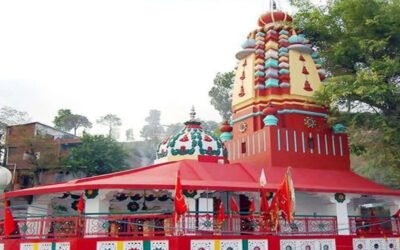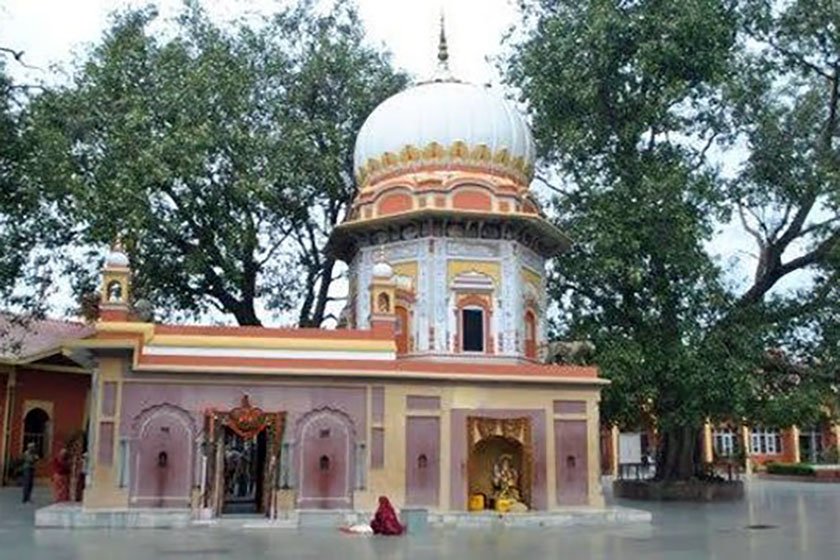
On a hillock near Nahan, Maa Bala Sundri is worshipped not as a distant warrior goddess, but as the child form of Durga — small in form, vast in devotion, and central to one of Sirmaur’s biggest pilgrim gatherings.
Some Devi temples announce themselves through height, remoteness, or old stone. Trilokpur does something gentler. It stands in the lower Shivalik belt of Sirmaur, close enough to the plains for pilgrims from Haryana, Punjab, Chandigarh, Uttar Pradesh, and Himachal to reach by road, yet old enough in memory to feel rooted in royal, local, and family tradition. The main shrine is dedicated to Shri Mahamaya Bala Sundri Ji, revered as a childhood form of Goddess Durga. Around her, Trilokpur gathers its name, its fairs, its temple trust, its legends, and its identity as one of the most important Shakti sites in southern Himachal.
🌄 Location & How to Reach It
Maa Bala Sundri Temple is located at Trilokpur in Sirmaur district, Himachal Pradesh, on an isolated hillock near the Nahan–Kala Amb side of the district. Official district information places Trilokpur about 24 km south-west of Nahan at an elevation of around 430 metres, while the temple trust’s travel page gives Nahan at about 16 km, Kala Amb at 6 km, Yamunanagar at 48 km, Ambala at 68 km, and Chandigarh at 78 km. The difference in Nahan distance appears to come from route and reference-point variation, so travellers should use current road navigation for the exact drive.
Google Maps: Get Directions
Elevation: about 430 metres
- By road: Trilokpur is the easiest to reach by road. The temple trust notes that National Highway 7 passes through Trilokpur, with bus and taxi access from nearby cities and towns. Kala Amb is the closest major roadside reference point.
- By rail: Practical railheads include Ambala, Yamunanagar, and Chandigarh, followed by road travel to Trilokpur or Nahan. The temple trust lists Ambala at about 68 km, Yamunanagar at about 48 km, and Chandigarh at about 78 km.
- By air: The nearest practical airports are Chandigarh and Dehradun. The temple trust gives Chandigarh Airport at roughly 75 km from the temple.
This is not a difficult Himalayan pilgrimage. It is a road-accessible Devi shrine, suitable for families, elderly devotees, and travellers moving between Nahan, Kala Amb, Paonta Sahib, and Chandigarh.
🌸 Best Time to Visit
The temple can be visited throughout the year, but the most comfortable months are October to March, when the lower Sirmaur belt is cooler. Summer afternoons can be hot around Trilokpur and Kala Amb, so morning darshan is better if you are visiting outside festival season.
The most important devotional periods are the two Navratri-linked fairs held at Trilokpur. District Sirmaur records that an important fair is held twice a year, in Chaitra and Asvina / Ashwin, from Sudi Ashtami to Chaudas, with the Chaitra fair drawing more people.
For ordinary visits, the official temple website lists the mandir opening time as 5:30 AM and closing time as 8:00 PM, with aarti timings at 5:30 AM and 7:45 PM. These timings are useful, but festival days can change the rhythm of darshan, queues, and crowd movement.
🕉️ The Child Form of Durga
The main shrine at Trilokpur is dedicated to Bhagwati Tripur Mahamaya Bala Sundri, described by the temple trust as a childhood form of Goddess Durga. This is the heart of the temple’s identity. Maa Bala Sundri is not only worshipped as power in its fierce form, but as Shakti in a childlike, tender, and deeply approachable form.
That detail matters. Many Devi temples in the Himalayas are associated with warlike force, local protection, or the goddess in her commanding form. Trilokpur carries another emotional register. The name Bala Sundri itself holds the sense of youthful beauty and divine girlhood. Devotees come with the usual prayers of health, family welfare, protection, and fulfilment of wishes, but the temple’s feeling is shaped by the image of the Mother as a child goddess.
This is also why the shrine has such a strong family pull. Many people visit with children, during Navratri, after vows, or during important family moments. The goddess is powerful, but the devotion around her is intimate.
🕉️ The Pindi in the Bag of Salt
The temple’s best-known origin story begins not with a king, but with a local shopkeeper named Lala Ram Dass. According to the temple trust’s own account, he dreamt of Maa Bala Sundri, who revealed that she had disappeared from Devban in Uttar Pradesh and instructed him to build a temple for her Pindi form. The next day, he found the sacred Pindi in a bag of salt brought from Devban. The story says that although salt was sold from the bag throughout the day, the bag remained full.
Lala Ram Dass then shared the event with Raja Dip Prakash of Sirmaur. The king agreed to construct a temple at Trilokpur for the installation of the divine Pindi. The temple trust states that artisans from Jaipur were invited in 1570 AD, and a marble temple dedicated to Goddess Tripur Bala Sundri was completed by 1573 AD.
This is a good example of how sacred memory works in Himachal. The legend preserves the shopkeeper, the salt bag, the dream, the king, the Pindi, and the arrival of the goddess in one flowing story. It is not necessary to read it like a modern historical file. Its purpose is different. It explains why the goddess chose Trilokpur, why a royal temple rose there, and why the descendants of Lala Ram Dass continue to be remembered in the temple’s ritual tradition.
🕉️ Trilokpur and the Three Shakti Temples
The name Trilokpur is often explained through a group of three Shakti temples in the area. The temple trust says the main temple is dedicated to Bhagwati Tripur Mahamaya Bala Sundri, while a second temple dedicated to Bhagwati Lalita Devi lies about 3 km away. A third temple is located about 13 km northwest of the main Bala Sundri temple, together forming a sacred triangle of Devi worship.
Himachal Eco Tourism also records three important Shakti temples at Trilokpur: Mata Balasundri, Mata Lalita Devi, and Tripur Bhairavi.
This triangle gives Trilokpur its deeper sacred geography. The main temple draws the largest pilgrim attention, but the name of the place points beyond a single sanctum. It suggests a spread of Shakti across the landscape — the goddess not only in one shrine, but in related forms held across nearby hills and routes.
🙏 What Maa Bala Sundri Temple Is Known For
Maa Bala Sundri Temple is known for its Pindi form of the goddess, its association with Raja Dip Prakash, the legend of Lala Ram Dass, and the two major annual fairs that draw lakhs of devotees from northern India. District Sirmaur describes Trilokpur as a place of great religious importance and notes that the temple of Mahamaya Bala Sundri attracts pilgrims from across North India.
For devotees, this is a place of vow, gratitude, and repeated return. Many families come during Navratri. Some come after a wish is fulfilled. Some come because their elders came before them. During the fairs, the shrine changes from a regular hill temple into a major public pilgrimage centre.
The temple trust also describes Trilokpur as the childhood place of Maa Vaishno Devi, a belief that adds another devotional layer to the site. This should be understood as temple tradition rather than a claim that all Vaishno Devi traditions agree on the same geography. For devotees of Trilokpur, however, the association increases the tenderness and importance of the place.
🏛️ Marble, Indo-Persian Lines, and a Royal Shrine
The present temple is often remembered as a royal construction of the Sirmaur state. District Sirmaur records that the temple was built by Raja Dip Parkash in 1573. The temple trust gives the fuller sequence: artisans invited from Jaipur in 1570 AD, temple completed in 1573 AD, renovation by Maharaja Fateh Prakash in 1823, and another renovation by Maharaja Raghubir Prakash in 1851.
The temple trust describes the shrine as a marble temple, while its introduction page mentions an amalgam of Indo-Persian styles of architecture. That makes Trilokpur different from many older Himachali shrines built in wood, stone, or kath-kuni styles. This is not a high-valley devta temple. It belongs to the Sirmaur courtly and Shivalik world — closer to plains routes, royal patronage, and marble temple design.
A visitor should not rush through the architecture only looking for mountain woodwork. The temple’s character lies in its clean lines, royal memory, Pindi worship, and the movement of devotees through a well-known pilgrimage complex. On a quiet day, the bells, marble surfaces, and hillock setting hold the place together. During fairs, the architecture becomes the centre around which a whole temporary world of devotion forms.
📜 Sirmaur’s Royal Memory and Living Temple Trust
Trilokpur’s story cannot be separated from the rulers of the old Sirmaur state. The temple’s origin account brings together local devotion and royal patronage: the goddess is discovered through a shopkeeper’s dream, then installed through the support of Raja Dip Prakash. The later renovations by Sirmaur rulers show that the shrine remained important beyond its founding generation.
The temple trust is also part of the site’s modern identity. The official website identifies it as Shri Mahamaya Balasundri Ji Temple Trust Trilokpur Sirmour H.P., registered and notified by the Government of Himachal Pradesh. This matters for visitors because Trilokpur is not an abandoned or informally managed shrine. It is an active, organised temple with facilities, timings, bhandara arrangements, accommodation links, donations, and notices.
At the same time, the older devotional line remains visible. The temple trust notes that the descendants of Lala Ram Das have been entrusted with performing the main puja and maintaining rituals and traditions. That continuity — shopkeeper’s dream, royal construction, family ritual line, and modern trust management — gives the temple a layered identity.
🎉 Festivals and Devotion
- Chaitra Navratri Fair: One of the two main annual fairs at Trilokpur. District Sirmaur notes that the Chaitra fair draws more people than the Ashwin fair.
- Ashwin / Asvina Navratri Fair: The second major fair of the year, also held from Sudi Ashtami to Chaudas according to the district record. Dates should be confirmed each year because they follow the Hindu calendar.
- Ashtami and Chaudas Gatherings: The district page notes that the biggest gatherings are seen on Ashtami and Chaudas, the first and final days of the fair period.
- Daily Aarti: The temple website lists aarti at 5:30 AM and 7:45 PM, though festival-day arrangements may vary.
- Bhandara: The official website lists bhandara timings as 11:00 AM to 3:00 PM and 8:15 PM to 9:45 PM. Visitors should confirm current arrangements during fairs and heavy crowd days.
🏞️ While You’re in the Area
- Nahan: The old Sirmaur town is the most practical base for Trilokpur, with markets, local stays, Rani Tal, and access to other sacred sites.
- Kala Amb: The nearest major road point, useful for travellers coming from Haryana, Chandigarh, Ambala, or Yamunanagar.
- Mata Lalita Devi Temple: Part of the Trilokpur Shakti triangle, about 3 km from the main Bala Sundri temple according to the temple trust.
- Tripur Bhairavi Temple: Another important Shakti shrine associated with Trilokpur’s sacred triangle, mentioned by Himachal Eco Tourism.
- Paudiwala Shiv Temple, Nahan: A nearby Shiva shrine known locally for the Ravana “stairway to heaven” legend.
- Suketi Fossil Park: A useful family and heritage stop near Kala Amb, especially if travelling with children.
- Renuka Ji: One of Sirmaur’s most important sacred landscapes, associated with Mata Renuka and Lord Parshuram; best planned as a separate half-day or full-day trip.
🙏 Getting in Touch
The temple has an official trust website under the name Shri Mahamaya Balasundri Ji Temple Trust Trilokpur Sirmour H.P. The website provides information on darshan timings, bhandara, accommodation, online donation, and temple notices.
For festival visits, check the latest trust notice board or district updates before travelling, because Navratri fair arrangements, room booking status, traffic movement, and crowd management can change. The temple website had 2026 notices related to mela tender and online room booking, showing that visitors should rely on current announcements rather than old travel blogs.
❓ Quick Questions Travellers Ask
Where is Maa Bala Sundri Temple located?
It is at Trilokpur in Sirmaur district, near Nahan and Kala Amb.
Which goddess is worshipped at Trilokpur?
The main shrine is dedicated to Shri Mahamaya Bala Sundri Ji, worshipped as a childhood form of Goddess Durga.
Who built Maa Bala Sundri Temple?
District Sirmaur records that it was built by Raja Dip Parkash in 1573. The temple trust links its construction to the discovery of the divine Pindi by Lala Ram Dass and royal patronage by Raja Dip Prakash.
When is the main fair held?
Two major fairs are held during Chaitra and Ashwin / Asvina Navratri, especially from Sudi Ashtami to Chaudas. Exact dates should be confirmed every year.
Is Trilokpur easy to reach?
Yes. It is road-accessible, close to Kala Amb, Nahan, Yamunanagar, Ambala, and Chandigarh, making it one of the more accessible major Devi temples in Himachal.
A Last Word
Maa Bala Sundri Temple does not feel important only because many people visit it. It feels important because several layers meet here without cancelling one another. A shopkeeper’s dream. A Pindi in a bag of salt. A Sirmaur king. Jaipur artisans. A marble shrine. A Shakti triangle. Two Navratri fairs. Families returning year after year.
At Trilokpur, the goddess is worshipped as a child, but the tradition around her is not small. It has travelled through centuries, through royal hands and local families, through fair crowds and quiet mornings. The temple stands close to roads and towns, yet its story still begins in the intimate space of a dream — Maa Bala Sundri choosing where she wished to be found.
Fact-check note: Maa Bala Sundri Temple’s location at Trilokpur in Sirmaur district, its association with Raja Dip Parkash / Dip Prakash, and the broad construction date of 1573 AD are supported by District Sirmaur and the official temple trust. The temple trust gives additional tradition about Lala Ram Dass, the Pindi found in a salt bag from Devban, artisans invited from Jaipur in 1570 AD, and later renovations in 1823 and 1851. The explanation of Trilokpur as a sacred triangle of three Shakti temples is supported by the temple trust and Himachal Eco Tourism, though names and distances of the associated shrines should be locally confirmed before planning a full circuit. Distances from Nahan vary between official district and temple-trust references, so this article gives both cautiously rather than forcing one exact figure.