Below the Dhauladhar mountains, Gyuto’s yellow monastery rises in Sidhbari as a school of deep ritual practice, carrying one of Tibet’s great tantric traditions into Himachal.
Some monasteries are known for silence. Gyuto is known for sound — deep, resonant, disciplined chanting that seems to come from somewhere lower than the chest and older than the building itself. The monastery at Sidhbari near Dharamshala is the Indian seat of Gyuto Tantric Monastery / Gyuto Dratsang, one of the great tantric institutions of the Gelug tradition of Tibetan Buddhism. Its roots go back to 15th-century Tibet, but its present life belongs to the story of exile, rebuilding, study, ritual, and survival. Many travellers know the place for its bright yellow architecture and Dhauladhar backdrop. For Buddhists, it is much more: a centre where tantric meditation, ritual arts, Buddhist philosophy, and the famous Gyuto chanting tradition continue far from their original home.
🌄 Location & How to Reach It
Gyuto Tantric Monastery is located in Sidhbari, near Dharamshala in Kangra district, Himachal Pradesh. Sidhbari sits below the Dhauladhar range, away from the heavier tourist flow of McLeod Ganj, which gives the monastery a calmer setting. Himachal Tourism identifies Gyuto Monastery at Sidhwari / Sidhbari near Dharamshala and notes its association with Tibetan Buddhist life in exile.
Google Maps: Get Directions
Elevation: around 1,300–1,400 metres in the Sidhbari–Dharamshala foothill belt, depending on the exact point of approach.
- By road: The usual route is through Dharamshala – Sidhbari, or from Gaggal / Kangra side towards Sidhbari. Taxis and local vehicles are easily available from Dharamshala, McLeod Ganj, and Gaggal.
- By rail: The nearest broad-gauge railway station is Pathankot, followed by road travel to Kangra, Dharamshala, and Sidhbari. The Kangra Valley narrow-gauge railway also serves parts of the region, but most long-distance travellers use Pathankot.
- By air: The nearest airport is Gaggal Airport / Kangra Airport, followed by a short road journey towards Dharamshala and Sidhbari.
This is an easy road-accessible monastery visit once you are in Dharamshala. It is quieter than McLeod Ganj’s temple zone, but it should still be visited respectfully as an active monastic institution, not as a photo stop alone.
🌸 Best Time to Visit
The best months to visit Gyuto Tantric Monastery are usually March to June and September to November. Spring and early summer bring pleasant weather, clear monastery views, and a good chance of seeing the Dhauladhar mountains behind the yellow temple building. Autumn often gives sharper light and clearer skies.
Monsoon can be heavy in the Dharamshala region. July and August bring mist, rain, slippery roads, and occasional landslide disruption. Winter is colder, but the monastery can look especially striking when the Dhauladhar peaks are snow-covered.
For ordinary visitors, daytime is best. Many travel references list general visiting hours roughly from morning to evening, but timings at active monasteries can change because of prayers, teachings, monastic routines, and special events. Do not force entry into prayer halls, do not interrupt monks, and ask before photographing interiors or ceremonies.
🕉️ The Upper Tantric College of the Gelug Tradition
Gyuto is not just a monastery name. It is one of the great tantric colleges of the Gelugpa school of Tibetan Buddhism. The official Gyuto website describes Gyuto Monastery as one of the most famous monasteries in Tibet, specializing in tantric meditation, tantric ritual arts, and Buddhist philosophy. It also records that the monastery was founded in 1474 by Jetsun Kunga Dhondup, the main disciple of the First Dalai Lama.
This makes Gyuto very different from a monastery that mainly serves local village worship. Gyuto’s role has always been scholastic and ritual. Monks trained here study advanced Vajrayana practice, ritual systems, philosophy, chanting, mandala work, and the disciplined forms of meditation connected with the Gelug tradition.
The name Gyuto Dratsang is often translated as the Upper Tantric College. Along with Gyume, the Lower Tantric College, Gyuto forms part of the old Tibetan system for advanced tantric education. The Geluk Foundation describes Gyuto as a major tantric institute established for preserving and promoting the tantric teachings of Je Tsongkhapa, whose lineage drew from Indian Buddhist masters such as Nagarjuna and the great Nalanda tradition.
To understand Gyuto properly, one has to understand this: the monastery is not only a place where Buddhism is remembered. It is a place where a highly specialised ritual education continues.
🕉️ From Tibet to India: A Monastery Rebuilt After Exile
Gyuto’s present home in Sidhbari is part of the larger Tibetan exile story. The monastery’s original life was in Tibet. After 1959, when the Tibetan religious and political world was shaken by exile, many monastic institutions had to rebuild in India.
Gyuto’s tradition was first carried out of Tibet by monks who escaped and preserved the lineage. Public references record that the monastery was re-established in India after the events of 1959, and that its main seat is now in Sidhbari near Dharamshala.
This gives the monastery a historical weight beyond its architecture. The yellow buildings at Sidhbari are not old in the way an ancient stone temple is old. But the institution inside them is old. The chants, rituals, texts, and monastic discipline come from a much older Tibetan world.
That is why Gyuto feels both new and ancient. The building belongs to modern Himachal. The ritual memory belongs to centuries of Tibetan Buddhism.
🙏 What Gyuto Tantric Monastery Is Known For
Gyuto Tantric Monastery is known for three major things: tantric Buddhist study, ritual practice, and the deep Gyuto chanting tradition.
The monastery specialises in the study of tantric meditation, tantric ritual arts, and Buddhist philosophy. Its monks are also famous for a form of deep overtone or chordal chanting, a distinctive sound associated with Tibetan tantric ritual. Public reference material notes that Gyuto monks became internationally known for this chanting tradition, especially through recordings and performances outside Tibet.
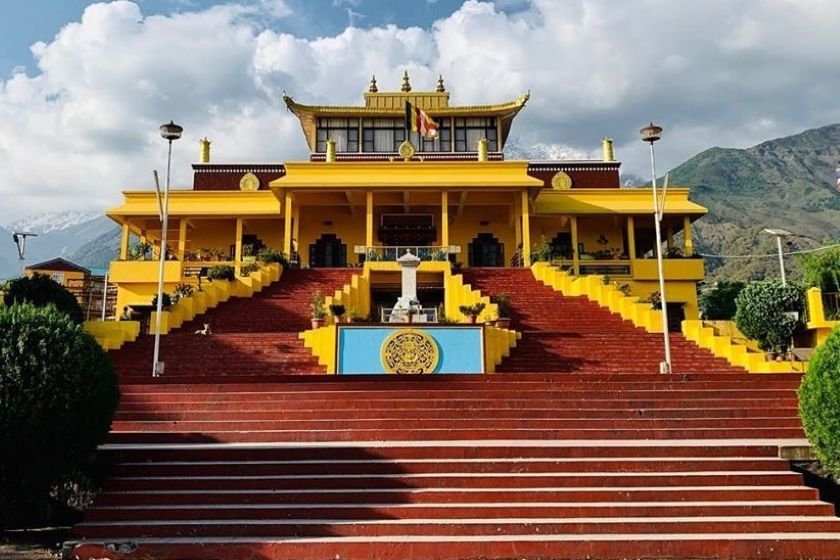
For visitors, the most visible features are the monastery’s bright yellow buildings, red stairways, prayer spaces, monks in maroon robes, and the mountain backdrop. But the real identity of Gyuto lies in practice, not colour. The monastery is a working centre of learning and ritual.
Gyuto is also widely known in the Dharamshala region because of its association with the 17th Karmapa, Ogyen Trinley Dorje, who was hosted at Gyuto after coming to India. Himachal Tourism describes Gyuto Monastery at Sidhbari as the dwelling place of the Karmapa in exile, while later reference material notes that he resided there until 2017. Because the Karmapa’s present movements and residence are sensitive and changeable, the safer way to write this is that Gyuto has been strongly associated with the Karmapa’s exile period, not that he is necessarily present there now.
🏛️ Yellow Walls, Red Steps, and the Dhauladhar Behind
Gyuto’s architecture is visually memorable. The main temple building is painted in a warm yellow, with red steps, Tibetan roof details, golden elements, and a broad front approach. When the Dhauladhar mountains are clear behind it, the monastery becomes one of the most photogenic Buddhist sites in the Dharamshala area.
But the building should not be reduced to a scenic frame. The architecture is functional and monastic. It holds prayer halls, study spaces, residential quarters, courtyards, and areas for ritual practice. The colours are bright, but the atmosphere is disciplined.
A visitor walking through the complex may notice the difference between outside and inside. Outside, the monastery has open views, clipped gardens, steps, and mountain air. Inside, the pace becomes slower. The sound of chanting or recitation, if heard, changes the mood immediately. Gyuto’s famous sound is not background music. It is part of ritual practice.
The best way to experience the monastery is quietly. Stand back. Watch how monks move. Do not block steps or doorways. Do not photograph monks closely without permission. Let the place remain a monastery first.
📜 Gyuto, Je Tsongkhapa, and the Discipline of Tantra
The Gelug tradition, founded by Je Tsongkhapa, places strong emphasis on disciplined study, ethical training, philosophical clarity, and tantric practice built on a solid foundation. Gyuto’s purpose fits that lineage. It was established to preserve and transmit tantric teachings in a formal monastic setting.
Tantra is often misunderstood by outsiders. In the Tibetan Buddhist monastic context, it is not exotic spectacle. It involves vows, visualisation, mantra, deity yoga, ritual precision, philosophical training, meditation, and strict discipline under qualified teachers. Gyuto’s identity comes from this seriousness.
That is also why the monastery’s chants matter. The deep voices of Gyuto monks are not performed simply to impress listeners. They belong to ritual, lineage, and trained practice. The sound carries a religious function.
For travellers, this is important. Gyuto should not be approached only as a beautiful stop on the Dharamshala sightseeing list. It is a living tantric college. The correct response is not curiosity alone, but respect.
🎉 Rituals, Chanting, and Devotion
- Tantric Ritual Practice: Gyuto is one of the major Gelugpa tantric institutions, dedicated to tantric meditation, ritual arts, and Buddhist philosophy.
- Deep Chanting Tradition: Gyuto monks are widely known for their distinctive overtone or chordal chanting tradition, which became famous internationally through recordings and performances.
- Monastic Study: The monastery functions as a centre of Buddhist learning and advanced ritual training, not only as a visitor site.
- Karmapa Association: Gyuto is strongly associated with the exile period of the 17th Karmapa, Ogyen Trinley Dorje, though visitors should not assume his current presence at the monastery.
- Visitor Conduct: Speak softly, dress modestly, avoid intrusive photography, and follow instructions around prayer halls, monk areas, and restricted spaces.
🏞️ While You’re in the Area
- Norbulingka Institute: A major Tibetan arts and culture centre near Sidhbari, useful for understanding Tibetan craft, thangka painting, woodwork, and cultural preservation.
- Chinmaya Tapovan / Sandeepany Himalayas: A major spiritual ashram in Sidhbari associated with Swami Chinmayananda, showing the area’s multi-tradition sacred character.
- Aghanjar Mahadev Temple, Khanyara: A Shiva temple near the Manuni stream, often visited from Dharamshala and Sidhbari.
- Dharamshala: The main town base for transport, hotels, markets, and access towards McLeod Ganj, Sidhbari, and Kangra Valley.
- Tsuglagkhang / Dalai Lama Temple Complex: The main Tibetan temple complex in McLeod Ganj, connected with His Holiness the Dalai Lama and Tibetan exile life.
- Namgyal Monastery: The personal monastery of the Dalai Lama, closely associated with the Tibetan Buddhist sacred area of McLeod Ganj.
- Kangra Art Museum: A useful stop in Dharamshala for travellers interested in Kangra painting, local heritage, and regional culture.
🙏 Getting in Touch
Gyuto has an official website that identifies the monastery as a major Tibetan Buddhist institution specialising in tantric meditation, ritual arts, and Buddhist philosophy, with its founding attributed to Jetsun Kunga Dhondup in 1474.
For ordinary visits, no special booking is usually required, but access can depend on monastic schedules, prayers, teachings, or internal restrictions. If a hall is closed, do not push for entry. Ask respectfully or visit another time.
For visitors hoping to see rituals or chanting, it is better to ask locally at the monastery about current timings rather than relying on old travel blogs. Monastic schedules can change.
❓ Quick Questions Travellers Ask
Where is Gyuto Tantric Monastery located?
It is in Sidhbari, near Dharamshala in Kangra district, Himachal Pradesh. Himachal Tourism identifies it as Gyuto Monastery at Sidhwari near Dharamshala.
What is Gyuto Monastery famous for?
It is famous for tantric Buddhist study, ritual practice, Buddhist philosophy, and the deep chanting tradition of Gyuto monks.
When was Gyuto Monastery founded?
The official Gyuto website says it was founded in 1474 by Jetsun Kunga Dhondup, the main disciple of the First Dalai Lama.
Is Gyuto Monastery connected with the Karmapa?
Yes. Gyuto Monastery at Sidhbari is strongly associated with the exile period of the 17th Karmapa, Ogyen Trinley Dorje. Visitors should not assume his current presence there.
Can visitors enter Gyuto Monastery?
Visitors can generally visit the monastery respectfully, but access to prayer halls or ceremonies may depend on monastic rules and schedules. Always follow instructions on site.
A Last Word
Gyuto Tantric Monastery is easy to photograph and harder to understand. The yellow walls, red steps, and snow peaks make a beautiful image, but the monastery’s real strength is not visual. It is carried in chanting, ritual discipline, lineage, and the quiet work of monks keeping a tantric tradition alive in exile.
At Sidhbari, Gyuto does not try to be dramatic. It stands below the Dhauladhar like a bright marker of continuity. Tibet’s old tantric college could not remain untouched by history, but it did not vanish. It moved, rebuilt, and continued.
That is what Gyuto teaches before any formal teaching begins: sacred sound can survive displacement, and a monastery can carry a whole world across the mountains.
Fact-check note: Gyuto Monastery’s official website identifies it as a major Tibetan Buddhist monastery specialising in tantric meditation, tantric ritual arts, and Buddhist philosophy, founded in 1474 by Jetsun Kunga Dhondup. The Geluk Foundation supports Gyuto’s identity as a tantric institute preserving the tantric teachings of Je Tsongkhapa and the Gelug lineage. Himachal Tourism places Gyuto Monastery at Sidhwari / Sidhbari near Dharamshala and notes its association with the Karmapa in exile. Because the 17th Karmapa’s present residence and movements are sensitive and have changed over time, this article describes Gyuto as strongly associated with his exile period rather than claiming he is currently resident there. General visiting hours and chanting times are not forced because monastic schedules can change.