Above the Gehrwin side of Bilaspur, Badol Devi is remembered through a simple village miracle: a cow releasing milk at one spot, an old man watching in wonder, and a goddess choosing where she wished to be worshipped.
Not every temple begins with a king, a war, or a grand inscription. Some begin with a sign noticed by an ordinary person. Badol Devi Temple in Badol village, near Gehrwin in Bilaspur district, belongs to that quieter category of Himalayan shrines where local faith gathers around a moment of discovery.
The temple is dedicated to Maa Badol Devi, locally worshipped as a powerful form of the goddess. Available references place it around 3 km from Gehrwin, on the Gehrwin–Dhanthar road, and describe it as a hilltop or elevated village shrine. Its most loved story is simple but deeply familiar in Indian sacred geography: a cow repeatedly offers milk at a mysterious spot, a villager notices, and the place becomes known as the seat of the Devi.
That story gives the temple its character. Badol Devi is not presented here as a distant goddess brought from elsewhere. She is found in the land itself.
🌄 Location & How to Reach It
Badol Devi Temple is located in Badol village in Bilaspur district, Himachal Pradesh. The temple is commonly described as lying about 3 km from Gehrwin on the Gehrwin–Dhanthar road. The setting is local, rural, and hill-facing, making it a peaceful Devi shrine for devotees from nearby villages as well as visitors exploring Bilaspur’s lesser-known sacred sites.
Google Maps: Get Directions
Elevation: Available local references place the temple area around 700 m above sea level, though a survey-certified temple-specific elevation is not consistently published.
- By road: The temple is approached from Gehrwin, with Badol village lying around 3 km away on the Gehrwin–Dhanthar side. Gehrwin is connected with Bilaspur, Ghumarwin, Jhandutta, and nearby villages by local roads.
- By rail: The nearest practical broad-gauge railway access is usually through Kiratpur Sahib, Una, Chandigarh, or other Punjab-side stations, followed by road travel into Bilaspur district.
- By air: The nearest commonly used airports are Chandigarh Airport and Kangra / Gaggal Airport, followed by road travel. For most visitors, road access is the simplest option.
This is not a difficult trek, but the temple’s hill-village setting means visitors should confirm the final local road or path before travelling, especially during monsoon or after heavy rain.
🌸 Best Time to Visit
Badol Devi Temple can generally be visited through most of the year. The most comfortable months are October to March, when the lower Bilaspur hills are cooler, and March to June, if visiting in the morning or evening.
Summer in Bilaspur district can be warm, so early visits are more comfortable. Monsoon brings greenery to the hills, but local roads may become slippery or damaged after heavy rain. Winter is usually manageable, though mornings and evenings can be cool.
As a Devi temple, Navratri is naturally a meaningful period for worship, but exact local arrangements should be confirmed in Badol or Gehrwin before planning around festival days. Some local pages and social references also show community gatherings and religious activity around the temple, but a stable official festival calendar is not widely published.
Visit during daylight, especially if you are unfamiliar with the Gehrwin–Dhanthar road or village approach. The temple should be treated as a living shrine, not as a picnic spot.
🕉️ The Cow, the Old Man, and the Chosen Spot
The most important local legend of Badol Devi Temple begins with an old villager named Bhura. According to the story, Bhura noticed something unusual: his cow was releasing milk at a particular place without being milked.
In rural sacred traditions, such a sign is never treated casually. A cow offering milk at one spot suggests that the land itself is sacred. Similar stories are found across India, especially around Shiva lingams, Devi shrines, serpent stones, and village deities. The idea is not that humans decide where the divine belongs. The divine reveals itself, and humans recognise it.
At Badol, the place where the cow gave milk became the point of worship. The Devi was understood to have chosen that spot.
This kind of legend matters because it roots the temple in local soil. The goddess is not distant. She is discovered in the village’s own landscape, through an animal associated with purity, nourishment, and sacred generosity. Bhura’s role is also important. He is not a king or priest in the story. He is an ordinary villager who notices what others might have missed.
The temple, in this sense, begins with attention.
🙏 Maa Badol Devi and the Village Devotion of Bilaspur
Maa Badol Devi is worshipped as a local form of the goddess, often connected in public references with Durga or Devi power. In village worship, the exact theological label is often less important than the relationship between the deity and the community. She is the mother of the place, the protector of the village, the one who listens to vows and receives offerings.
Devotees may come for health, family peace, protection, relief from trouble, and fulfilment of wishes. Like many local Devi shrines, the temple carries both tenderness and strength. The goddess is mother, but she is not weak. She protects, warns, heals, and holds authority over the land.
What makes Badol Devi Temple meaningful is this closeness. It is not a temple where devotion feels distant or ceremonial only. It belongs to people who may have grown up hearing the cow legend, visiting during family occasions, or stopping at the shrine when life becomes uncertain.
For outsiders, the temple offers a glimpse of how Himachal’s village Devi tradition works. The goddess is not only worshipped in famous Shakti Peethas. She is also present in small hill villages, on local roads, in places where faith is carried by memory more than publicity.
🏛️ A Hilltop Shrine With Local Strength
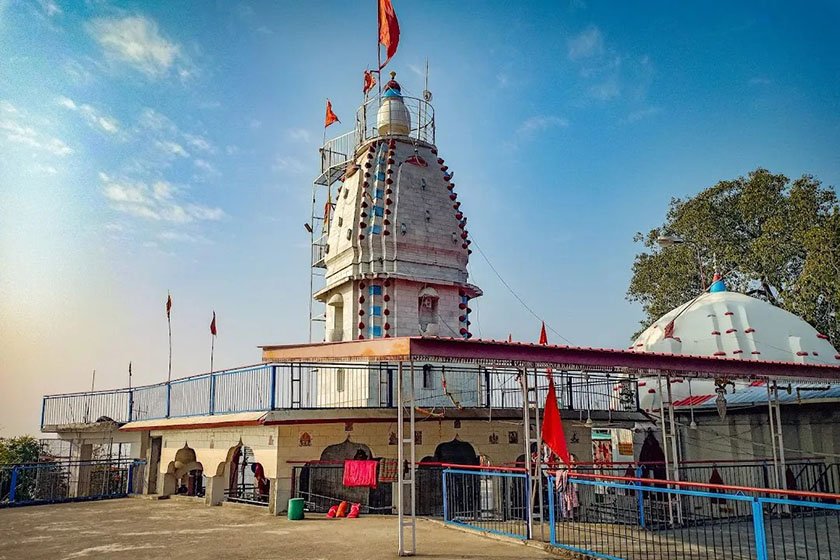
Badol Devi Temple is often described as a hilltop or elevated shrine. Its setting gives it a quiet separation from ordinary movement without making it inaccessible. The climb or approach is part of the experience. The devotee leaves the roadside rhythm and moves into a more focused sacred space.
The temple itself should not be judged by the standards of large archaeological monuments. Its value lies in living devotion. Local temples often change over time through repairs, repainting, additions, community work, and seasonal care. Their sacred identity does not depend on preserving every original material layer.
What matters at Badol is the goddess’s seat, the legend of discovery, and the way people continue to gather there.
The hill setting also gives the temple a wider visual presence. Even a modest shrine can feel powerful when placed above surrounding land. The visitor senses why such places become sacred: height, quiet, air, and view all support worship.
Stone and concrete may change. The feeling of a Devi watching from above remains.
📜 Badol, Gehrwin, and the Local Devi Network
Badol Devi Temple belongs to the local sacred geography of the Gehrwin region in Bilaspur district. This area includes other village and Devi shrines, including Sheetla Mata Temple at Jangla, which is often mentioned in connection with the Gehrwin side. Some local references describe Sheetla Devi as the younger sister of Badol Devi, showing how these shrines are understood not as isolated places, but as related sacred presences.
This is typical of Himachal’s village deity world. Deities have relationships. They may be sisters, brothers, guardians, attendants, or companions. Their temples form a local network that people understand through stories, fairs, routes, and family tradition.
Badol Devi therefore should not be seen only as one temple in one village. She is part of a wider landscape of local Devi worship. Her story connects with animals, land, village memory, and neighbouring goddess traditions.
For travellers, this is important. The famous temples of Himachal are only one layer. The deeper religious map is often held by such local shrines, where a village deity may be more emotionally central to nearby people than a famous pilgrimage centre many kilometres away.
🕉️ The Goddess as Power and Peace
Some local references describe Badol Devi as a symbol of both power and peace. That combination is common in Devi worship. The goddess is not only gentle, and she is not only fierce. She can cool fear and confront danger. She can bless a child and punish arrogance. She can receive flowers and still command deep respect.
Badol Devi’s cow-discovery legend shows her peaceful side: a sacred sign given through milk, nourishment, and wonder. Her hilltop presence shows her power: a Devi established above the village, watching the surrounding land.
This balance is one reason local goddess temples remain so important. People do not come only for philosophical ideas. They come because life requires both strength and calm. A family may ask for protection. A farmer may ask for good conditions. A mother may pray for a child. A devotee may return after a vow is fulfilled.
The goddess meets these needs not as an abstract cosmic figure, but as Maa — the mother of the place.
🎉 Festivals and Devotion
- Navratri: As a Devi shrine, Navratri is a meaningful period for worship. Local dates, rituals, and crowd levels should be confirmed in Badol or Gehrwin before planning a visit.
- Local Devi worship: Devotees visit Maa Badol Devi for blessings, protection, family well-being, and fulfilment of vows.
- Community gatherings: Local social and religious references indicate community activity around the temple, but an official annual event calendar is not widely available.
- Offerings and vows: Visitors may offer flowers, prasad, coconut, chunri, or other items according to local temple custom.
- Related goddess sites: Devotees may combine Badol Devi with nearby Sheetla Mata Temple because of the local relationship between the two goddess traditions.
🏞️ While You’re in the Area
- Sheetla Mata Temple, Jangla: A nearby temple around 1.5 km from Gehrwin, known for its water-tank setting and local connection with Badol Devi tradition.
- Gehrwin: The nearest local reference point for reaching Badol village and understanding the surrounding village-temple circuit.
- Jhandutta: A nearby tehsil-region centre useful for local roads, village access, and movement in this part of Bilaspur district.
- Bilaspur Town: A practical base for food, transport, and combining the visit with other Bilaspur sacred sites.
- Baba Nahar Singh Temple, Dholra: A major local devta shrine in Bilaspur town, associated with Baba Nahar Singh Ji and his sacred kharaun.
- Laxmi Narayan Mandir, Bilaspur: A town temple dedicated to Lord Vishnu and Goddess Lakshmi, located near the Bilaspur bus stand side.
- Naina Devi Temple: One of Himachal’s major Shakti shrines, suitable for travellers planning a wider Bilaspur district pilgrimage route.
🙏 Getting in Touch
There is no widely verified official website, booking system, public temple office, or formal contact number available for Badol Devi Temple in accessible public sources. For current darshan access, local festival arrangements, priest availability, and the exact village approach, ask locally in Badol, Gehrwin, or nearby Bilaspur district villages.
If you are visiting during Navratri or a local gathering, confirm arrangements before travelling. Village temples often follow community-based schedules rather than formal tourist-facing timings.
As with all living Devi shrines, remove shoes where required, keep the temple area clean, avoid loud behaviour, and ask before photographing the sanctum, deity, or ritual spaces.
❓ Quick Questions Travellers Ask
Where is Badol Devi Temple located?
Badol Devi Temple is located in Badol village, around 3 km from Gehrwin in Bilaspur district, Himachal Pradesh.
Which deity is worshipped here?
The temple is dedicated to Maa Badol Devi, worshipped as a local form of the Devi / Durga tradition.
What is the main legend of Badol Devi Temple?
The popular local legend says that an old villager named Bhura saw his cow releasing milk at a particular spot, which led to the discovery and worship of the goddess there.
Is the temple on a hill?
Yes. Available local references describe it as a hilltop or elevated village shrine.
How far is Badol Devi Temple from Gehrwin?
It is commonly described as about 3 km from Gehrwin on the Gehrwin–Dhanthar road.
Is Badol Devi connected with Sheetla Mata?
Local references connect the two goddess traditions, describing Sheetla Devi as the younger sister of Badol Devi.
Is there a trek to reach the temple?
It is not a major trek, but the final approach may involve local village roads or a short climb depending on the route.
What is the best time to visit?
The cooler months from October to March are comfortable. Navratri is spiritually meaningful, but local arrangements should be confirmed.
Can it be combined with other Bilaspur temples?
Yes. It can be combined with Sheetla Mata Temple, Baba Nahar Singh Temple, Laxmi Narayan Mandir, and other Bilaspur sacred sites.
Are photos allowed inside?
Photography rules may depend on local custom. Ask before photographing the sanctum, deity, or ritual areas.
A Last Word
Badol Devi Temple carries the kind of story that belongs naturally to Himachal’s villages. A cow gives milk at one spot. An old man notices. The land reveals a goddess. A shrine grows, and generations keep returning.
There is no need to make the story larger than it is. Its strength is in its simplicity. The goddess did not arrive through royal power or public announcement. She was found through attention, humility, and a sign given in the daily life of a village.
In Badol, Maa Badol Devi remains close to the land and its people. The hill holds her seat, the village carries her name, and the old legend still explains why this place is sacred.
Fact-check note: Public information on Badol Devi Temple, Bilaspur is limited, but available local and travel references consistently place the temple in Badol village, about 3 km from Gehrwin on the Gehrwin–Dhanthar road in Bilaspur district. The temple is described as a hilltop or elevated Devi shrine dedicated to Maa Badol Devi / Durga. The popular legend of an old villager named Bhura seeing his cow pour milk at a specific spot is treated here as local sacred tradition rather than documentary history. Some local references connect Sheetla Devi as the younger sister of Badol Devi; this relationship is included as regional devotional tradition. Exact construction date, founder, formal temple management details, daily timings, and temple-specific elevation are not firmly verified in accessible public sources, so this article avoids forcing those claims.