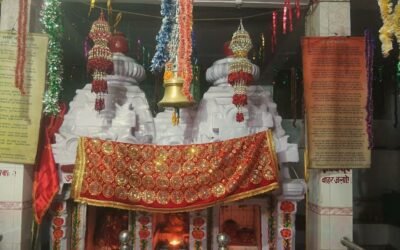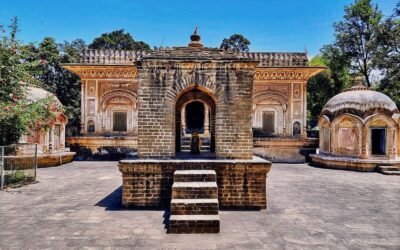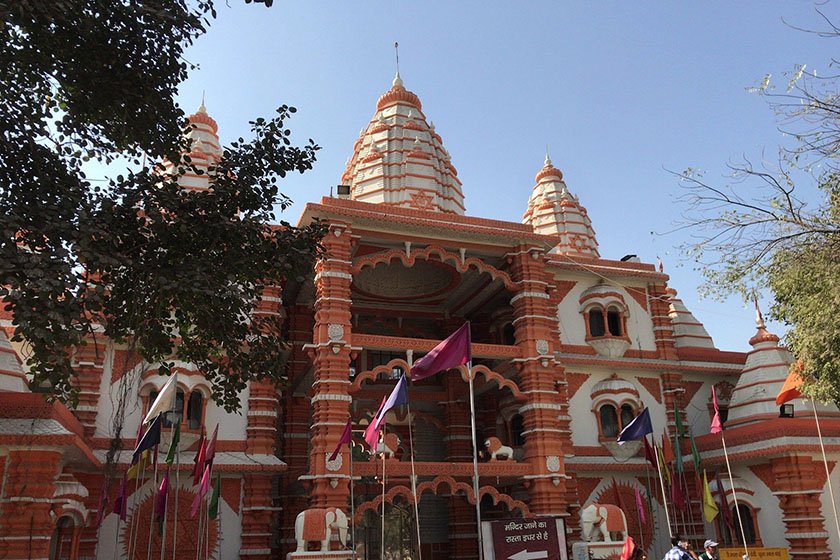
Near Gehrwin, a small temple stands not on a hilltop or inside a crowded bazaar, but in the middle of a tank — where the goddess of cooling grace is approached across water.
Some temples are remembered first by their deity. Some by their age. Some by a festival, a legend, or a hilltop view. Sheetla Mata Temple near Gehrwin is remembered first by its setting. The shrine stands in Jangla village, about 1.5 km from Gehrwin in Bilaspur district, and is built in the middle of a water tank.
That single detail gives the temple its character. To reach the shrine, devotees cross towards it by a concrete pathway, leaving the ordinary ground behind and entering a small sacred island of devotion. For a goddess whose name is associated with cooling, healing, and relief from heat and disease, the presence of water around the temple feels deeply appropriate.
Sheetla Mata is worshipped across India as a mother connected with protection, cooling energy, health, and relief from afflictions. At Jangla near Gehrwin, that wider goddess tradition takes a local form — a quiet Bilaspur shrine surrounded by water, linked with nearby Badol Devi, and remembered through simple rural devotion.
🌄 Location & How to Reach It
Sheetla Mata Temple is located in Jangla village, about 1.5 km from Gehrwin in Bilaspur district, Himachal Pradesh. Gehrwin lies in the Bilaspur region and is connected with nearby local sacred places such as Badol Devi Temple and other village shrines. The temple’s most distinctive feature is its placement in the middle of a tank, reached by a concrete pathway.
Google Maps: Get Directions
Elevation: A precise temple-specific elevation is not consistently published in reliable public sources. Gehrwin lies in the lower hill region of Bilaspur district, not in a high-altitude snowbound zone.
- By road: Gehrwin is connected by local roads with Bilaspur, Ghumarwin, Jhandutta, and nearby villages. From Gehrwin, the temple is around 1.5 km away in Jangla village. Visitors should confirm the exact local approach before travelling.
- By rail: The nearest practical broad-gauge railway access is generally through Kiratpur Sahib, Una, Chandigarh, or other Punjab-side stations, followed by road travel into Bilaspur district.
- By air: The nearest commonly used airports are Chandigarh Airport and Kangra / Gaggal Airport, followed by road travel. For most visitors, road access is the practical choice.
This is not a trekking shrine. It is a local village temple and can be visited comfortably with local directions from Gehrwin or nearby Bilaspur-side routes.
🌸 Best Time to Visit
Sheetla Mata Temple can generally be visited through most of the year. The most comfortable months are October to March, when the lower Bilaspur hills are cooler, and March to June, if visiting in the morning or evening.
Summer in Bilaspur district can be warm, and since Sheetla Mata is associated with cooling grace and relief, many devotees naturally connect her worship with protection from heat, fever, and disease. Morning visits are better in hot months. Monsoon brings greenery but may make local roads slippery, so confirm conditions if heavy rain is expected.
The most meaningful devotional period for Sheetla Mata worship in many North Indian traditions comes around Sheetla Ashtami / Basoda, usually observed after Holi, though local observance can vary. Since public sources do not provide a verified festival calendar for this specific Jangla temple, travellers should confirm locally before planning around a special ritual day.
Visit during daylight, especially if you want to see the tank setting clearly. As always, ask locally before photographing the sanctum or inner shrine.
🕉️ The Goddess Who Cools
The name Sheetla comes from the idea of coolness. Sheetla Mata is widely worshipped as the goddess who cools fever, protects from disease, and brings relief from heat and affliction. In older village belief, she was especially associated with protection from pox-related illnesses, childhood disease, and sudden outbreaks.
This does not mean the temple should be understood only through fear of illness. Sheetla Mata’s worship is also about peace, balance, cleansing, and maternal protection. She is the mother who calms what is burning — in the body, in the home, or in the mind.
At Gehrwin, the water around the temple strengthens that meaning. The shrine stands inside a tank, so the devotee does not approach the goddess only through a doorway. The visitor crosses water first. That crossing gives the visit a gentle ritual feeling. It is a small movement from heat to coolness, from road to reflection, from daily noise to darshan.
This is why the temple’s setting matters. The water is not merely scenic. It helps explain the goddess.
🌊 A Shrine in the Middle of a Tank
Sheetla Mata Temple’s most memorable feature is its position in the middle of a tank. Local travel references compare the setting loosely with the idea of a shrine surrounded by water, though the scale is much smaller and should not be confused with large pilgrimage complexes.
A concrete pathway leads to the temple, allowing devotees to walk across the tank towards the shrine. That approach is simple, but meaningful. The water makes the temple feel separated from ordinary ground without making it difficult to reach.
In many Indian sacred sites, water marks transition. A pond, spring, tank, baodi, or kund may cleanse, cool, reflect, or protect. At Sheetla Mata Temple, the tank gives the shrine a calm visual identity. It makes the temple easy to remember even for those who visit only once.
The water also asks for responsibility. Visitors should not throw waste, plastic, flowers wrapped in polythene, or food remains into the tank. A sacred water body is part of the temple, not a dumping place. Keeping it clean is itself a form of respect to Sheetla Mata.
🏛️ The Idol Said to Come From Makhowal
One of the important traditions connected with Sheetla Mata Temple is that the idol of the goddess installed here was sculpted at Makhowal, near Anandpur Sahib. Public travel references repeat this detail, though they do not provide a detailed inscriptional history of the idol’s making or installation.
The tradition is still worth noting because it links this Bilaspur shrine with the broader sacred-art landscape around Anandpur Sahib. Makhowal is historically associated with the Anandpur Sahib region, a place with deep religious memory in Punjab and the lower Himalayas. If the idol tradition is accepted as local memory, it suggests that the temple’s sacred image was not merely a village-made object, but something brought with care from a known devotional region.
This should be treated cautiously. The exact date, sculptor, patron, and installation history are not firmly verified in accessible public sources. But the belief itself adds depth to the shrine. It tells us that the image of Sheetla Mata is remembered as special, crafted elsewhere and installed in this water-ringed temple at Jangla.
In small temples, such details matter. They are how communities preserve value when written records are few.
🙏 Sheetla Mata and Badol Devi
Available references describe Sheetla Devi as the younger sister of Badol Devi and say that she symbolises power and peace. This relationship is important because Gehrwin and the surrounding Bilaspur region have several local goddess shrines that are understood together rather than separately.
Badol Devi Temple, located in the wider Gehrwin region, is another locally important Devi shrine. When Sheetla Mata is remembered as Badol Devi’s younger sister, the two temples become part of a shared sacred geography. Devotees may not think of these goddesses as isolated figures. They may see them as related powers watching over the same region.
This is common in Himachal’s devta and Devi traditions. Local deities often have family-like relationships: sisters, brothers, attendants, companions, guardians, or associated village seats. These relationships create a sacred map that is understood by local people even when it is not explained in formal history books.
At Jangla, Sheetla Mata’s identity as a goddess of coolness and healing is deepened by this regional relationship. She is both part of the wider Sheetla tradition and part of Bilaspur’s local Devi network.
🏛️ A Village Temple With a Clear Visual Memory
Sheetla Mata Temple should not be judged by the scale of large Shakti Peethas or ancient protected monuments. Its strength lies in being local, accessible, and visually distinct.
The shrine in the middle of the tank gives the temple a compact beauty. The path across the water slows the visitor just enough. The tank reflects light. The temple appears slightly removed, yet close. It is not dramatic, but it is memorable.
Small village temples often survive through routine care rather than formal conservation. Their walls may be repaired, painted, altered, or renewed over time. This does not reduce their devotional value. In fact, it shows that the temple is alive. A living shrine changes because people continue to maintain it.
At Sheetla Mata Temple, the architecture is not the main story. The setting is. Water, pathway, goddess, and village devotion together create the temple’s atmosphere.
📜 Gehrwin, Jangla, and the Local Sacred Map
Gehrwin is known in the Bilaspur region as a local settlement with village networks, roads, schools, temples, and seasonal fairs. The area does not have the same tourist profile as Naina Devi or Deotsidh, but it has its own devotional landscape.
Jangla village, where Sheetla Mata Temple is located, forms part of that local sacred map. Nearby goddess traditions, especially Badol Devi, and other Bilaspur district shrines give the region a layered character. This is the kind of area where a traveller has to move beyond famous-name tourism to understand how village religion works.
In such places, temples are often close to agriculture, family vows, seasonal illness, marriage customs, and everyday concerns. People may visit when a child is unwell, before an exam, after a fulfilled wish, or during a family ceremony. The sacred is not separate from ordinary life. It moves with it.
Sheetla Mata Temple belongs to this world. Its tank may catch the eye, but its real significance lies in the continuing relationship between the goddess and local devotees.
🎉 Festivals and Devotion
- Sheetla worship: Sheetla Mata is worshipped as the cooling mother who protects from disease, fever, heat, and affliction.
- Sheetla Ashtami / Basoda: In many North Indian traditions, this is an important time for Sheetla Mata worship. Local dates and practices at Jangla should be confirmed before planning a visit around it.
- Local Devi devotion: The temple is part of the wider Devi worship tradition of the Gehrwin region, including the nearby memory of Badol Devi.
- Water reverence: Since the temple stands in the middle of a tank, visitors should treat the water body as part of the sacred site.
- Family prayers: Devotees may visit for health, peace, protection of children, and relief from household difficulties.
🏞️ While You’re in the Area
- Badol Devi Temple: A nearby Devi shrine in the Gehrwin region, locally connected with Sheetla Mata through the tradition that Sheetla Devi is Badol Devi’s younger sister.
- Gehrwin: The nearest local reference point for reaching Jangla village and understanding the surrounding village-temple circuit.
- Jhandutta: A nearby tehsil-region centre useful for local movement, roads, and village access.
- Bilaspur Town: A practical base for food, transport, and combining the visit with other Bilaspur sacred sites.
- Baba Nahar Singh Temple, Dholra: A major local devta shrine in Bilaspur town, associated with Baba Nahar Singh Ji and his sacred kharaun.
- Laxmi Narayan Mandir, Bilaspur: A town temple dedicated to Lord Vishnu and Goddess Lakshmi, located near the Bilaspur bus stand side.
- Naina Devi Temple: One of Himachal’s major Shakti shrines, suitable for travellers planning a larger Bilaspur district pilgrimage route.
🙏 Getting in Touch
There is no widely verified official website, booking system, public temple office, or formal contact number available for Sheetla Mata Temple, Gehrwin / Jangla in accessible public sources. For current darshan access, local festival arrangements, priest availability, and the exact village approach, ask locally in Gehrwin, Jangla, or nearby Bilaspur district villages.
If you are visiting around Sheetla Ashtami, Basoda, or any local Devi gathering, confirm the date and arrangements locally before travelling.
As with all living shrines, remove shoes where required, keep the tank area clean, avoid loud behaviour, and ask before photographing the sanctum or ritual spaces.
❓ Quick Questions Travellers Ask
Where is Sheetla Mata Temple located?
Sheetla Mata Temple is located in Jangla village, about 1.5 km from Gehrwin in Bilaspur district, Himachal Pradesh.
Which goddess is worshipped here?
The temple is dedicated to Sheetla Mata, the goddess associated with cooling grace, healing, protection, and relief from affliction.
What is special about the temple setting?
The temple is built in the middle of a water tank and is reached by a concrete pathway.
Is Sheetla Mata connected with Badol Devi?
Local references describe Sheetla Devi as the younger sister of Badol Devi, another important Devi of the Gehrwin region.
Where was the idol of the goddess made?
Local references say the idol was sculpted at Makhowal near Anandpur Sahib, though detailed inscriptional evidence is not available in public sources.
Is there a trek to reach the temple?
No. It is a local village temple near Gehrwin and does not require a trek.
What is the best time to visit?
The cooler months from October to March are comfortable. Morning or evening is better during summer.
Is Sheetla Ashtami celebrated here?
Sheetla Ashtami / Basoda is important in wider Sheetla Mata worship, but the exact local observance at Jangla should be confirmed before planning around it.
Can it be combined with other Bilaspur temples?
Yes. It can be combined with Badol Devi Temple, Baba Nahar Singh Temple, Laxmi Narayan Mandir, and other Bilaspur sacred sites.
Are photos allowed inside?
Photography rules may depend on local custom. Ask before photographing the sanctum, deity, or ritual areas.
A Last Word
Sheetla Mata Temple near Gehrwin is not remembered because it is large. It is remembered because it is placed with care — a goddess of cooling grace standing in the middle of water.
That setting says more than a long inscription could. The devotee crosses a path over the tank, reaches the shrine, and stands before the mother who cools fever, fear, and restlessness. Around her, the water remains still.
In Jangla, Sheetla Mata’s temple reminds us that small sacred places often carry the clearest meanings. A tank, a pathway, a village, a goddess, and a prayer for peace — sometimes that is enough.
Fact-check note: Available public information on Sheetla Mata Temple, Gehrwin is limited but consistent on key points: the temple is located in Jangla village, about 1.5 km from Gehrwin in Bilaspur district; it stands in the middle of a water tank and is reached by a concrete pathway. Local references say the idol was sculpted at Makhowal near Anandpur Sahib and describe Sheetla Devi as the younger sister of Badol Devi, symbolising power and peace. Exact construction date, founder, formal management contacts, daily timings, and a temple-specific elevation are not firmly verified in accessible sources, so this article avoids forcing those claims. Sheetla Ashtami / Basoda is mentioned in the wider context of Sheetla Mata worship and should be confirmed locally for this specific temple.