Above Chamba’s old lanes, a flight of stone steps remembers a queen who did not rule from a throne in legend, but entered the earth so that water could enter the town.
Chamba has many temples where gods sit in stone sanctums and wooden roofs rise against the hills. Sui Mata Temple is different. Its deepest story is not about a distant deity alone, but about a queen remembered as a mother, wife, and protector of her people.
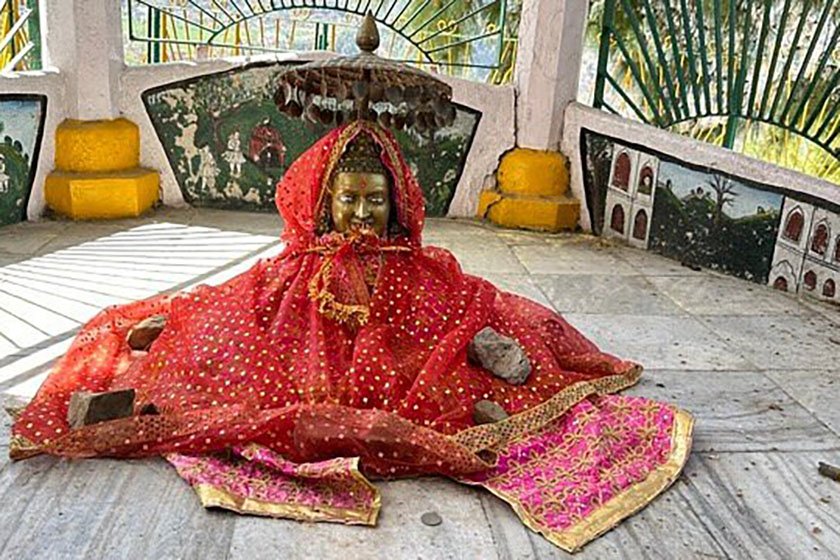
The temple stands on Shah Madar Hill in Chamba and is associated with Rani Sui, also remembered in many accounts as Queen Sunaina, the wife of Raja Sahil Varman, the founder of Chamba town. The legend says that when water refused to flow into the newly founded town, the queen accepted sacrifice in place of her son. The water came, and Chamba remembered her not only with a shrine, but with an annual fair where women and children still honour her devotion.
🌄 Location & How to Reach It
Sui Mata Temple is located on Shah Madar Hill in Chamba town, Himachal Pradesh. The temple is reached through a historic route of stone steps that connects the hill shrine with the lower town and the old water-channel memory associated with the Sarota stream. The site is part of Chamba’s old sacred and civic landscape, where temples, water systems, bazaar lanes, and royal history are closely tied together.
Google Maps: Get Directions
Elevation: The temple stands on an elevation above Chamba town, but a precise temple-specific elevation is not consistently published in reliable sources. Chamba town itself is generally around 1,006 m / 3,300 ft above sea level.
- By road: Chamba is connected by road with Dalhousie, Banikhet, Pathankot, Khajjiar, Saho, and Bharmour. From Chamba town, visitors can ask locally for the Sui Mata Temple route near the Shah Madar Hill side.
- By rail: The nearest major railway station is Pathankot, from where travellers continue by road to Chamba.
- By air: The nearest commonly used airports are Pathankot Airport and Kangra / Gaggal Airport, followed by road travel to Chamba.
The temple visit involves steps and a hill approach, so it is not difficult like a remote trek, but it does require a slow climb. Visit in daylight, carry water, and allow enough time to walk without rushing.
🌸 Best Time to Visit
Sui Mata Temple can be visited through most of the year, but the most meaningful time is during the Sui Mata Mela, which is traditionally held from 15th Chait to 1st Baisakh. In the modern calendar, this usually falls around March–April, though exact local dates should be confirmed before planning a festival visit.
The most comfortable months for a general visit are March to June and September to November. These months are suitable for walking through Chamba town and climbing to the temple without the extremes of monsoon rain or winter cold.
Summer can be warm in the lower town, so morning or late afternoon is better for the climb. Monsoon months may make steps slippery and roads in the wider district uncertain. Winter is usually manageable in Chamba town, but mornings and evenings can be cold.
There is no need to expect a ticketed monument system here. Sui Mata Temple is a living sacred site tied to local memory. Visit respectfully, ask locally about access, and confirm festival details before planning around rituals.
🕉️ The Queen, the Water, and the Terrible Choice
The legend of Sui Mata begins with the founding of Chamba. Raja Sahil Varman is remembered as the ruler who established the town in the early medieval period. But according to local tradition, when the town was being settled, there was a serious problem: the planned water supply would not flow.
The water was to come through an aqueduct connected with the Sarota stream, but the channel remained dry. The failure was not treated as a simple engineering problem. In the imagination of the time, it was understood as a sign that the spirit of the stream had not been appeased.
The Brahmins and religious advisers gave a terrible answer. A sacrifice was needed. Either the queen or the prince had to be offered so that water could enter the town.
One version says the king was told directly by Brahmins that the victim had to be either his wife or his son. Another tradition says the king had a dream in which he was instructed to sacrifice his son. In that version, the queen pleaded to be accepted in the child’s place.
The names vary across tellings. She is called Rani Sui, Sui Mata, and often Queen Sunaina. But the heart of the story remains the same: the queen chose herself.
🌊 When the Water Began to Flow
The legend says that on the appointed day, the queen, along with her maidens, was buried alive. When the grave was filled, water began to flow into Chamba.
This is not a story that should be treated like ordinary history. It belongs to the world of sacred memory, where sacrifice, water, kingship, motherhood, and the survival of a town are folded into one narrative. But it should not be dismissed either. The story tells us how Chamba remembers the cost of water.
In many Himalayan towns, water is never just a utility. It is life, settlement, agriculture, ritual purity, and public survival. A town without water cannot live. In the Sui Mata legend, the queen becomes the one through whom life returns to the people.
That is why her memory has remained powerful. She is not worshipped simply as a royal figure. She is remembered as someone who gave herself so the town could endure.
🏛️ A Temple in Three Parts
Sui Mata Temple is unusual because its sacred geography is not confined to one building. The official district description explains that the temple can be understood in three physically separated parts.
The first is the main Sui Mata Temple on the elevation of Shah Madar Hill. From there, a steep flight of steps descends to a small pavilion above the Saho road. Then, from the Saho road, the steps continue down towards the main town, a little east of Chauntra Mohalla. At the end of the steps is another small pavilion with gargoyles and running water.
This layout matters because it links the shrine directly with the old water story. The steps are not only a route for visitors. They are part of the memory of the aqueduct, the stream, the sacrifice, and the town’s dependence on water.
One also finds references to the stone steps being built by Rani Sarda, the queen of Raja Jeet Singh, who ruled Chamba from 1794 to 1808. This suggests that the shrine’s commemorative landscape continued to be shaped by later Chamba queens and royal patronage.
A visitor walking this route is not simply going from one point to another. The climb itself becomes a way of reading the legend: town below, water memory along the way, queen above.
🙏 What Sui Mata Temple Is Known For
Sui Mata Temple is known for the memory of Rani Sui / Queen Sunaina, whose sacrifice is believed to have brought water to Chamba. It is one of the most emotionally powerful sacred sites in the town because its central figure is not worshipped as a distant goddess of cosmic mythology, but as a queen whose story is tied to civic survival.
Devotees honour her for sacrifice, motherly courage, and devotion to the people of Chamba. The temple is especially significant for women and children during the annual fair. Traditional accounts describe women and children dressing in their best clothes, singing praises of the Rani, and offering homage for her extraordinary sacrifice.
The temple is also known for its paintings and visual storytelling. Several travel references mention paintings depicting the life and sacrifice of Sui Mata. These are important because the temple’s story is not only spoken; it is also shown.
For Chamba, Sui Mata is not just a shrine on a hill. She is part of the town’s moral memory. Her story asks a difficult question: what does a community remember as the price of its own survival?
🏛️ The Atmosphere of the Hill Shrine
Sui Mata Temple does not overwhelm visitors with grand scale. Its power comes from setting, story, and approach. The hill position gives it a sense of separation from the market and town below. The steps make the body participate in the visit. You do not simply arrive; you climb.
On the way, the town begins to open behind you. Chamba’s roofs, lanes, river valley, and surrounding hills create a quiet backdrop. The movement upward suits the story. This is a shrine where the act of walking matters.
Inside and around the temple, the mood is shaped by memory rather than spectacle. The paintings, the shrine space, the hill air, and the old route together form a sacred atmosphere. One does not need exaggerated language here. The story itself is heavy enough.
The temple also reflects a distinctive Chamba way of remembering women in sacred history. Like Champavati Temple, which is associated with Princess Champavati and the founding memory of Chamba, Sui Mata Temple places a royal woman at the heart of the town’s sacred identity. These are not side stories. They are central to how Chamba remembers itself.
📜 Chamba, Sahil Varman, and the Memory of Founding
To understand Sui Mata Temple, one must understand its relationship with Chamba’s founding story. Raja Sahil Varman is closely associated with the establishment of Chamba town. Many of Chamba’s sacred traditions, including temples and legends, cluster around this early royal period.
Chamba’s old identity is not only political. It is sacred, architectural, and ecological. The town developed with temples, water channels, palace spaces, and public grounds like the Chaugan. Sui Mata Temple belongs to that world. It remembers that a town is not founded only with walls and rulers; it is founded with water, sacrifice, and collective belief.
The legend also reveals the importance of queens in Chamba’s historical imagination. Sui Mata is remembered for sacrifice. Rani Sarda is remembered in connection with the stone steps to the aqueduct. Princess Champavati is remembered in another foundational temple story. Through these women, Chamba’s sacred geography becomes more than a list of male rulers and stone buildings.
Sui Mata Temple therefore stands at the meeting point of legend and civic history. It may not provide a modern historical document for every detail, but it preserves how the people of Chamba have chosen to remember the beginning of water in their town.
🎉 Festivals and Devotion
- Sui Mata Mela: The main annual observance is Sui Mata Mela, traditionally held from 15th Chait to 1st Baisakh, generally falling around March–April. Dates should still be confirmed locally each year.
- Women and children’s participation: The fair is especially associated with women and children, who dress in festive clothes, sing in praise of the Rani, and offer homage to Sui Mata.
- Songs of the Rani: Traditional singing is an important part of the observance. The fair remembers the queen through voice, movement, and communal emotion, not only through ritual offerings.
- Offerings and homage: Devotees visit to honour the queen’s sacrifice and seek blessings.
- Water memory: The fair is deeply tied to the story of water reaching Chamba after the queen’s sacrifice, making it one of the town’s most distinctive ritual memories.
🏞️ While You’re in the Area
- Champavati Temple: Closely tied to Chamba’s founding memory and the story of Princess Champavati, making it a natural companion to Sui Mata Temple.
- Lakshmi Narayan Temple Complex: Chamba’s most important temple complex, associated with Raja Sahil Varman and the town’s early sacred architecture.
- Chaugan: The open public heart of Chamba, important for festivals, walking, and understanding the town’s civic rhythm.
- Bhuri Singh Museum: A valuable place to understand Chamba’s paintings, inscriptions, royal history, craft traditions, and cultural depth.
- Hari Rai Temple: A historic Vaishnavite shrine in Chamba, known for its old stone temple character.
- Chamunda Devi Temple: A hill-facing goddess shrine that offers another layer of Chamba’s Shakti tradition and town views.
- Akhand Chandi Palace: A former royal palace that helps visitors understand Chamba’s political and architectural history.
🙏 Getting in Touch
There is no widely verified official visitor centre, booking system, or temple contact number available for Sui Mata Temple in public tourism sources. For current access, festival arrangements, priest availability, and local customs, ask in Chamba town, especially near the old market areas or through local residents familiar with the Shah Madar Hill route.
During the Sui Mata Mela, local arrangements may differ from ordinary days. If you are travelling specifically for the fair, confirm the current year’s dates and route details locally before visiting.
As with all living shrines, remove shoes where required, avoid loud behaviour, ask before photographing inner areas or paintings, and treat the story of Sui Mata with respect.
❓ Quick Questions Travellers Ask
Where is Sui Mata Temple located?
Sui Mata Temple is located on Shah Madar Hill in Chamba town, Himachal Pradesh.
Who is Sui Mata?
Sui Mata is remembered as Rani Sui / Queen Sunaina, the wife of Raja Sahil Varman, who sacrificed herself so that water could flow into Chamba.
What is the main legend of Sui Mata Temple?
The legend says that when water would not enter the newly founded town of Chamba, a sacrifice was required. The queen accepted sacrifice in place of her son, and after her death, water began to flow.
Is Sui Mata Temple connected with water?
Yes. The temple’s story is deeply connected with the old aqueduct from the Sarota stream and Chamba’s water supply legend.
When is Sui Mata Mela held?
It is traditionally held from 15th Chait to 1st Baisakh, generally around March–April. Confirm local dates before planning.
Who mainly participates in Sui Mata Mela?
The fair is especially associated with women and children, who honour the queen with songs, offerings, and festive dress.
Is there a trek to reach the temple?
It is not a remote trek, but the temple is reached by climbing steps to Shah Madar Hill. Visitors should be ready for an uphill walk.
Can it be combined with other Chamba temples?
Yes. It can be combined with Champavati Temple, Lakshmi Narayan Temple, Hari Rai Temple, Chamunda Devi Temple, and Bhuri Singh Museum.
What is the best time of day to visit?
Morning or late afternoon is best, especially if you want to climb comfortably and avoid harsh sun.
Are photos allowed inside?
Photography rules may depend on local custom. Ask before photographing inner areas, paintings, or ritual spaces.
A Last Word
Sui Mata Temple is not only a place of worship. It is Chamba’s memory of water, motherhood, and sacrifice. The story may come to us through legend, but its emotional truth is clear: a town remembers the one who gave herself so that others could live.
The steps to the temple make that memory physical. Each climb moves from town to hill, from daily life to story, from water below to sacrifice above. Chamba has many beautiful shrines, but Sui Mata Temple carries a different kind of weight.
Here, devotion is not only offered to a goddess in the sky. It is offered to a queen in the earth, whose name still rises each year in the songs of women and children.
Fact-check note: Sui Mata Temple’s location on Shah Madar Hill in Chamba, its connection with Rani Sui / Queen Sunaina, and the legend of her sacrifice for the town’s water supply are supported by official District Chamba material and other tourism references. The official district page describes the temple as having three physically separated parts, including the hill temple, the steps and pavilion near the Saho road, and the lower pavilion with running water. It also records the traditional fair period as 15th Chait to 1st Baisakh. Some accounts vary in wording, especially around whether the prophecy came through Brahmins or through the king’s dream, so this article presents both traditions cautiously. Exact daily timings, priest contact details, and a temple-specific elevation are not firmly verified in accessible public sources and are therefore not forced.