A fortress that once housed a kingdom’s rulers also, over the centuries, appears to have quietly swapped which school of Buddhism it belonged to — each time the royal family upstairs changed its own allegiance.
Most monasteries in Spiti settled into one Tibetan Buddhist school early and stayed there. Dhankar’s history is stranger and more political than that. Perched on a spur above the meeting point of the Spiti and Pin rivers, it wasn’t just a monastery — it was the seat of a kingdom, and more than one account suggests its religious affiliation shifted along with whichever royal house held power there. Add to that a structure now so fragile that only a handful of visitors are allowed inside at once, and Dhankar starts to look less like a postcard cliffhanger and more like a place that has spent a thousand years adapting, under real pressure, just to still be standing.
🌄 Location & How to Reach It
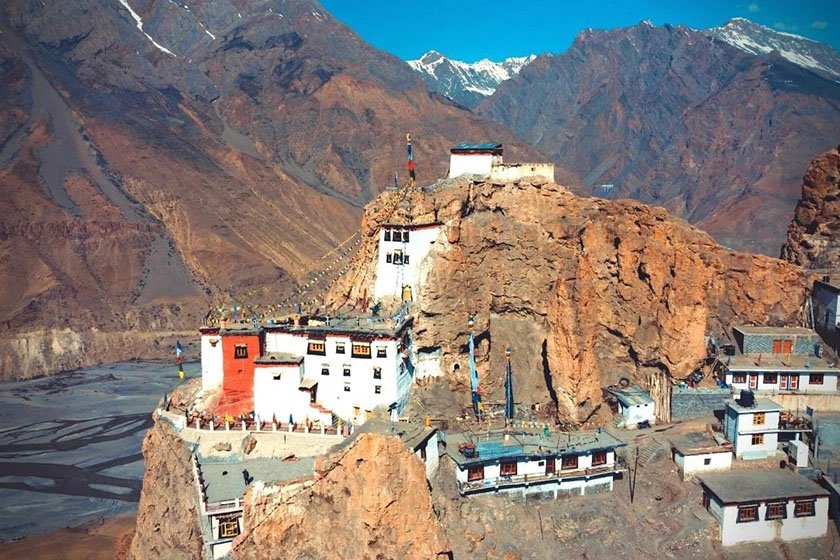
Dhankar Monastery stands above Dhankar village, on a narrow, roughly 1,000-foot (300-metre) spur overlooking the confluence of the Spiti and Pin rivers — widely considered one of the most dramatic settings of any gompa in the Himalaya. It sits between the towns of Kaza and Tabo, historically the capital of the old Spiti kingdom before administrative power eventually moved to Kaza.
Google Maps: Get Directions
Elevation: 3,894 metres (12,774 ft).
- By road: A motorable branch road, suitable for small vehicles only, leaves the main Kaza–Tabo road at a point roughly 24 km from Kaza and climbs a further 8 km up to Dhankar; total road distance from Kaza is reported at anywhere from 32 to 39 km depending on the source and route taken.
- By rail: No rail access — this is a multi-day road journey from Shimla or Manali, not a same-day connection.
- By air: The nearest airport is Bhuntar (Kullu), a full day’s drive from Dhankar via Kaza.
Compared to remoter Spiti sites like Komic or Kibber, Dhankar is a relatively straightforward stop on the main Kaza–Tabo corridor — most visitors combine it with Tabo Monastery on the same day.
🌸 Best Time to Visit
May to October is the reliable travel window, when the roads connecting Kaza, Dhankar, and Tabo are open and clear. Outside this period, heavy snow and cold make the area considerably harder to reach. The monastery keeps informal hours typical of a small Himalayan gompa, and given its structural fragility, arriving with patience rather than a fixed schedule in mind is the right approach.
🕉️ A Monastery That Kept Changing Its Mind
Dhankar’s religious history isn’t a single, tidy lineage. Various sources describe the monastery as having belonged, at different points, to the Nyingma, Sakya, and Kagyu schools of Tibetan Buddhism before eventually settling into the Gelugpa order it follows today — a transition some accounts date to around the 1450s. What makes this unusual is the reason given for the shifts: allegiance is said to have tracked the religious affiliation of whichever royal family held power in Spiti at the time, rather than a single unbroken monastic tradition choosing its own path. Few monasteries in the region carry this kind of documented sectarian drift, and it fits naturally with Dhankar’s dual identity as both a religious house and a seat of government — when the rulers changed their allegiance, it seems the monastery they controlled sometimes changed with them.
The figure most closely tied to the monastery’s founding or renovation is a lama remembered locally as Lha-‘od (a local rendering of Zla-‘od). Sources disagree on his birth year — most give 1121, though at least one gives 1211, a discrepancy that reads more like a transposed digit than two genuinely different traditions. Local monks have reportedly gone further still, asserting that the monastery predates not only nearby Tabo but even the 7th-century Tibetan emperor Songtsen Gampo — a claim with no independent verification, but one repeated with enough conviction locally that it’s worth noting as belief rather than dismissing outright.
🏛️ A Fortress Built to Be Escaped From
Dhankar functioned as a genuine seat of power as much as a religious site. It served as the traditional capital of the Spiti kingdom during the 17th century, and was the base of the Nonos, Spiti’s hereditary local rulers, who were responsible for keeping the fort in repair, cultivating nearby government lands, and administering justice — reportedly with harsh penalties — until British administration eventually took over these functions. The fort’s strategic position on a projecting spur allowed the Spitians to watch for approaching threats and pass warning messages to surrounding settlements, since the valley suffered repeated incursions from its neighbours over the centuries. Some accounts describe secret underground passages, used by monks and royalty alike as escape routes during periods of invasion — a detail that turns the fortress framing from a metaphor into something closer to literal architecture.
🙏 What the Monastery Is Known For
Beyond its political history, Dhankar houses a striking central image: a statue of Vairochana, depicted as four Buddha figures seated back-to-back, along with a collection of aging thangkas and manuscripts kept in a small on-site museum. Devotees and visitors alike are drawn as much to the setting as to any single object — the sheer, vertiginous drop to the river confluence below is, by most accounts, as central to the experience as anything inside the shrine itself.
🏛️ Standing Room for Twenty
Dhankar’s physical condition is inseparable from its story today. In 2006, the World Monuments Fund placed Dhankar Gompa on its Watch List of 100 Most Endangered Sites, citing the structure’s genuine vulnerability to erosion, earthquake damage, and simple age. A major earthquake in 1975 caused significant damage, prompting repairs and eventually the construction of a new monastery at Shichilling, in the valley below, now home to roughly 150 monks of the Gelug school — meaning most of the living religious community has already relocated away from the old cliffside structure. At least one source reports that no more than twenty people are permitted inside the old gompa at any one time, a restriction that says more about the building’s fragility than any ritual requirement. A nonprofit group, the Dhangkar Initiative, has been working on conservation efforts, though the underlying erosion problem — a spur of rock and mud slowly losing ground to wind and rain — isn’t the kind of threat a single restoration project fully resolves.
📜 A Capital That Moved On
Dhankar’s decline as a political centre mirrors its physical one. Once the seat of the Spiti kingdom’s rulers, the capital function eventually shifted to Kaza as administrative needs modernised, leaving Dhankar village — now home to fewer than a hundred families — as a quiet settlement perched on genuinely dangerous inclines, with houses positioned against slopes steep enough that a wrong step matters. The old fort above the monastery, largely in ruins today, is reachable by a short hike and offers little beyond sweeping views — but it’s a reminder that this entire hillside once organised the defence of a whole valley, not just the devotional life of a monastery.
🎉 Festivals and Devotion
- Cham Dance Festival — held in July, featuring monks in elaborate masks and costume performing ritual dances intended to invoke peace and prosperity and dramatise the triumph of good over evil
- Daily prayers — morning and evening chanting, which visitors are generally welcome to observe respectfully
- Occasional meditation retreats — hosted from time to time for visiting spiritual seekers, though not on a fixed public schedule
🏞️ While You’re in the Area
- Dhankar Lake (Dhankar Tso) — a glacial lake roughly a 2 km uphill trek from the monastery, taking about 1.5–2 hours round trip, with views over snow-capped peaks and alpine meadows
- Tabo Monastery — the “Ajanta of the Himalayas,” around 23–30 km away, and easily combined with Dhankar in a single day
- Pin Valley National Park — a haven for snow leopards and other Himalayan wildlife, a short drive south
- Key (Kye) Monastery — Spiti’s largest gompa, roughly 50 km away
- Kaza — the valley’s modern administrative centre and the practical base for supplies and accommodation
🙏 Getting in Touch
There’s no formal booking system for visiting the old monastery, and given the occupancy limits and structural concerns, patience and flexibility matter more here than at most Spiti sites. Basic guesthouse rooms are available at the monastery itself and in Dhankar village, with more options in Kaza or Tabo; asking locally about current access conditions before planning your visit is worthwhile, particularly outside peak season.
❓ Quick Questions Travellers Ask
Why is Dhankar Monastery considered endangered? The World Monuments Fund placed it on its Watch List of 100 Most Endangered Sites in 2006, citing erosion, earthquake damage, and the fragility of its clifftop position.
Is it true only a limited number of people can enter at once? At least one source reports a cap of around twenty visitors inside the old monastery at any given time, reflecting its structural fragility.
What sect does Dhankar Monastery belong to? It follows the Gelugpa school today, but historical sources describe it as having belonged to the Nyingma, Sakya, and Kagyu schools at earlier points, reportedly shifting with the religious allegiance of Spiti’s ruling family.
Is the monastery still an active religious site? Most of the resident monastic community, numbering around 150, now lives at the newer monastery in Shichilling village below; the old cliffside gompa remains a devotional and historical site rather than the primary living monastery.
How do I combine Dhankar with other Spiti sites? It sits directly between Kaza and Tabo on the main road, making it easy to visit alongside Tabo Monastery, with Key Monastery and Pin Valley also reachable within a day’s drive.
A Last Word
There’s a temptation to describe Dhankar purely in terms of its cliffhanger drama — the sheer drop, the crumbling walls, the earthquake damage. But its more interesting story is political: a monastery that seems to have bent, more than once, to whichever royal house ruled from its rooms, and a fortress-capital that eventually watched its own administrative purpose drift downhill to Kaza, much as its monks have now drifted down to Shichilling. What’s left on the spur today is something rarer than a simple old building — a site that has had to keep renegotiating what it is, long before conservationists ever added it to a list of things worth saving.
Fact-check note: The claim that Dhankar’s sectarian affiliation shifted between Nyingma, Sakya, Kagyu, and eventually Gelugpa according to the ruling family’s own allegiance appears in some but not all sources consulted; it is presented here as a documented account rather than universal consensus, since other sources simply describe the monastery as Gelugpa without discussing earlier affiliations. The founding lama’s birth year is given as either 1121 or 1211 across sources — likely a transposed digit in one source rather than a genuine dispute, but both figures are noted rather than one being silently chosen. Founding-era claims vary more broadly still, with some sources suggesting a 7th-to-9th-century origin and others an 11th-to-12th-century one; local tradition asserting the monastery predates the 7th-century Tibetan emperor Songtsen Gampo is noted as belief, not independently verified. Road distance from Kaza is given as anywhere from 32 to 39 km depending on the source. The claim of a 20-person occupancy limit inside the old monastery comes from a single source and could not be independently corroborated elsewhere, so it is presented cautiously. The World Monuments Fund’s 2006 Watch List inclusion is well corroborated across multiple sources, including Wikipedia and WMF’s own published lists. No independently verified GPS coordinates were found, so none are given; the Get Directions link above should be replaced with your own verified link if you have one. This is a distinct article from the version of Dhankar Monastery already published on aguidetohimachal.com (subtitled “The Fortress of Faith Above the Confluence”); this piece takes the shifting-sect and structural-endangerment angles as its hook rather than repeating that one’s framing, though basic geographic facts (Dhankar Lake trek distance/duration, nearby sites) necessarily overlap since they are fixed, shared facts about the location.