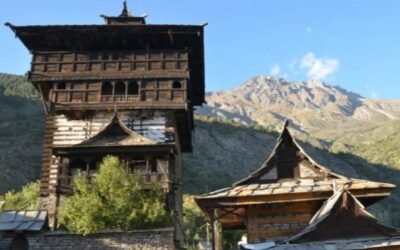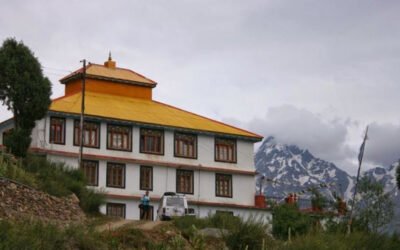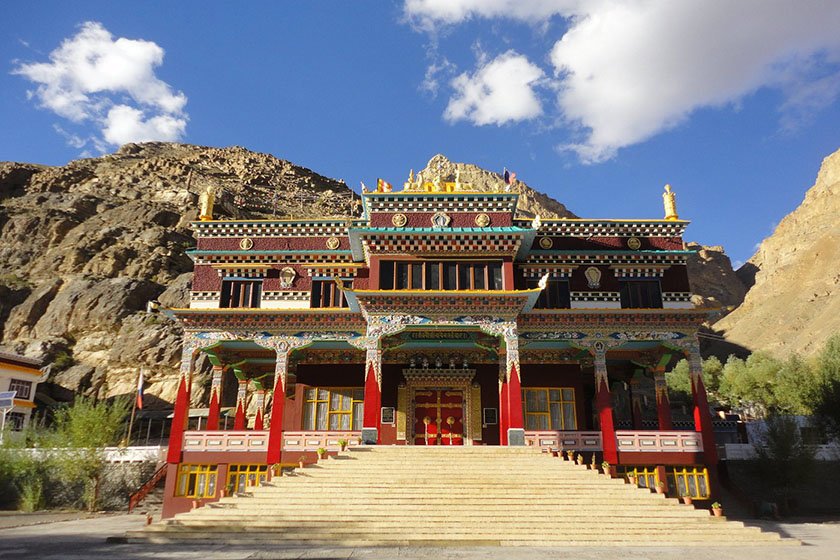
Almost every monastery in Spiti today belongs to the Gelug or Drukpa traditions. One fortress on the edge of a canyon, above the highest motorable village in the world, is holding out for an older, rarer school.
Walk through Spiti’s monasteries one by one — Ki, Kibber, Dhankar, Tabo — and a pattern quickly emerges: this valley belongs, almost entirely, to the Gelugpa and Drukpa Kagyu traditions. The Sakya sect, once a genuine power in the wider Tibetan Buddhist world, has all but vanished from Spiti’s monastic map, reduced to a single serious foothold. That foothold is Tangyud Monastery, built like a fortress on the edge of a canyon above Komic village, at one of the highest altitudes any gompa in India reaches. Everything else Sakya in Spiti — a small monastery down in Kaza — is, by most accounts, a minor annex by comparison. Whatever else Tangyud is, it is first and foremost a last stand.
🌄 Location & How to Reach It
Tangyud Monastery (also written bTang-rGyud or Tangyuth, and known locally as Sa-skya-gong-mig Gompa) stands at the village of Komic, roughly 2 km southeast of Hikkim, on the edge of a deep canyon overlooking Kaza, Spiti’s main town, about 4 km away. It sits on the periphery of the Kibber Wildlife Sanctuary, in a landscape of barren, high-altitude terrain that makes the monastery’s massive mud walls look, from a distance, more like a natural rock formation than a building.
Google Maps: Get Directions
Elevation: sources give figures ranging from roughly 4,520 to 4,587 metres (about 14,830–15,050 ft) for the monastery itself, with the adjoining Tangyud/Komic village a little lower, around 4,450–4,470 metres. It’s regularly described as one of the highest-altitude monasteries in India, and Komic itself is widely promoted as the highest motorable village in the world — a claim worth taking as “among the highest” rather than a strictly verified world record.
- By road: Reached via Kaza, roughly 4 km away by road; a paved but high-altitude route connects Kaza to Hikkim and on to Komic, usually covered by taxi or private vehicle.
- By rail: No rail access anywhere near Spiti — this is entirely a road journey, typically approached via Manali or Shimla and several days’ travel.
- By air: The nearest airport is Bhuntar (Kullu), followed by a long, high-altitude road journey into Spiti.
Given the altitude, this is not a stop to rush: proper acclimatization in Kaza before continuing up to Komic is strongly advisable, and altitude sickness is a real risk this high regardless of overall fitness.
🌸 Best Time to Visit
June through September is the realistic window for Komic and Tangyud Monastery, when the high passes into Spiti are open and the village itself is accessible; the rest of the year, snow and extreme cold cut the area off almost entirely. There’s no fixed visiting-hours system at the monastery — arriving in daylight and asking a resident monk for access, particularly to the inner tantric chambers, is the normal approach.
🕉️ Which Way Did It Move?
Tangyud’s own history includes a relocation — but sources can’t agree which direction it went. Several accounts describe the monastery as originally standing near Hikkim, later shifting to its present site at Komic after a devastating earthquake (dated variously to 1972 or 1975 depending on the source), with some remains of the earlier structure reportedly still visible near Hikkim today. At least one other account describes the opposite: a local legend holding that the monastery originally stood at Komic and was moved to the lower-lying village of Hikkim because of a drought. These two stories can’t both be literally true as told, and no source available resolves which is the accurate account — it’s presented here as an unresolved local contradiction rather than a settled history, and worth asking about locally if the detail interests you.
🏛️ The Monastery Before This Monastery
A second, older layer of history sits beneath Tangyud’s visible fortress walls. Some accounts hold that an earlier Kadampa establishment once stood on or near this site, founded by the great translator-monk Rinchen Zangpo (958–1055 CE) and known as Rador-lha — centuries before the structure seen today was raised. The monastery familiar to visitors now is instead thought to date from the early 14th century, built as the Sakya school rose to regional prominence under Mongol patronage. Even the monastery’s name may carry a specific scholarly memory: “Tangyud” is thought to possibly refer to a Sakya revision of the Tengyur — the 87 volumes of Tantric treatises forming part of the Tibetan Buddhist canon — a project reportedly carried out around 1310 CE by a team of scholars under a Sakya lama named Ch’os-Kyi-‘Od-zer. None of this can be fully verified, but together it suggests a site with real religious activity considerably older than the current fortress walls, even if the building itself is “only” seven centuries old.
🙏 What the Monastery Is Known For
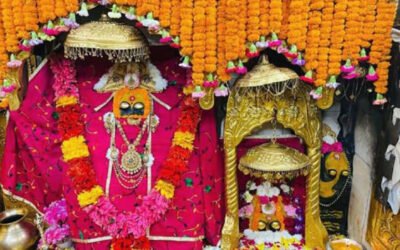
Tangyud’s monks are said to be particularly accomplished in tantric practice, and the monastery’s most striking devotional space reflects that reputation: a dark, windowless inner chamber dedicated to Mahakala, a wrathful protective emanation of Avalokiteshvara, where daily pujas are traditionally offered each morning around 8am. The room is filled with tantric masks and fearsome statuary, photography is prohibited inside, and in the oldest surviving section of the complex — a smaller red building on the ridge, notable for a stuffed snow leopard hanging in its porch — women are reportedly not permitted to enter the inner prayer room. It’s a striking, slightly unsettling space by most visitor accounts, and one of relatively few genuinely restricted tantric chambers still open to outside visitors at all in the region.
🏛️ A Fortress Built to Look Taller Than It Is
Architecturally, Tangyud is unmistakably castle-like: massive, sharply slanted mud walls and battlements, striped with vertical bands of red ochre and white, an effect that makes the structure appear considerably taller than its actual height. The design has been compared by some observers to Chinese fortress architecture rather than the more typical Tibetan monastic style — one more small detail suggesting the building’s design owes something to influences beyond the immediate region. A special guest cell is built into the monastery’s southeastern side, historically reserved for visits by the Nonos, the local hereditary chieftains of Spiti, underlining the monastery’s long-standing role as a seat of both religious and political authority rather than religion alone. The community here has thinned over the centuries: roughly 60 monks were recorded in 1855, compared with a considerably smaller resident population today. The monastery has also had a genuinely hard history to survive — it was robbed repeatedly between roughly 1920 and 1940 by thieves reported to have come from Kashmir and elsewhere, and was badly damaged in an earthquake in 1972 (or, per other accounts, 1975), on top of whatever earlier relocation it may have already undergone.
📜 The Last of a Once-Powerful Sect
Tangyud’s deepest significance in Spiti isn’t really architectural — it’s sectarian. The monastery belongs to the Sakya school of Tibetan Buddhism, one of the tradition’s four principal schools and, in earlier centuries, a genuinely dominant political and religious force under Mongol backing. In present-day Spiti, though, Sakya monasteries have all but disappeared: Tangyud and one small monastery in Kaza are the only two left, and the Kaza monastery is generally described as considerably smaller and less significant than Tangyud. That makes this remote, high-altitude fortress the de facto last serious foothold of an entire school of Tibetan Buddhism in a valley now dominated by Gelug and Drukpa Kagyu institutions — a distinction easy to miss amid the more commonly repeated framing of Tangyud as simply “one of the world’s highest monasteries.”
🎉 Festivals and Devotion
- Daily Mahakala worship — morning pujas offered to the monastery’s principal protective deity, a core and consistent part of monastic life here
- Some visitor accounts mention masked festival traditions associated with Komic Monastery, though detailed, independently confirmed festival names and dates specific to Tangyud (as opposed to other Spiti gompas) are thin in available sources — worth confirming locally rather than planning a trip around an assumed date
- Tantric study and practice — the monastery’s monks maintain a particular reputation for tantric proficiency, reflected in the dedicated Mahakala chamber described above
🏞️ While You’re in the Area
- Hikkim — home to the world’s highest post office, a short distance from Komic and often visited together
- Langza — known for its giant Buddha statue overlooking the village and its fossil-rich terrain
- Kibber Wildlife Sanctuary — high-altitude habitat on whose edge the monastery itself sits, home to snow leopards, ibex, and other Himalayan wildlife
- Ki (Kye) Monastery — Spiti’s largest gompa, a short drive away, useful for contrast with Tangyud’s smaller, fortress-like scale
- Kaza — Spiti’s main town, roughly 4 km away, with the valley’s basic supplies, accommodation, and its own small Sakya monastery
🙏 Getting in Touch
There’s no formal visitor centre or booking system at Tangyud Monastery. Given the altitude and remoteness, it’s worth checking road conditions and weather in Kaza before setting out, and asking there or in Komic itself about current access to the inner prayer chambers, since visiting hours and permissions can vary by season and by which monks are in residence.
❓ Quick Questions Travellers Ask
What sect does Tangyud Monastery belong to? The Sakya school of Tibetan Buddhism — one of only two Sakya monasteries remaining in Spiti, and by far the more significant of the two.
How high up is the monastery? Sources give figures between roughly 4,520 and 4,587 metres, making it one of the highest-altitude monasteries in India.
Did the monastery move from Hikkim to Komic, or the other way around? Accounts genuinely disagree — most describe a move from Hikkim to Komic after an earthquake, while at least one source describes the opposite direction, prompted by drought. This isn’t resolved in available sources.
Can visitors enter the inner prayer rooms? Some access is possible, but photography is prohibited in the Mahakala chamber, and women are reportedly not permitted into the inner prayer room of the oldest surviving section.
What’s nearby worth combining with a visit? Hikkim’s high-altitude post office and Langza’s Buddha statue are both close by and commonly visited on the same day as Komic.
A Last Word
It’s easy to visit Tangyud purely for the superlative — the highest this, the highest that — and leave without registering what’s actually rare about it: an entire school of Tibetan Buddhism holding on here by a thread, in a valley that has otherwise moved on to other traditions. Between the dueling relocation legends, the older Kadampa layer buried beneath the visible fortress, and a monk population that’s shrunk from sixty to a fraction of that since the mid-19th century, Tangyud reads less like a postcard monastery and more like a small, stubborn holdout — still standing, still keeping its own counsel about which direction it actually came from.
Fact-check note: Sources genuinely disagree on which direction the monastery relocated — most describe a move from Hikkim to Komic following an earthquake (dated to either 1972 or 1975 depending on the source), while at least one source describes the opposite, a drought-driven move from Komic to Hikkim; this piece presents both without resolving them, since no available source reconciles the contradiction. At least one source incorrectly identifies the monastery as belonging to the Gelugpa (Yellow Hat) sect; the more consistent and better-sourced identification, including Wikipedia and the Tibetan Buddhist Encyclopedia, is Sakya, and this piece treats the Gelugpa claim as a likely error rather than a genuine alternative. Reported elevation figures vary (4,520m vs. 4,587m for the monastery, and 4,450–4,470m for the adjoining village); both ranges are given rather than one being picked arbitrarily. The claim that “Tangyud” refers to a 1310 CE Sakya revision of the Tengyur, and the claim of an earlier Kadampa establishment founded by Rinchen Zangpo, both come from a single detailed source (the Tibetan Buddhist Encyclopedia/Wikipedia) and are presented as plausible tradition rather than independently confirmed fact. Mentions of a “Gustor Festival” specific to this monastery appear in only one source and could not be independently corroborated, so festival details are presented cautiously rather than as settled fact. No independently verified GPS coordinates were found, so none are given; the Get Directions link above should be replaced with your own verified link if you have one. This is a distinct article from the version of this monastery already published on aguidetohimachal.com (subtitled “The Castle of Compassion at the Edge of the Sky”); this piece takes the sect’s rarity in Spiti and the contradictory relocation legend as its central hook rather than repeating that one’s framing.