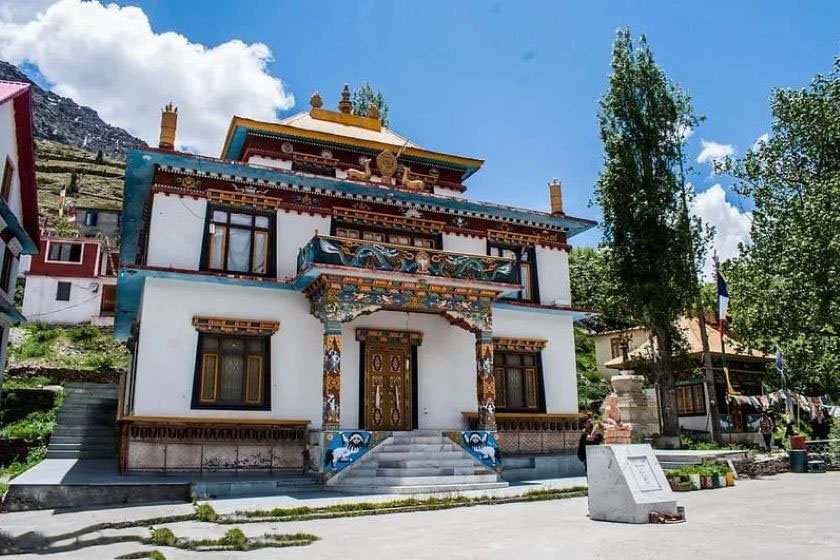
Above the Bhaga river, a whitewashed monastery sits on a hillside it wasn’t originally built on — because the mountain it started on wouldn’t let it stay.
Most Himalayan gompas earn their reputation for stillness: prayer flags, silence, a fixed point that has watched the valley for centuries without moving. Gemur Monastery earns its reputation for something slightly different — resilience through relocation. Founded in the turbulent, expansionist decades when Drukpa Kagyu lamas from Ladakh and Bhutan were first planting monasteries across Lahaul, Gemur wasn’t left where it started. At some point in its history, the community that built it had to bring it down the mountain to somewhere more stable, and start again. What stands above Gemur village today is that second attempt — still standing, still the district’s spiritual hub for half a dozen smaller gompas, and still quietly aware of the mountain that came before it.
🌄 Location & How to Reach It
Gemur Monastery sits above Gemur village, a small settlement in the Bhaga river valley on the Manali–Leh Highway (NH-505), roughly 18 km beyond Keylong and about 4 km before Jispa. The monastery itself is a further, steep climb above the village — a walk of roughly 15–20 minutes uphill past a large chorten and fluttering prayer flags, though a rural motorable road off the highway now runs closer to the gompa for those who’d rather not make the climb.
Google Maps: Get Directions
Elevation: approximately 3,370 metres above sea level.
- By road: Regular buses and taxis ply the Manali–Leh Highway between Keylong and Jispa; Gemur village is a stop along this route, from where it’s a short walk or drive up to the monastery.
- By rail: No direct rail access — the nearest practical railhead for onward road travel is well outside Lahaul, and this leg is a long connect-and-drive journey rather than a same-day option.
- By air: The nearest airport is Bhuntar (Kullu), followed by a full day’s road journey into Lahaul.
Compared to some of Lahaul’s more strenuous gompas, Gemur is an easy add-on rather than an expedition — most visitors reach it as a short detour on the way to or from Jispa, not as a dedicated day’s outing in itself.
🌸 Best Time to Visit
May to September is the reliable window, when the Manali–Leh Highway is open (it typically clears around mid-June at the higher passes, though the Keylong–Jispa stretch itself opens earlier) and the weather sits in a comfortable range. Outside this window, Lahaul’s winters make the valley considerably harder to travel through. There’s no fixed visiting-hours board at the monastery itself — arriving in daylight and finding a monk to let you in is the practical approach, as more than one visitor has discovered standing outside its locked doors calling out for a “Lama ji.”
🕉️ A Patron and a Builder
Gemur’s founding story comes in two layers that don’t quite agree on whose monastery this really is. One tradition credits its founding to sTagtshang Raspa (also written Taktsang Repa), the influential Drukpa Kagyu lama whose teaching lineage, carried down from Ladakh’s Hemis Monastery, seeded a string of gompas across Lahaul in the 17th century. A separate, more local tradition instead credits the actual construction to Lama Tenzin Paldan, a monk of Gemur village itself, working with the material support of the Thakurs of Khangsar — the local ruling family whose patronage underwrote much of the sTod valley’s early monastic building. It’s the familiar pattern of a famous name providing the spiritual authority and a local figure doing the actual work, and both versions are told here without either one cancelling the other out. The woodwork of the monastery is separately credited to a craftsman named Tashi Tamphel, a detail that at least grounds part of the story in a specific, named pair of hands.
🏛️ The Mountain That Wouldn’t Hold It
The building visible above Gemur village today is not the original. Scholars examining the site have concluded that the monastery originally stood higher up the mountainside, and that the present structure was relocated to its current, lower site in 1870. Some retellings attach a specific cause to the move — an avalanche damaging the original shrine beyond repair — though this detail rests on thinner sourcing than the relocation itself, and is worth treating as a plausible explanation rather than a settled fact. What’s better attested is the outcome: a whitewashed building with distinctive red-and-black window frames, a Dukhang (assembly/prayer hall), and a stone courtyard, standing on ground the community judged safer than whatever came before it. Little of the pre-1870 structure survives to compare against, which makes the current building — however handsome — a monument to continuity through disruption rather than an unbroken original.
🙏 What the Monastery Is Known For
Gemur’s presiding image is a sculpture of Marichi Vajravarahi, a fierce, protective tantric goddess associated with wisdom, radiance, and the removal of obstacles — housed in the monastery’s inner sanctum and central to its daily devotional life. A visiting lama has, on at least one occasion, told visitors that the statue dates to the 11th century — several centuries older than the monastery’s own founding, which would mean it was either brought here from an older site or the dating itself is more folklore than fact; there’s no independent scholarship to settle which. Daily practice at Gemur follows the familiar rhythm of a small Himalayan gompa: chanting of mantras, offerings of butter lamps, and circumambulation with prayer wheels, with resident monks also undertaking periods of meditation retreat and textual study under the guidance of a head lama.
📜 A Mother Monastery for the sTod Valley
Gemur’s significance in Lahaul has as much to do with administration as with architecture. As one of the region’s established Drukpa Kagyu seats, it historically sent lamas out to serve smaller gompas across the sTod valley — including those at Dartse, Chhukutsi, Zong, Khangsar, and Photang in Jispa — functioning less like an isolated retreat and more like a small monastic head office for the surrounding villages. That regional role, tied to the broader Drukpa Kagyu network stretching back to Hemis in Ladakh and onward to Bhutan, is arguably a bigger part of Gemur’s historical importance than any single building on the hillside. The monastery hasn’t been free of loss along the way: a valuable thangka depicting the protector deity Dam-can Jagpa Me-len, along with other articles, was reported stolen in the 1960s — a reminder that a working monastery’s collection is as vulnerable to theft as any other repository of old and valuable objects.
🎉 Festivals and Devotion
- Tshechu Fair — Gemur’s signature annual celebration, held in early summer (accounts place it in either June or July, and it’s worth checking locally rather than assuming a fixed date), featuring the Cham dance (also called the Devil Dance): monks performing masked ritual dances in elaborate animal and demon costumes, enacting the triumph of good over evil to the sound of drums, horns, and cymbals
- A note of honesty rather than a sales pitch: while the Tshechu and its Cham performances are widely listed as Gemur’s main draw, at least one recent on-the-ground account suggests the masked dances haven’t been consistently performed here in recent years, with locals describing the tradition as dormant rather than active — worth confirming locally before planning a visit specifically around it
- Daily worship — chanting, butter-lamp offerings, and prayer-wheel circumambulation continue year-round regardless of the festival calendar
🏞️ While You’re in the Area
- Jispa Village — a scenic riverside hamlet just 4 km further along the highway, with homestays and trekking routes, and a natural base for the night
- Tayul Monastery — another of Lahaul’s Drukpa gompas, near Keylong, worth combining with Gemur on a monastery-focused day
- Kardang & Shashur Monasteries — the two major gompas closer to Keylong itself, both part of the same Drukpa network Gemur once helped administer
- Suraj Tal & Baralacha La — a glacial lake and high-altitude pass further up the Leh highway, for those continuing beyond Jispa
- Keylong market — the district headquarters, useful for supplies, food, and a sense of Lahaul’s everyday life outside its monasteries
🙏 Getting in Touch
There’s no formal visitor centre, phone line, or booking process for Gemur Monastery — it’s a small, functioning religious community, not a tourist facility. If the gates are closed when you arrive, calling out or asking a passer-by to fetch a monk is the normal way in, as generations of visitors have found. For up-to-date road conditions or festival timing, asking locally in Keylong or Jispa before setting out is the most reliable option.
❓ Quick Questions Travellers Ask
How far is Gemur Monastery from Keylong? About 18 km by road, plus a short uphill walk from Gemur village to the monastery itself.
Is Gemur Monastery difficult to reach? No — it’s one of the more accessible gompas in Lahaul, requiring only a brief climb rather than a serious trek.
What deity is worshipped at Gemur Monastery? Marichi Vajravarahi, a protective tantric goddess central to the Drukpa Kagyu tradition practised here.
Is the Cham (Devil Dance) festival still held every year? Sources list it as an annual June or July event, though recent accounts suggest performances have been inconsistent in practice — it’s worth checking locally rather than assuming it will be running.
Can I combine Gemur with other monasteries in one trip? Yes — Kardang, Shashur, and Tayul monasteries near Keylong, along with Gemur, make for a reasonable single- or two-day monastery circuit in Lahaul.
A Last Word
There’s a particular kind of resilience in a monastery that had to relocate rather than simply endure in place — it means every prayer said inside Gemur today is being said in a building that exists because a community decided, at some point in the 1800s, that giving up wasn’t an option even when the mountain itself was. Between the founding duality of patron and builder, the quiet loss of a stolen thangka, and a festival tradition that may or may not still be running, Gemur doesn’t offer the tidy, unbroken-lineage story some monasteries like to tell about themselves. What it offers instead is closer to the truth of most old religious sites in hard terrain: continuity that had to be worked for, more than once.
Fact-check note: Founding dates for Gemur Monastery vary significantly across sources — Wikipedia and most travel sources place it in the first half of the 17th century, while a small number of other sources give a 13th-century or “1300” founding date; this piece follows the better-attested 17th-century dating and flags the earlier claims as unresolved rather than adopting them. The two named founding figures, sTagtshang Raspa and Lama Tenzin Paldan, are both cited in the historical record without a clear resolution of which role each actually played, so both are presented as competing/complementary traditions rather than settled fact. The claim that the presiding Vajravarahi statue dates to the 11th century comes from an on-site account of what a visiting lama told a visitor, not from independent scholarship, and sits awkwardly against the monastery’s own 17th-century founding date — it’s presented here as a local claim, not a verified one. The specific cause of the monastery’s 1870 relocation (reports of an avalanche) rests on thinner sourcing than the relocation itself and is flagged accordingly. Similarly, claims about a library holding a complete Kangyur collection and ongoing ties to Hemis Monastery in Ladakh come from a single, less rigorously sourced reference and are omitted from the main text for that reason. No independently verified GPS coordinates were found, so none are given — the Get Directions link above should be replaced with your own verified link if you have one. This is a distinct article from the version of “Gemur Monastery, Lahaul” already published on aguidetohimachal.com (subtitled “The Serpent Path to the Seat of Silence”); this piece takes the relocation-and-dual-founding angle as its hook rather than repeating that one’s framing.