Almost everyone who visits credits it to Padmasambhava. The name on the door belongs to someone else entirely.
Lahaul’s oldest monasteries tend to collect big names the way old buildings collect moss — Padmasambhava, Rinchen Zangpo, Nagarjuna, all said to have passed through or left something behind at one site or another, whether or not the timeline actually allows it. Guru Ghantal, perched above the confluence of the Chandra and Bhaga rivers near Tandi, has more of these attributions than most, and most visitors leave repeating the most famous one. But the name itself — Ghantal — doesn’t come from Padmasambhava at all. It commemorates a different figure, one of Buddhism’s eighty-four mahasiddhas, whose meditation practice here is the actual reason this hillside carries the name it does. Untangling which legend explains what is most of the fun of the place.
🌄 Location & How to Reach It
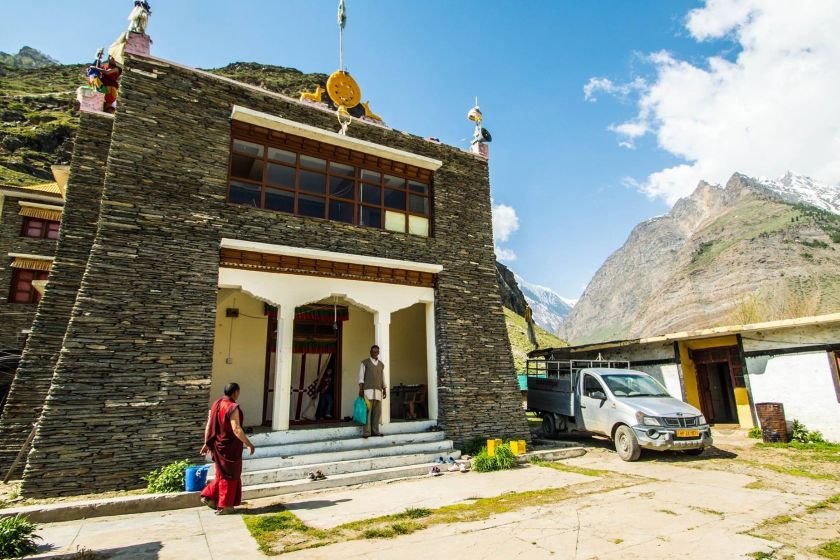
Guru Ghantal Monastery — also called Gandhola or Gondhla Monastery — stands on the slope of Drilbu Ri, a hill above Tupchiling village, close to the Tandi bridge where the Chandra and Bhaga rivers meet to form the Chandrabhaga (Chenab). The setting is dramatic even by Lahaul standards: a weathered, partly ruined wood-and-stone structure looking down on one of the valley’s most sacred confluences. Accounts differ on how demanding the final approach actually is — the horizontal distance from Tupchiling is sometimes given as a short 4 km walk, while other visitor accounts describe a genuinely steep, 3–4 hour uphill climb on overgrown, sandy trails. Both are probably describing the same slope; don’t assume it’s a casual stroll just because the map distance looks short.
Google Maps: Get Directions
Elevation: approximately 3,150–3,160 metres above sea level.
- By road: Reachable via Keylong, roughly 18 km away on the Manali–Leh Highway; from the highway near Tandi, it’s a walk up through Tupchiling village to reach the monastery itself.
- By rail: No direct rail access — this is a road-and-climb journey, not a same-day rail connection.
- By air: The nearest airport is Bhuntar (Kullu), followed by a full road journey into Lahaul.
This is a genuinely strenuous stop compared to most of Lahaul’s roadside shrines — closer in effort to a proper hike than a quick temple visit, and worth budgeting real time for.
🌸 Best Time to Visit
May to October is the reliable window, when the Manali–Leh Highway and the local roads around Tandi and Keylong are open and the climb up to the monastery is manageable. Winters here are severe, with heavy snowfall making the area quiet and largely inaccessible from November through March. The monastery itself keeps no fixed visiting hours and is frequently locked; the practical approach is to ask the lamas at Tupchiling Gompa below for the key before making the climb, rather than assuming it will be open.
🕉️ The Saint Behind the Name
Most tourist accounts credit Guru Ghantal’s founding to Padmasambhava (Guru Rinpoche), placing it in the 8th century CE as part of his broader mission spreading Vajrayana Buddhism across the Himalaya. It’s the version repeated almost everywhere, and it isn’t baseless — local tradition and the Tibetan terma text Padma bKa’i Thang, discovered in 1326 in Tibet’s Yarlung valley, does associate this site with him. But the monastery’s actual name has a separate origin: it commemorates Guru Ghantapa, one of the eighty-four mahasiddhas of tantric Buddhism, whose profound meditative practice (tapasya) is said to have taken place at this exact spot. In other words, the famous name people repeat and the name actually written on the building may point to two different saints entirely — a distinction that gets lost almost every time the story is retold in passing.
Adding a further layer, archaeological evidence suggests the site was a working Buddhist establishment even earlier than either saint’s lifetime — a chased copper goblet, discussed further below, points to Buddhist monastic activity here as far back as the 1st century BCE or CE, centuries before Padmasambhava is traditionally dated. Some accounts also credit the philosopher-monk Nagarjuna with a retreat here in the 2nd century CE. None of these figures’ presence can be independently confirmed, and they shouldn’t be read as a single tidy timeline — more a stack of separate, overlapping claims about a site that has clearly mattered to different traditions across very different centuries.
🏛️ The Sculpture That Surfaced Too Soon
A second, quite different story attaches to the monastery’s most prized and most fragile relic: a damaged white marble head of Avalokiteshvara. According to one local telling, recorded by Himachal Pradesh’s own tourism department, the full statue was once seen slowly emerging from a sandbank at Tandi — but whoever spotted it didn’t wait for it to surface completely, and sliced the head off before the rest of the figure had a chance to emerge. A separate local tale instead describes the monastery’s own visage as belonging to a demon named Tsedak. Neither story can be verified, and they sit oddly alongside the more scholarly claim that the head dates to the era of Nagarjuna, in the 2nd century CE — but together they capture something true about the object itself: an old, damaged, partial thing that has attracted competing explanations precisely because no one alive can say for certain how it came to look the way it does. What’s beyond dispute is more mundane and more telling: the head is now kept under lock and key at the monastery, specifically because of theft concerns — a modern, practical worry sitting right next to a centuries-old myth.
🙏 What the Monastery Is Known For
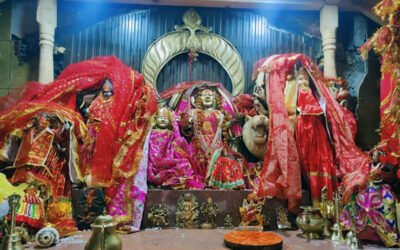
Guru Ghantal is unusual among Lahaul’s monasteries for wearing its Hindu-Buddhist overlap so plainly. Alongside its Buddhist images, the innermost part of the shrine holds a black stone idol of Kali, known locally as Vajreshwari Devi — a detail some who’ve studied the site read as evidence that this was originally a Hindu shrine before its Buddhist identity took over, in a pattern similar to the shared worship seen at Trilokinath temple nearby. Whatever the order of arrival, the monastery functioned for a long period as sacred ground for both traditions rather than one displacing the other. It remains a pilgrimage destination for tantric practitioners in particular, drawn by its association with the mahasiddha lineage and its unusually old artistic remains.
🏛️ Wood, Stone, and a Ceiling Worth Looking Up At
Architecturally, Guru Ghantal breaks from the pattern of the clay-built gompas typical of neighbouring Spiti — it’s constructed in Indian-style stone and timber, a two-storey structure roughly 17 by 12 metres, facing northwest, with the du-khang (assembly hall) on the ground floor. Repairs in 1959 added a small pagoda-style roof of Kangra slates in what’s been described as a somewhat improvised fashion, layered over the older mud roof beneath. The building’s real quiet treasure is above eye level: a painted, coffered ceiling carrying unusually intricate mandala designs, including what scholars examining photographs of the site believe is likely a damaged Chakrasamvara mandala at its centre. Much of this painted work, along with the images of the Drukpa lineage holders inside, is credited to Lama Tashi Temphel, a Bhutanese-trained lama sent to guide and teach Lahaulis in the latter half of the 19th century, who is said to have completed this decorative work around 1870. The monastery also houses a wooden Buddha statue attributed to the great translator-monk Rinchen Zangpo (958–1055 CE), along with wooden idols of Padmasambhava and other lamas, murals, and the black stone Kali image already mentioned.
📜 The Vase That Left, and the Objects That Stayed
Guru Ghantal’s deepest verifiable claim to age doesn’t come from a legend at all, but from a single object dug out of the ground in 1857 by a British officer, Major Hay: a chased copper goblet, decorated with a frieze depicting a chariot procession, dated to roughly the 1st century BCE or CE and considered one of the oldest surviving examples of decorated metalwork of its kind found in India. Known today as the Kulu Vase, it never stayed in Lahaul — it’s now held in the British Museum, a quiet, somewhat uncomfortable reminder that the monastery’s oldest confirmed artefact isn’t one visitors here can actually see. What remains on-site — the marble head kept under lock, the black stone Kali, the wooden statues — is what stayed behind after the single object with the clearest scientific dating left the valley entirely.
On the ridge nearby stands the Gondhla fort, a seven-or-eight-storey stone-and-timber tower built in the Kath-Kuni style. Its own origin is similarly contested: one tradition credits its construction to Raja Man Singh of Kullu, around 1700, after he married the daughter of Gondhla’s Thakur; a separate local tradition instead holds that it was built earlier by a Thakur Rattan Pal, said to have migrated from Bir in Kangra. The fort, now largely disused, still stores old weaponry, thangkas, and family relics of the Thakurs of Gondhla, and was painted by the Russian artist Nicholas Roerich during his summers in Lahaul between 1929 and 1932 — one of relatively few well-documented outside artistic records of the site from that era.
🎉 Festivals and Devotion
- Ghantal Festival — the monastery’s annual celebration, traditionally held in June on a full moon night (some accounts specify the 15th lunar day), featuring masked lama dances and communal feasting, with Thakurs and lamas historically participating jointly
- Several sources now describe the festival as rare or largely historic rather than a reliably annual event in its full form — worth confirming locally rather than planning a visit specifically around it
- Daily and informal devotion continues at the caretaker monastery below rather than at the ruined main structure itself, as most rituals have shifted downhill to Tupchiling Gompa in recent generations
🏞️ While You’re in the Area
- Tupchiling Monastery — the small branch gompa at the base of the climb, now the caretaker of most of Guru Ghantal’s living ritual life, and the place to ask about keys and access
- Tandi Sangam — the sacred confluence of the Chandra and Bhaga rivers, visible from the monastery’s hillside and a short drive away
- Gondhla Fort — the historic timber-and-stone tower nearby, painted by Nicholas Roerich in the early 20th century
- Kardang & Shashur Monasteries — major Drukpa Kagyu gompas closer to Keylong, part of the same lineage network
- Trilokinath Temple — Lahaul’s other great shared Hindu-Buddhist shrine, worth the comparison given Guru Ghantal’s own Kali idol and syncretic history
🙏 Getting in Touch
There’s no formal visitor centre or contact number for Guru Ghantal — access depends on whichever monks are currently based at Tupchiling Gompa below. Asking there for someone to accompany you up and unlock the main shrine is the standard, and often necessary, approach, since the monastery is regularly kept closed when no one specifically requests entry.
❓ Quick Questions Travellers Ask
Who really founded Guru Ghantal Monastery? Most popular accounts credit Padmasambhava in the 8th century, but the monastery’s own name honours a different figure, the mahasiddha Guru Ghantapa — and evidence suggests Buddhist activity at the site may predate both.
How hard is the walk up to the monastery? Accounts vary considerably, from a short 4 km walk to a strenuous 3–4 hour climb — treat it as a real hike rather than a quick stop, and check current conditions locally.
Is the monastery usually open? Not reliably — it’s often locked, and visitors typically need to ask the monks at Tupchiling Gompa below for the key.
Where is the monastery’s oldest known artefact today? The Kulu Vase, a copper goblet dated to roughly the 1st century BCE/CE and found here in 1857, is now held in the British Museum rather than at the site itself.
Is Guru Ghantal only a Buddhist site? No — it also houses a black stone image of Kali (Vajreshwari Devi), reflecting a Hindu-Buddhist shared history similar to nearby Trilokinath temple.
A Last Word
There’s something fitting about a monastery this layered having lost its most scientifically dateable object to a museum on the other side of the world, while still guarding, under lock and key, a damaged marble head nobody can definitively explain. Guru Ghantal doesn’t offer a single clean story — it offers several, stacked on top of each other by centuries of different visitors, different faiths, and different retellings, most of them still unresolved. Standing on Drilbu Ri looking down at the Chandra and Bhaga meeting below, that layered uncertainty feels less like a gap in the record and more like the actual shape of a very old place.
Fact-check note: Guru Ghantal’s founding is attributed in different sources to Padmasambhava (8th century), to the mahasiddha Guru Ghantapa (whose meditation is credited with the site’s name), and to a Buddhist presence predating both, based on a 1st-century BCE/CE copper vessel found on site in 1857. These attributions are not mutually resolved by available sources and are presented here as separate, overlapping traditions rather than a single settled history. The marble Avalokiteshvara head’s origin story (the “sliced off during emergence” legend versus a claimed 2nd-century Nagarjuna-era dating) is similarly unresolved — both are local/traditional claims, not scholarly consensus. The distance and difficulty of the walk up from Tupchiling village is given very differently across sources (a short 4 km walk versus a 3-4 hour climb); both figures are reported here rather than one being discarded, since they may describe different measures (map distance versus actual climbing time on a steep trail). The current status of the annual Ghantal Festival is inconsistently described — some sources treat it as an ongoing annual event, others as now-rare or largely historic — and this piece reflects that uncertainty rather than picking one account. No independently verified GPS coordinates were found, so none are given; the Get Directions link above should be replaced with your own verified link if you have one. This is a distinct article from the version of this monastery already published on aguidetohimachal.com (subtitled “The Whispering Wood of the White Marble Sage”); this piece takes the dual-founding-legend and the Kulu Vase’s removal to the British Museum as its central hook rather than repeating that one’s framing.