High in a Lahaul valley village, one carved wooden ceiling holds a slain demon, a meditating Buddha, and a goddess who has never had to choose which name to answer to.
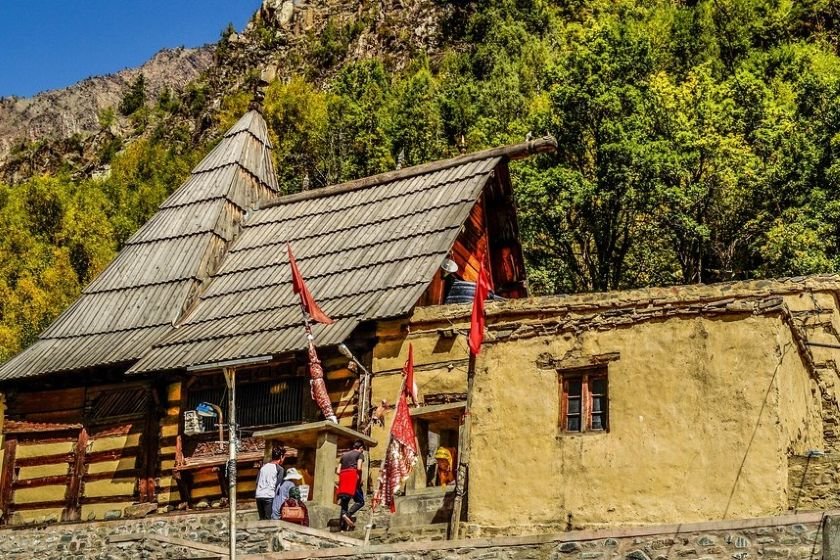
Across the Himalaya, a certain kind of shrine keeps recurring: a single roof under which two entirely different faiths have quietly agreed to worship the same wooden or stone form, each in its own language, without either ever fully converting the other. Most such places wear the compromise lightly — a prayer flag next to a trishul, a Buddhist lama and a Hindu priest taking turns with the same lamp. The Markula Devi Temple at Udaipur, tucked into the Chandrabhaga valley of Lahaul, takes the idea further than almost anywhere else in Himachal. Its ceiling panels don’t just tolerate two traditions side by side — they carve Shiva’s fierce doubles, the assault of a demon on the Buddha, and courtly musicians and dancers into eight bordering shapes around a single lantern-style crown. Who exactly built it, and when, nobody fully agrees on. What everyone agrees on is that it has been answering to more than one name for a very long time.
🌄 Location & How to Reach It
Udaipur sits in the Pattan valley of Lahaul, at the point where the Chandrabhaga (as the Chenab is known here) is joined by the Miyar Nala, on the old Tandi–Kishtwar route. It’s a quiet, thinly populated hamlet rather than a town — the kind of place with a temple, a scattering of houses, and not much else, which is part of what makes the setting feel undisturbed. Keylong, the district headquarters of Lahaul & Spiti, is roughly 50 kilometres away and is the nearest place with real facilities.
Google Maps: Get Directions
Elevation: sources disagree, giving figures anywhere from roughly 2,620 to 2,740 metres above sea level — treat it as “around 2,700 m” rather than a precise number.
- By road: Reached via the Atal Tunnel from Manali (a roughly 71 km, 2-hour drive that replaced the old Rohtang Pass crossing and now keeps Lahaul open through most of the year), then on through Sissu, Tandi, and Keylong to Udaipur. Local buses and taxis run this stretch, though the final approach to Udaipur itself is a quieter, less-trafficked road than the main Keylong–Kaza highway.
- By rail: The nearest railhead is Pathankot, several hours away by road — this is a long haul-and-connect journey, not a same-day rail option.
- By air: The nearest airport is Bhuntar (Kullu), around 204 km away.
Compared to some of Lahaul’s higher pilgrimage sites, Udaipur is an easy stop once you’re in the valley at all — the real effort is simply getting into Lahaul in the first place, not the last mile to the temple.
🌸 Best Time to Visit
There’s no formally published visiting-hours board at Markula Devi — like most Lahaul village temples, it keeps to informal daylight hours rather than a fixed schedule, so arriving in the middle of the day gives you the best chance of finding it open and someone around. The most comfortable window to visit is roughly May to October, when the valley is clear of heavy snow and the roads in and around Udaipur are reliably passable; Lahaul’s winters are severe enough that travel gets considerably harder outside this stretch. Navratri is the main period of concentrated Devi worship here, though — honestly — very little in the way of a dedicated, well-documented temple fair or fixed festival date for Markula Devi specifically has been reliably recorded, unlike some of the region’s bigger pilgrimage sites.
🕉️ Two Names for One Goddess
The temple’s central, defining fact isn’t really a single legend — it’s that two entirely different religious communities have never stopped meeting inside the same small wooden room. To Hindu worshippers, the presiding image is Mrikula or Markula Devi, a silver form of Mahishasuramardini — the goddess in her aspect as slayer of the buffalo-demon Mahishasura, shown standing over him in triumph. To Buddhist worshippers, the same shrine houses Vrikula, understood as a form of Vajravarahi, a wrathful tantric protector goddess. Neither tradition treats the other as a mistake or a later intrusion; they simply worship in parallel, at the same spot, under the same roof. Local Buddhist tradition adds a further layer: it holds that the great tantric master Padmasambhava himself meditated here during his travels through the region — a claim that, like much oral history in these valleys, has no independent corroboration but is told with complete sincerity by those who hold it.
Devotees also point to a smaller, stranger detail inside the sanctum: a khapar, or skull-cup, kept beneath the main idol, said to be the very vessel in which Kali caught Mahishasura’s blood as she killed him. It’s the kind of object that turns an abstract myth into something you can point to in the room in front of you — whether or not it is, in fact, ancient, it functions as a physical anchor for the story every time a devotee’s eye falls on it.
🏛️ A Temple Built by Instinct, Not Just Hands
The origin story devotees tell about the building itself is a separate legend from the goddess’s own — and it belongs to the Pandavas. During their exile, as the story goes, Mahabali Bhima carried a single enormous tree to this spot and instructed Lord Vishwakarma, the divine architect, to raise the temple from that one block of wood, completing it in a single day. It’s a story that turns up, in slightly different forms, attached to more than one wooden shrine across the western Himalaya, and it should be read as devotional legend rather than history — but it captures something true about the temple’s character: it really does read as carved from an idea rather than assembled piece by piece.
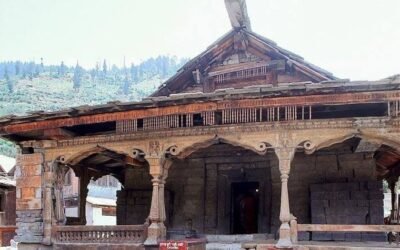
Very little of whatever structure stood here originally survives; the temple has been rebuilt and repaired many times across its history, and what a visitor sees today is the accumulated result of that long maintenance, not a single untouched medieval object. Most independent accounts place its construction in the 11th century CE, though a handful of sources instead tie it — without solid supporting evidence — to the reign of a Kashmiri ruler named Ajayvarman; this connection is repeated online but doesn’t hold up as an established fact. What is architecturally striking, whatever the exact date, is the carved wooden ceiling of the sanctum: nine decorated panels, eight of varying size and shape bordering a central “lantern style” piece. Four of the surrounding panels show Gandharvas with their consorts; others show Shiva flanked by his fierce alter-egos, the Bhairavas. One panel breaks from Hindu iconography entirely, depicting the “Assault of Mara” — the Buddha seated in the earth-touching gesture (bhumisparsha mudra) on the vajrasana, calling the earth goddess to witness his victory over the god of desire and death. A three-headed image of Vishnu inside the temple has similarly been read by scholars as belonging to a transitional moment between Hindu and Buddhist iconographic traditions in the region — one more thread in the same weave.
In the late 20th century, an old wooden image of the deity was discovered hidden behind the altar; some scholars believe this may in fact be the temple’s original murti, predating the silver image now worshipped. It was removed and is now on display at the Shimla State Museum rather than in the temple itself — worth knowing if you arrive expecting to see it in situ.
🙏 What the Goddess Is Known For
Devotees come to Markula Devi seeking the same broad range of blessings sought at Shakti shrines across Himachal — protection, the resolution of difficulties, and the fulfilment of personal vows — but the temple’s real distinction isn’t in what’s asked of the goddess so much as who’s doing the asking. Hindu and Buddhist pilgrims arrive here as a matter of course, not as an exception, and the rituals of one community don’t crowd out the other. It’s a much quieter, more workaday form of religious coexistence than the phrase “interfaith harmony” usually suggests — less a statement than simply how the place has always worked.
📜 A Village Renamed for a King
The village around the temple carries its own layered history. Before some point prior to the 16th century (accounts differ on exactly when), it was known as Margul, later also recorded as Marul. The change to its current name came when Raja Udai Singh of Chamba visited Lahaul and installed an Ashtadhatu (eight-metal alloy) statue of the goddess here; the settlement was subsequently renamed Udaipur in his honour. Some accounts place this renaming within Udai Singh’s reign in the late 17th/early 18th century; others give a later 1695 date for when Chamba formally raised the settlement to district-centre status. Either way, the temple and the town’s name are bound together by the same royal visit — a rare case where a shrine’s foundation story and a place’s naming story are, for once, the same event.
🎉 Festivals and Devotion
- Navratri — the primary period of concentrated Devi worship at the temple, observed by Hindu devotees with the general practices common across Himachal Shakti shrines
- Daily and informal worship — rather than a packed festival calendar, Markula Devi is sustained mostly by steady, everyday devotion from both Hindu and Buddhist visitors, in keeping with its role as a working village shrine rather than a mass-pilgrimage site
- Photography inside the sanctum is prohibited, a rule enforced out of respect for the sanctity of the space rather than for any documented conservation reason
🏞️ While You’re in the Area
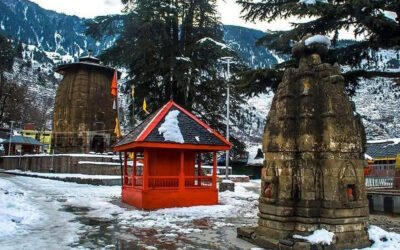
- Trilokinath Temple — a short distance away, and Lahaul’s other great Hindu-Buddhist shared shrine, dedicated to Shiva and revered by Buddhists as a form of Avalokiteshvara; the two temples are often visited as a pair
- Tandi Sangam — the confluence of the Chandra and Bhaga rivers, which together form the Chandrabhaga (Chenab), a short drive from Udaipur
- Keylong — the district headquarters, with the Kardang, Shashur, and Tayul monasteries nearby, and the most practical base for food and lodging
- Miyar Valley — a trekking route beginning near Udaipur, known for wildflower meadows and glacial streams, popular with trekkers heading toward Kangla and onward to Zanskar
- Sissu — a scenic riverside village just past the Atal Tunnel’s north portal, with a well-known waterfall
🙏 Getting in Touch
There’s no formal booking process, phone contact, or visitor centre attached to the temple — it’s a village shrine, not an institution set up for tourist logistics. There’s also no hotel or guesthouse in Udaipur itself, so most visitors base themselves in Keylong and carry their own food and water for the day trip out. If you need current information on road conditions or the temple’s status, asking locally in Keylong before setting out is the practical approach.
❓ Quick Questions Travellers Ask
Is Markula Devi Temple the same as Mrikula Devi Temple? Yes — Markula, Mrikula, and Marikula are all spellings of the same name for the same temple.
Do I need to be Hindu or Buddhist to visit? No. The temple is open to devotees of both traditions and to respectful visitors generally; it’s precisely the shared, non-exclusive nature of worship here that makes the site notable.
How far is it from Manali? Via the Atal Tunnel, Manali to Keylong is roughly a 71 km, 2-hour drive; Udaipur is a further stretch beyond Keylong along the Tandi–Kishtwar road.
Can I take photographs inside? No — photography is prohibited inside the temple sanctum.
Is there somewhere to stay in Udaipur itself? No formal hotels or guesthouses exist in the village; Keylong, about 50 km away, is the usual base.
A Last Word
It would be easy to describe Markula Devi as a curiosity — a temple that happens to host two religions rather than one. But spend a little time with the ceiling panels, with the khapar under the altar, with the quiet fact that nobody here has ever needed the goddess to pick a name, and the curiosity framing starts to feel too small. This is a shrine that has spent roughly a thousand years being exactly what it is without asking permission from either tradition to keep being it. In a region full of dramatic peaks and famous monasteries, Markula Devi’s real distinction is smaller and stranger than scenery: a single roof, carved once, that two faiths have simply kept using.
Fact-check note: Most independent sources date the temple’s construction to the 11th century CE; a minority tie it instead to the reign of a Kashmiri ruler, Ajayvarman, though this connection lacks solid supporting evidence and should be read as one competing tradition rather than settled fact. Elevation figures for Udaipur vary across sources (roughly 2,620–2,740 m); this piece gives the range rather than a false-precise number. The exact century in which the village’s name changed from Margul/Marul to Udaipur is also inconsistently dated across sources (some placing it before the 16th century, others tying it to Raja Udai Singh’s reign in the late 17th/early 18th century or a specific 1695 date); both traditions are noted rather than resolved. No independently verified GPS coordinates for the temple were found, so none are given here — the Get Directions link above should be checked and replaced with your own verified link if you have one. No reliably documented, dedicated festival date specific to this temple (beyond general Navratri observance) could be confirmed, so none has been invented. A separate published piece on aguidetohimachal.com already covers this temple under the title “The Wooden Goddess of the Northern Valleys,” and dates its construction to the 7th century; that figure is not well supported by independent sources and appears to be an error worth flagging rather than repeating — this article uses the better-attested 11th-century dating instead and takes the Hindu-Buddhist shared-worship angle as its distinct hook.