Once a year, by long-standing custom, every deity in the Kullu valley is expected to show up at a small temple in Sultanpur and pay homage to a stone image that technically outranks all of them — including the king who put it there.
Most temples exist within a kingdom. This one, in a very literal administrative sense, became the kingdom. In the mid-17th century, a Kullu king took the unusual step of formally declaring a stone idol of Rama the actual sovereign ruler of his territory, demoting himself to the status of “first servant” of his own throne. It wasn’t just religious theatre — for centuries afterward, the hundreds of local village deities scattered across the valley were treated as vassals of this one god, obligated to appear before him once a year at his court in Sultanpur. That arrangement, remarkably, still shapes the valley’s most famous festival today.
🌄 Location & How to Reach It
The temple stands in Sultanpur, now part of Kullu town, on the right bank of the Beas River near its confluence with the Sarvari stream, at an elevation of roughly 2,050–2,056 metres. Sultanpur itself was once the walled, fortified capital of the Kullu kingdom — a status it held for roughly three centuries before the modern town of Kullu grew up around it.
Google Maps: Get Directions
GPS Coordinates: not independently pinned in this note; Sultanpur’s location, about 1 km from Kullu’s main market, is a reliable practical reference for navigation.
Elevation: approximately 2,050 metres above sea level.
- By road: Well within Kullu town, reachable by a short walk, auto-rickshaw, or taxi from the main bazaar or bus stand.
- By rail: The nearest useful railhead is Joginder Nagar, around 108 km away, with Chandigarh (roughly 252 km) offering broader connections.
- By air: Bhuntar (Kullu-Manali) Airport is about 10 km away, making this one of the more conveniently located historic temples in the valley.
This is a straightforward town visit with no trek involved — Kullu itself is well set up for tourism, and the temple sits comfortably within a short walk of most accommodation in town.
🌸 Best Time to Visit
The temple is worth visiting year-round, but the valley transforms entirely during Kullu Dussehra, held over the first fortnight of the lunar month of Ashwin (typically October). Unlike Dussehra elsewhere in India, which concludes with the burning of Ravana’s effigy, Kullu’s celebration begins the day Dussehra ends everywhere else — a full week of deity processions rather than a single day of ritual burning. Outside festival season, March to June and September to November offer the most comfortable weather for visiting the temple and wandering Sultanpur itself.
🕉️ A Brahmin’s Curse and a Stolen God
The story behind the temple begins with Raja Jagat Singh, who ruled Kullu through much of the mid-17th century and had recently moved his capital from Naggar to this newly seized settlement of Sultanpur. According to the accounts preserved in Kullu’s own historical record, the king learned that a Brahmin named Durga Dutt, living in the nearby village of Tippari, was rumoured to possess a substantial quantity of pearls. Jagat Singh demanded them. Durga Dutt, having none to give, refused — and rather than face the king’s men, he set his own house on fire, killing himself and his entire family in the flames.
The guilt that followed, compounded by an illness some accounts describe as leprosy, consumed the king. On the advice of a Brahmin from Suket, Jagat Singh was told the only way to atone was to bring the sacred image of Raghunath Ji — Rama in his princely form — from Ayodhya itself. A Brahmin named Damodar Das was dispatched, and by some tellings, the idol he returned with wasn’t offered freely: he took it from Ayodhya’s own Tretanath temple, reportedly the very image Rama had once worshipped during his own Ashwamedha sacrifice. As the story goes, the people of Ayodhya pursued the theft as far as the banks of the Saryu River, only to find that the idol had grown impossibly heavy whenever it was turned back toward them — and became light as nothing the moment it faced Kullu again. Taking this as a divine verdict, they let it go.
Back in Sultanpur, Jagat Singh drank the idol’s charanamrit — water used to bathe its feet — for over a month, and his affliction lifted. In gratitude, he did something no other regional ruler of the time is recorded as having done: he placed the idol formally on his own throne, declared himself merely its servant, and made Raghunath Ji the true Maharaja of Kullu.
📜 The Kingdom Ruled by Vassal Gods
This wasn’t just a symbolic gesture confined to temple ritual — it restructured how the entire valley’s spiritual and political order worked. Historical accounts of the period describe how Jagat Singh’s declaration effectively subordinated every other local deity in Kullu to Raghunath’s authority: the many devtas presiding over individual villages across the valley became, in formal terms, his vassals, obligated once a year to travel to Sultanpur and pay homage at his court — the same duty a feudal lord’s subordinate nobles would owe their king. This is, as far as record shows, a genuinely unusual arrangement even by the standards of India’s many royal temple foundations: a kingdom in which the human ruler held only delegated authority, and the region’s actual network of local gods were bound by something functionally close to feudal obligation to a single, comparatively new state deity.
It’s also worth noting what this replaced. Before Jagat Singh’s reign, worship across Kullu leaned heavily toward Devi and Shakti traditions — the valley’s own royal family, in fact, still reveres the goddess Hidimba as its ancestral kuldevi to this day. Raghunath’s installation marked a formal turn toward structured Vaishnavism as state religion, layered on top of, rather than erasing, those older devotional currents — which is precisely why, even now, Hidimba’s palanquin is the one that ceremonially leads the way into Dussehra’s festivities before Raghunath’s own procession begins.
🙏 What the Temple Is Known For
Raghunath Ji is worshipped here not merely as a deity but as the valley’s constitutional sovereign — devotees pray for justice, dharma, and social harmony as much as personal blessings, reflecting his role as head of a moral and civic order rather than only a spiritual one. Daily worship includes aarti, flower and tulsi offerings, and regular recitation of the Ramayana. Locals have historically treated the temple’s blessing as a precondition for major decisions in the valley, from weddings to public undertakings, a custom that persists in more limited form today.
🏛️ The Temple Itself
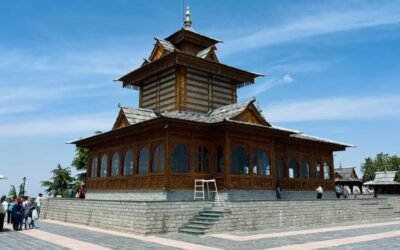
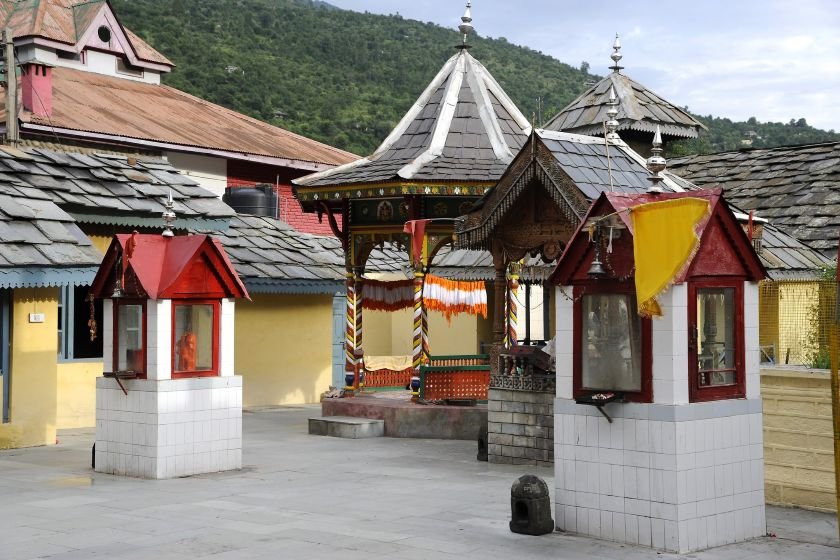
The temple is built in a blend of Pahari and pyramidal styles, with a steeply slanted, three-tiered roof designed to shed heavy snowfall, stone walls, and wooden beams carved with religious motifs. The sanctum houses a black stone idol of Raghunath Ji, seated with regal ornamentation befitting his status as sovereign rather than simply a devotional image. Above the main hall sits a distinctive vimana, an ornamental structure sometimes described locally as resembling a celestial vehicle, and a golden kalash crowns the temple’s spire. The complex has been renovated and expanded over the centuries, though it retains its essential form.
📜 The Vanished Walls of Sultanpur
Sultanpur, the temple’s home, has its own separate story of decline worth knowing. Jagat Singh seized this settlement from a local chieftain named Sultan Chand — whose name the town still carries — and made it his fortified capital, the third such seat of power in Kullu’s history after Jagatsukh and Naggar. Nineteenth-century British colonial accounts describe Sultanpur as a “regularly walled town,” but by the time those same officials were documenting it, its fortifications had already been largely torn down, leaving only two difficult-to-reach gateways standing on its north and south sides. The temple, in other words, is one of the few substantial survivals of what was once a proper walled capital in its own right — a pattern echoed elsewhere in the Kullu valley, where old fortified centres have repeatedly given way to whatever religious or administrative structure outlasted them.
🎉 Festivals and Devotion
- Kullu Dussehra (October, week-long): the temple’s defining event. Hidimba Devi’s palanquin, escorted by the royal family, arrives first; Raghunath’s idol is then placed beside her on a chariot for a procession to Dhalpur Maidan
- The Dev Sammelan: hundreds of local deities — historical accounts cite figures ranging from roughly 200 to as many as 365 — are carried in decorated palanquins from villages across the district to pay ceremonial homage, transforming Dhalpur into what’s often described as a genuine assembly, or parliament, of gods
- Mohalla celebrations: later days of the festival bring music, dance, and hymn performances involving the assembled deities together
- Lanka Dahan: the festival concludes on the banks of the Beas with a symbolic burning representing Lanka’s destruction, closing the reversed Dussehra sequence
- Animal sacrifice, once part of the festival’s concluding rituals, has been officially banned in recent decades — a modern reform layered onto centuries-old practice
🏞️ While You’re in the Area
- Dhalpur Maidan: the ceremonial grounds where the Dussehra deity assembly and chariot procession take place
- Basheshar Mahadev Temple, Bajaura: roughly 15 km south, a stone Shiva temple from an earlier, pre-Vaishnavite era of the valley’s religious history
- Naggar Castle & Tripura Sundari Temple: about 27 km away, the valley’s former capital before Sultanpur
- Manikaran: roughly 40 km, for hot springs sacred to both Hindus and Sikhs
- Manali: about 40 km further up the valley, for the region’s better-known temples and hill attractions
🙏 Getting in Touch
There’s no formal booking process for ordinary visits; the temple follows general daily worship hours rather than an appointment system, with reported morning visiting windows around 8 am to early afternoon on typical days, though hours can extend on festival occasions. No entry fee is charged, though donations toward upkeep are accepted. For Dussehra-specific planning, checking locally in Kullu closer to the date is worthwhile, since exact scheduling can shift.
❓ Quick Questions Travellers Ask
Is Raghunath really considered the “king” of Kullu? In a formal historical sense, yes — Raja Jagat Singh declared the idol the valley’s sovereign and himself merely its servant, and the region’s local deities were treated as obligated to attend his court annually, a structure that shaped the valley’s religious politics for generations.
When exactly was the temple built? Sources vary between roughly 1651 and 1660 for when the idol was installed and the temple established; the more specific historical records point toward 1651–1653, though 1660 is the figure most commonly repeated in tourism material.
Why does Kullu’s Dussehra work differently from the rest of India? Instead of burning Ravana’s effigy on Vijayadashami, Kullu’s celebration begins on that day and runs for about a week, centred on deity processions and a gathering of local gods rather than a single symbolic burning, which occurs only at the very end.
Is there an entry fee? No, though donations are welcomed for the temple’s upkeep.
What else is worth combining with a visit here? Dhalpur Maidan, a short distance away, is worth seeing even outside festival season simply to picture the scale of the annual gathering it hosts.
A Last Word
There’s something genuinely strange, in the best sense, about a kingdom whose human ruler chose to become a footnote to his own throne. Whatever mix of guilt, faith, and political calculation drove Jagat Singh to that decision three and a half centuries ago, it produced an arrangement that outlived his dynasty’s actual political power by a wide margin — a valley where, once a year, gods still travel from village to village to answer what amounts to a summons. Stand in Sultanpur today, in a town that lost its walls long ago, and the temple at its centre is really the last part of that old order still doing exactly the job it was built for.
Fact-check note: Cross-checked across the Kullu district government history page, academic and heritage summaries of Kullu’s princely history (including material drawing on Vogel’s documentation and colonial-era records from Harcourt), and multiple independent tourism sources. Dates for the idol’s installation vary by source (1651, 1653, and 1660 all appear across different accounts); this piece favours the more specific historical-record dates (1651–1653) while noting 1660 as the commonly repeated tourism figure. The number of deities attending the annual Dussehra assembly is cited inconsistently (roughly 200 to 365 depending on source) and is presented as a range. The claim that the idol was the very image Rama worshipped during his own Ashwamedha Yagya is devotional tradition, not verifiable history, and is presented as such. The existing site article on this temple was not used as a source, consistent with a pattern of copy-paste contamination found across other articles on the same site; this piece draws instead from historical and government sources. No independently verified GPS pin, priest contact, or fully confirmed visiting hours could be established, so those gaps are stated plainly rather than invented.