Above Solan’s old lanes, Maa Shoolini is not only worshipped as a Devi; she is remembered as the mother-presence from whom the town itself takes its name.
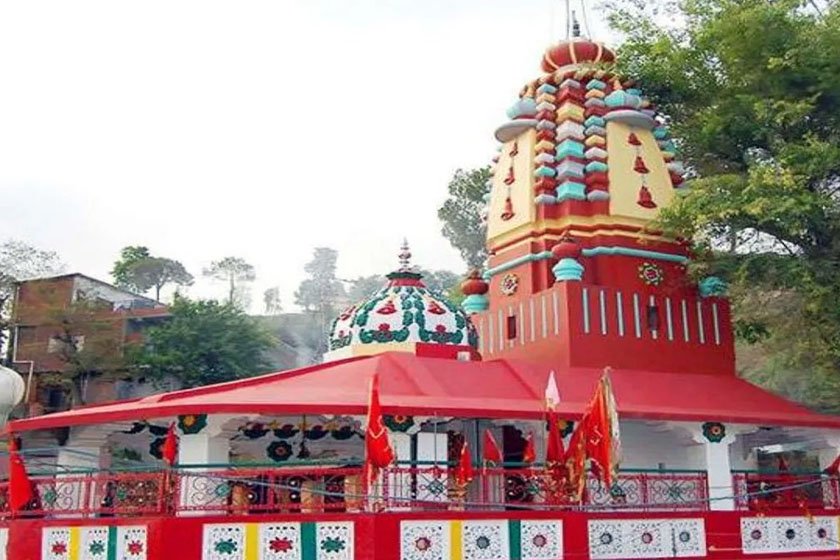
Some temples belong to a town. Shoolini Mata Temple feels more like the town belongs to the temple. Solan’s name is widely linked with Maa Shoolini, the presiding goddess of the region, and every year the city publicly remembers that bond through the Shoolini Mela. The temple itself stands on the old court road side of Solan, close enough to the town’s daily rhythm that it never feels remote, yet important enough to become the emotional centre of the city during the annual fair. It is a shrine of Goddess Shoolini, an incarnation of Maa Durga, but it is also a shrine of local identity — the place where devotion, memory, and Solan’s civic life meet.
🌄 Location & How to Reach It
Shoolini Mata Temple is located in Solan town, in Solan district, Himachal Pradesh. Himachal Tourism places the temple about 2 km from the Solan city centre, on the old court road side, and describes it as a highly revered temple of the region. Solan itself lies on the Chandigarh–Shimla highway, making the temple one of the easier major Devi shrines to access in Himachal.
Google Maps: Get Directions
Elevation: approximately 1,500 metres around Solan town
- By road: Solan is well connected by road with Chandigarh, Shimla, Kalka, Parwanoo, Kandaghat, and Rajgarh. From Solan town, the temple can be reached by local taxi, auto, private vehicle, or on foot depending on where you are staying.
- By rail: Solan Railway Station on the Kalka–Shimla heritage railway is the closest local rail access. Travel references commonly place the temple around 1.5 km from Solan Railway Station.
- By air: The nearest practical airports are Chandigarh Airport and Shimla Airport, followed by road travel to Solan. Chandigarh is generally the more useful airport for most travellers because of better connectivity.
This is an easy in-town temple visit, not a difficult hill pilgrimage. The only real challenge comes during the annual fair, when traffic, parking, processions, and crowds change the normal rhythm of Solan.
🌸 Best Time to Visit
Shoolini Mata Temple can be visited throughout the year. For comfortable weather and town walks, March to June and September to November are usually pleasant, while winter gives Solan a quieter hill-town mood.
The most important time to visit is during the annual Shoolini Mela, held in June. Himachal Tourism describes the fair as a three-day annual event held in June, while the Government of India’s Utsav portal notes that Maa Shoolini halts at her sister’s place for three days before returning to her own temple.
For 2026, the official Solan district event page listed Maa Shoolini Mela 2026 from 26 June to 28 June at Thodo Ground, Solan, with the Shobha Yatra, cultural nights, food and exhibition stalls, and amusement rides forming part of the celebration.
For peaceful darshan, choose an ordinary weekday morning. For the full cultural and devotional experience of Solan, visit during Shoolini Mela — but expect a large city-wide gathering.
🕉️ The Goddess Behind the Name Solan
Maa Shoolini is widely regarded as the presiding deity of Solan. The Utsav portal describes Shoolini Devi as an incarnation of Goddess Durga and states that Solan is named after Shoolini Mata.
This is the most important fact about the temple. Shoolini Mata is not simply one Devi among many in the town. She is the goddess around whom Solan’s sacred identity is organised. The name of the place, the fair, the public procession, and the emotional attachment of residents all return to her.
The name Shoolini is often understood in relation to the trident or spear-bearing form of the goddess. The temple’s own public description calls her “the Wielder of Spears” and identifies the shrine as dedicated to Goddess Shoolini, an incarnation of Maa Durga.
In local devotion, this gives the goddess both protective and maternal force. She is fierce enough to guard the region, but close enough to be addressed as Mata by the people of Solan.
🕉️ The Visit to the Sister’s House
The most memorable living tradition of Shoolini Mata is not inside the temple alone. It unfolds across the town during the annual mela.
According to the Utsav portal, the goddess is taken to her sister’s place for three days and then returns to her own temple. The return journey of Maa Shoolini is celebrated on the last day of the mela with even greater enthusiasm.
This sister-visit tradition gives the fair a deeply human tone. It is not just a procession for display. It is a family story made public. The goddess leaves her temple, stays with her sister, and returns. The city gathers around this movement, and for three days Solan becomes less like a town hosting a fair and more like a household receiving its deity.
That is why Shoolini Mela has a different emotional quality from an ordinary exhibition or cultural programme. Food stalls, rides, markets, performances, and official functions are all there, but they gather around a devotional centre: the movement of Maa Shoolini through her own town.
🙏 What Shoolini Mata Temple Is Known For
Shoolini Mata Temple is known for three things: Maa Shoolini as Solan’s presiding deity, the annual Shoolini Mela, and the temple’s place in the heart of Solan’s local identity.
For devotees, Maa Shoolini is worshipped as a form of Maa Durga. People visit for blessings, protection, family welfare, fulfilment of vows, and gratitude. On ordinary days, the temple has the feel of a local Devi shrine. During the fair, it becomes the centre of a city-wide sacred celebration.
The temple is also known because Solan’s identity is repeatedly tied to it. Utsav clearly states that the town is named after Shoolini Mata, and Himachal Tourism highlights the temple as one of the important religious places to visit in Solan.
This makes Shoolini Mata Temple important even for travellers who are not only looking for darshan. To understand Solan, one has to understand why the city gathers around this goddess every June.
🏛️ A Town Temple With a Public Heart
Shoolini Mata Temple is not a remote cave, not a high-altitude shrine, and not a large stone monument from a forgotten dynasty. Its power comes from being close to the town. It sits within Solan’s everyday geography — near roads, homes, shops, schools, offices, and old public spaces.
This closeness is important. Some sacred places gain force by being difficult to reach. Shoolini Mata Temple gains force by being repeatedly approached. People can come before work, during family occasions, around festivals, or during a casual walk through town. The temple becomes part of the city’s ordinary rhythm.
During Shoolini Mela, that ordinary rhythm opens outward. The deity’s procession, cultural events, exhibition stalls, markets, and public gatherings spread the temple’s meaning beyond its walls. The sanctum remains the centre, but the whole town participates.
The sensory experience changes with the season. On a quiet morning, the temple may feel intimate: bells, incense, folded hands, the murmur of prayers. During the mela, the same goddess moves through sound — drums, announcements, crowds, fair lights, and the slow return of the palanquin.
📜 Shoolini Mela and Solan’s Civic Memory
The annual Shoolini Mela is one of the strongest examples of how a temple festival can become a town’s public identity. The official Solan district page for the 2026 mela describes it as taking place at Thodo Ground, with Mata Shoolini’s Shobha Yatra, cultural night performances, food and exhibition stalls, and amusement rides.
In 2026, the fair also received public attention as a major cultural event. A Times of India report noted that Governor Kavinder Gupta attended the closing ceremony and described the national-level Shoolini Fair as a symbol of Himachal Pradesh’s cultural heritage, traditions, and deep-rooted faith.
This modern public status does not reduce the fair’s devotional meaning. It shows how the mela has grown into a layered event: religious procession, local economy, cultural performance, government organisation, family outing, and Solan’s annual moment of collective identity.
For a traveller, this matters because visiting Shoolini Mata Temple during the mela is very different from visiting it on a quiet day. On an ordinary day, you meet the goddess in her temple. During the fair, you meet the goddess through the city.
🎉 Festivals and Devotion
- Shoolini Mela: The main annual fair of Solan, held in June for three days. Himachal Tourism and Utsav both describe it as the major fair connected with Shoolini Mata.
- Mata Shoolini’s Shobha Yatra: The most important devotional movement of the mela, with Maa Shoolini’s procession forming the sacred centre of the celebration. The 2026 district event page specifically mentioned the Shobha Yatra as part of the official programme.
- Stay at the sister’s place: Utsav records the tradition that Maa Shoolini halts at her sister’s place for three days and returns to her own temple on the final day.
- Cultural nights and town fair: The fair includes cultural programmes, food stalls, exhibitions, and amusement rides, especially around Thodo Ground.
- Navratri and Devi worship: As a Durga-form shrine, Navratri is also a natural devotional period, though the June Shoolini Mela remains the temple’s most distinctive public celebration.
🏞️ While You’re in the Area
- Thodo Ground: The public heart of Solan’s Shoolini Mela, where cultural programmes, stalls, gatherings, and fair activities are held during the annual celebration.
- Jatoli Shiv Temple: One of Solan’s best-known nearby temples, famous for its tall temple structure and hilltop setting on the Solan side.
- Mohan Shakti National Heritage Park: A large religious and cultural complex near Solan, useful for travellers interested in temple architecture, sculpture, and Hindu heritage themes.
- Karol Tibba: A popular local trekking and sacred landscape above Solan, associated with the Pandava cave tradition and wide views of the region.
- Bon Monastery, Dolanji: A major Tibetan Bon monastery near Solan, offering a different sacred tradition within the same district.
- Kasauli: A nearby hill town with colonial-era churches, walking roads, and quiet forested views, best combined as a separate half-day outing.
- Barog: A nearby hill station and railway stop on the Kalka–Shimla line, useful for travellers interested in the heritage rail route and old tunnel stories.
🙏 Getting in Touch
The temple has an online presence under Shri Shoolini Mata Mandir, Solan, which identifies the shrine as dedicated to Goddess Shoolini, an incarnation of Maa Durga.
For mela dates, traffic arrangements, processions, parking, and cultural programmes, the most reliable source is the latest notice or event update from District Solan. The 2026 district event page was updated in July 2026 and listed the official fair dates as 26–28 June 2026, showing that current district updates should be checked before planning around the mela.
For ordinary darshan, no booking is needed. Arrive respectfully, avoid crowding narrow approach roads, and check locally if you want to attend a specific ritual.
❓ Quick Questions Travellers Ask
Where is Shoolini Mata Temple located?
It is in Solan town, Himachal Pradesh, around 2 km from the city centre on the old court road side.
Who is Maa Shoolini?
Maa Shoolini is worshipped as an incarnation of Goddess Durga and is regarded as the presiding deity of Solan.
Is Solan named after Shoolini Mata?
Yes. Public tourism and festival sources state that Solan is named after Shoolini Mata.
When is Shoolini Mela held?
The mela is held every year in June for three days. In 2026, the official district event page listed it from 26 June to 28 June.
Is the temple easy to reach?
Yes. It is an in-town temple in Solan, accessible by local road and close to Solan Railway Station.
A Last Word
Shoolini Mata Temple is not only a place where people go for blessings. It is one of the reasons Solan understands itself the way it does. The goddess gives the town its name, and the town gives the goddess its annual public devotion.
On quiet days, the temple is a local Devi shrine above the movement of the city. During the mela, that movement turns into a procession, a fair, a gathering, and a return. Maa Shoolini leaves, visits, and comes back — and in that journey, Solan remembers its oldest centre. The temple may stand in one part of town, but its meaning spreads across the whole city.
Fact-check note: Shoolini Mata Temple’s location in Solan town, about 2 km from the city centre on the old court road side, is supported by Himachal Tourism. The identity of Maa Shoolini as an incarnation of Goddess Durga, the statement that Solan is named after Shoolini Mata, and the tradition of the goddess staying at her sister’s place during the three-day fair are supported by the Government of India’s Utsav portal. The 2026 Shoolini Mela dates, 26–28 June 2026, are taken from the official District Solan event page. Exact temple ritual timings and older origin legends are not strongly documented in official public sources, so this article does not force a fixed founding date, priest lineage, or detailed miracle story.