A remote Himalayan gompa spent nine hundred years known mainly to Lahaul itself — until an American reality show sent a trucker across a Himalayan cliff road to deliver it a golden Buddha statue on live television.
Most of Lahaul’s monasteries measure their fame in pilgrims and scholars. Kardang, the largest and most important of them all, has that reputation too — but it also has a stranger, far more recent claim: a cameo on American cable television, when a trucker on a reality series about the world’s most dangerous roads hauled a large golden Buddha statue up the valley and delivered it into the hands of the monastery’s head lama. It’s an unlikely footnote for a monastery whose real weight comes from something much older — the fact that the village beneath it used to run all of Lahaul, before power quietly shifted across the river to Keylong.
🌄 Location & How to Reach It
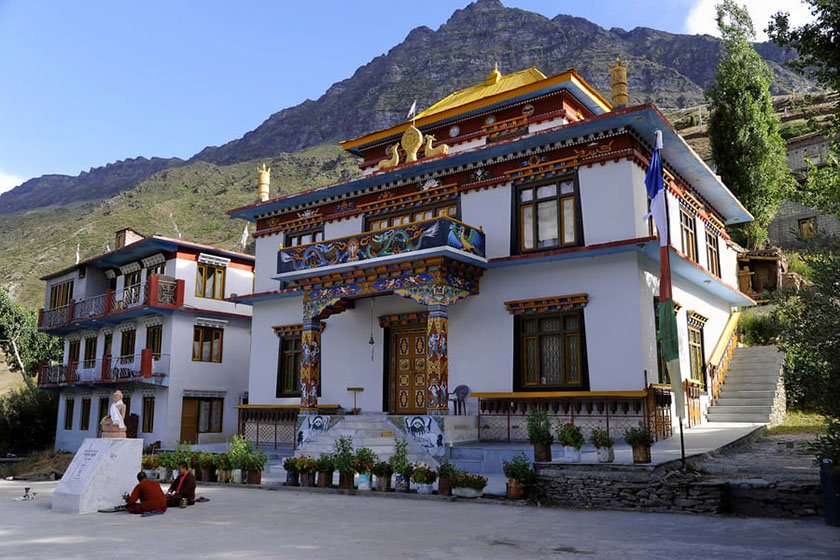
Kardang Monastery stands on a ridge above Kardang village, on the left bank of the Bhaga River, facing Keylong across the valley, with the barren, 15,000-foot Rangcha peak rising behind it as a dramatic backdrop. Distances to Keylong are reported differently depending on how they’re measured: the village itself is often given as roughly 5 km from Keylong, the monastery as about 8 km away in a straight line across the valley, and the by-road route (which has to loop around via the Tandi bridge to cross the river) comes to closer to 14 km — all of these can be true at once, since a river crossing rarely follows a straight line.
Google Maps: Get Directions
Elevation: approximately 3,500 metres above sea level.
- By road: A drivable road connects Keylong to Kardang via the Tandi bridge crossing; taxis and occasional local transport cover this route.
- By foot: For those based in Keylong, a shorter walking route drops down to and crosses the Bhaga River more directly than the vehicle road, cutting the distance closer to the 5–8 km figures above.
- By air: The nearest airport is Bhuntar (Kullu), followed by a full road journey into Lahaul via Manali and the Atal Tunnel or Rohtang Pass.
As Lahaul’s largest and most visited monastery, Kardang is comparatively well set up for visitors by valley standards — an easy half-day outing from Keylong rather than a demanding trek.
🌸 Best Time to Visit
May through September/October offers the most reliable travel window, when roads into and around Lahaul are open and clear of snow. The monastery’s own Chaam dance festival, held in June or July, is worth timing a visit around if the masked dances are of particular interest. Outside the main travel season, Lahaul’s winters make the valley considerably harder to reach, and the monastery, like most of the region, settles into a much quieter pace.
🕉️ A Capital That Lost Its Footing
Kardang’s deepest historical claim has less to do with the monastery building itself and more to do with the village around it: Kardang was once the capital of Lahaul, the seat of regional power before administrative authority eventually shifted across the Bhaga River to what is now Keylong. The monastery is believed to have been founded in the 12th century, roughly nine hundred years ago, making it — at least by tradition — one of the oldest Drukpa Kagyu foundations in the valley and, by most accounts, the single most important monastery in Lahaul today. It’s a useful reminder that Keylong’s current status as district headquarters is a relatively modern arrangement layered on top of a much older seat of power just across the water.
🏛️ The Two Lamas Who Rebuilt It
Like much of Lahaul’s monastic history, Kardang’s story includes a long stretch of decline. After its founding, the monastery fell into ruin and stayed that way for centuries, until a restoration in 1912 brought it back to life. Most accounts credit this revival to a single figure, Lama Norbu Rinpoche (who died in 1952), crediting him with transforming the ruined site into a working center of monastic education and tantric practice once again. At least one detailed source instead describes the 1912 rebuilding as a joint effort between Lama Norbu Rinpoche and a second lama, Lama Kunga — a detail not repeated everywhere, but plausible enough given the scale of restoring a monastery that had stood in ruins for so long. Either way, the building visitors see today is substantially a 20th-century reconstruction sitting on a genuinely ancient foundation, not an unbroken medieval structure.
🙏 What the Monastery Is Known For
Kardang has a reputation, distinct from most Himalayan monasteries, for its comparatively progressive internal life: it is said to house more lamas and chomos (female Buddhist monastics) than any other monastery in the region, and its community is often described as treating monks and nuns with a notable degree of equality, with monks here permitted to marry — a departure from stricter celibate traditions found elsewhere in Tibetan Buddhism. The monastery’s enormous prayer wheel is another point of local pride, said to contain roughly a million individual strips of paper, each inscribed with the mantra Om Mani Padme Hum, spun by visitors and monks alike as an act of accumulated merit.
🏛️ Sakyamuni, Padmasambhava, and Vajradhara Under One Roof
Architecturally, Kardang is a large, whitewashed building, its walls strung with prayer flags and set against the stark backdrop of the Rangcha massif. Inside the main temple, the arrangement of deities follows a specific order: Sakyamuni Buddha occupies the centre, with Padmasambhava to the right and Vajradhara to the left — a layout that visitors familiar with other Drukpa gompas will recognise as a fairly classical hierarchy. The walls carry extensive frescoes and murals, and the monastery’s holdings include old weapons, musical instruments such as horns, flutes, and drums, and a substantial library of Kangyur and Tangyur scriptures written in the Bhoti (Bhotia/Sherpa) language — among the more complete such collections in Lahaul.
📜 The Monastery That Made It Onto American Television
Kardang’s best-documented brush with the wider world outside Lahaul came in 2010, when the monastery featured in an episode of the History Channel series IRT Deadliest Roads, first aired on 7 November 2010. In it, a trucker named Rick Yemm hauled a large golden Buddha statue over one of the region’s notoriously hazardous mountain roads and delivered it to the monastery, where he was received by the monastery’s head, Lama Paljor Larje. It’s a small, oddly specific piece of Kardang’s modern history — a reminder that even a monastery whose real significance is measured in centuries can still end up, briefly, on the other side of the world’s television screens. More broadly, Kardang belongs to the same international Drukpa Kagyu network that includes Hemis Monastery in Ladakh and monasteries across Bhutan and Nepal, tying this Lahaul hillside into a lineage with a genuinely global reach.
🎉 Festivals and Devotion
- Chaam dance festival — held annually in June or July, featuring monks performing masked ritual dances in elaborate headgear and costume, a tradition shared across Lahaul’s Drukpa gompas
- Daily monastic life — chanting, ritual, and study continue year-round, supported by what is reportedly the valley’s largest resident community of monks and nuns
- Prayer wheel devotion — an everyday practice at Kardang given the scale and significance of its million-mantra prayer wheel
🏞️ While You’re in the Area
- Shashur Monastery — a short distance away near Keylong, another major Drukpa Kagyu gompa, often visited on the same day
- Tayul Monastery — roughly 6 km from Keylong, known for its large Padmasambhava statue and Kangyur library
- Tandi Sangam — the confluence of the Chandra and Bhaga rivers, near the bridge crossing used to reach Kardang by road
- Keylong — the district headquarters directly across the valley, with basic facilities, a market, and views back across to Kardang itself
- Guru Ghantal & Gemur Monasteries — further along the valley, both part of the wider network of Lahaul gompas historically connected through the Drukpa Kagyu lineage
🙏 Getting in Touch
There’s no formal booking system for visiting Kardang, though as the valley’s largest and most-visited monastery, it tends to be more consistently open and accustomed to visitors than some of Lahaul’s smaller, quieter gompas. Arriving during daylight hours is still the most reliable approach, and asking locally in Keylong about current road or weather conditions before setting out is worthwhile, especially outside the main summer season.
❓ Quick Questions Travellers Ask
Why is Kardang considered so historically important? Kardang village was once the capital of Lahaul, and its monastery, founded around the 12th century, is regarded as the largest and most important in the valley today.
Is the current monastery building original? No — it fell into ruin after its founding and was substantially rebuilt starting in 1912, so what stands today is largely a 20th-century reconstruction on an old foundation.
Is Kardang really the monastery from the TV show about dangerous roads? Yes — it featured in a 2010 episode of the History Channel’s IRT Deadliest Roads, in which a trucker delivered a golden Buddha statue to the monastery.
What makes Kardang different from other Lahaul monasteries? It’s noted for having more monks and nuns than any other monastery in the region, along with a comparatively progressive internal culture, including monks being permitted to marry.
How do I get from Keylong to Kardang? By road via the Tandi bridge (a longer route due to the river crossing), or on foot via a more direct walking trail — total distance is reported anywhere from about 5 to 14 km depending on the route taken.
A Last Word
There’s something quietly funny about a nine-hundred-year-old monastery’s most-repeated modern anecdote being about a truck and a TV crew — but it doesn’t diminish what Kardang actually is. This is a place that watched Lahaul’s centre of gravity shift away from it centuries ago, fell into ruin, and was rebuilt anyway, by lamas whose names aren’t even fully agreed upon across the sources that remember them. The golden Buddha delivered by truck in 2010 sits, presumably, alongside statues and texts that have been here far longer and will likely still be here long after that particular episode is forgotten. Kardang’s real story was never really about the cameras.
Fact-check note: The distance between Keylong and Kardang is reported inconsistently across sources (roughly 5 km for the village, 8 km for the monastery in a straight line, and 14 km by the road route via Tandi bridge); rather than resolving this to one number, this piece explains why multiple figures can be simultaneously accurate given the river crossing. The 1912 restoration is credited to a single lama (Norbu Rinpoche) in most sources, but at least one source names a second lama (Kunga) as a joint restorer; both versions are presented rather than one being silently dropped. The monastery’s founding date (12th century, “about 900 years ago”) is consistently reported across sources and is treated as reasonably well-established, though it should still be read as traditional dating rather than an archaeologically confirmed date. No independently verified GPS coordinates were found, so none are given; the Get Directions link above should be replaced with your own verified link if you have one. This is a distinct article from the version of Kardang Monastery already published on aguidetohimachal.com (subtitled “The White Fortress of the Bhaga Valley”); this piece takes the former-capital and the 2010 television-appearance angles as its hook rather than repeating that one’s framing, though the progressive monks-and-nuns detail is factual and unavoidably appears in both.